Zcash to Monero No Registration Swaps in 2026
You can swap Zcash to Monero without registration by using non-custodial exchange services that support atomic swaps or instant swap protocols. These platforms require only wallet addresses and execute trades without collecting personal information, creating accounts, or storing transaction logs.
The demand for zcash to monero no registration swaps has grown as privacy-conscious users seek to move between different privacy models. Zcash offers selective transparency through shielded and transparent addresses, while Monero enforces privacy by default on every transaction. Moving between these two ecosystems without exposing your identity requires understanding how registration-free swaps work and which technical approaches preserve anonymity throughout the exchange process.
Why Registration-Free Swaps Matter for Privacy Coins
Traditional exchanges ask for a document scan and a selfie before you can trade. They log your IP address, tie transactions to your verified identity, and share data with authorities when requested. This surveillance model directly contradicts the purpose of holding privacy coins in the first place.
Registration-free swaps eliminate these risks:
- No personal documents required
- No email or phone verification
- No account creation or password storage
- No transaction history linked to your identity
- No IP logging on privacy-focused platforms
Zcash users often hold shielded ZEC in z-addresses to obscure transaction amounts and sender details. Monero users benefit from ring signatures, stealth addresses, and RingCT on every transaction. When you move between these coins using a registered exchange, you create a permanent on-chain link between your verified identity and both privacy coin addresses.
Non-custodial platforms that offer zcash to monero no registration swaps preserve the privacy you've built on both chains. The exchange never learns who you are, only which addresses are involved in the swap.
How Non-Custodial Zcash to Monero Swaps Work
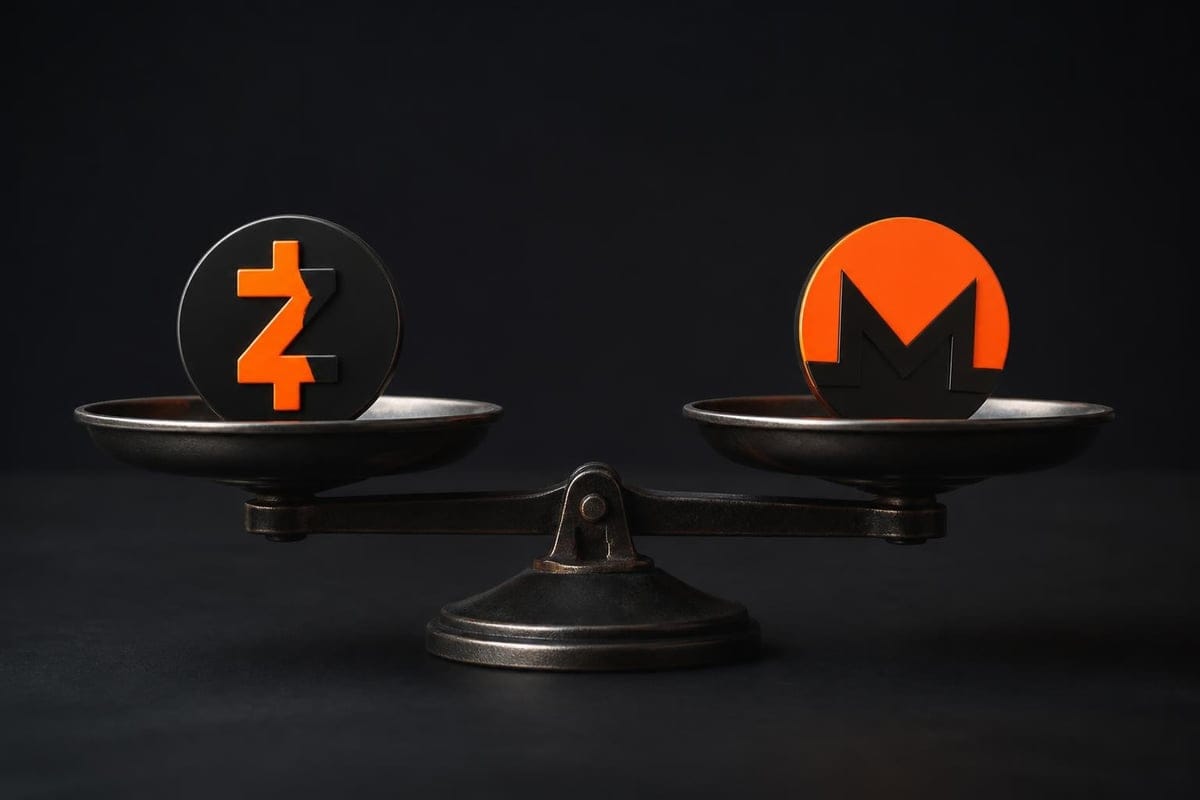
Non-custodial swaps execute without the platform taking control of your funds. You retain custody of your private keys throughout the entire process. Two main technical approaches enable this: atomic swaps and instant swap protocols.
Atomic Swap Protocols
Atomic swaps use hash time-locked contracts (HTLCs) to ensure both parties fulfill the trade or neither does. The protocol locks your Zcash and the counterparty's Monero in smart contracts that require both sides to reveal a secret or trigger a refund after a timeout period.
The challenge with Zcash-Monero atomic swaps lies in Monero's lack of native smart contract support. While recent research explores multi-blockchain atomic swap designs, production implementations adapt the protocol using adaptor signatures and zero-knowledge proofs to bridge the gap.
Atomic swap process:
- You initiate a swap and lock your Zcash in a contract
- Counterparty locks equivalent Monero using adaptor signatures
- Either both parties complete the swap by revealing secrets
- Or timeout triggers automatic refunds to both parties
Atomic swaps provide trustless execution but require longer confirmation times. You wait for on-chain settlement on both networks before the trade finalizes.
Instant Swap Protocols
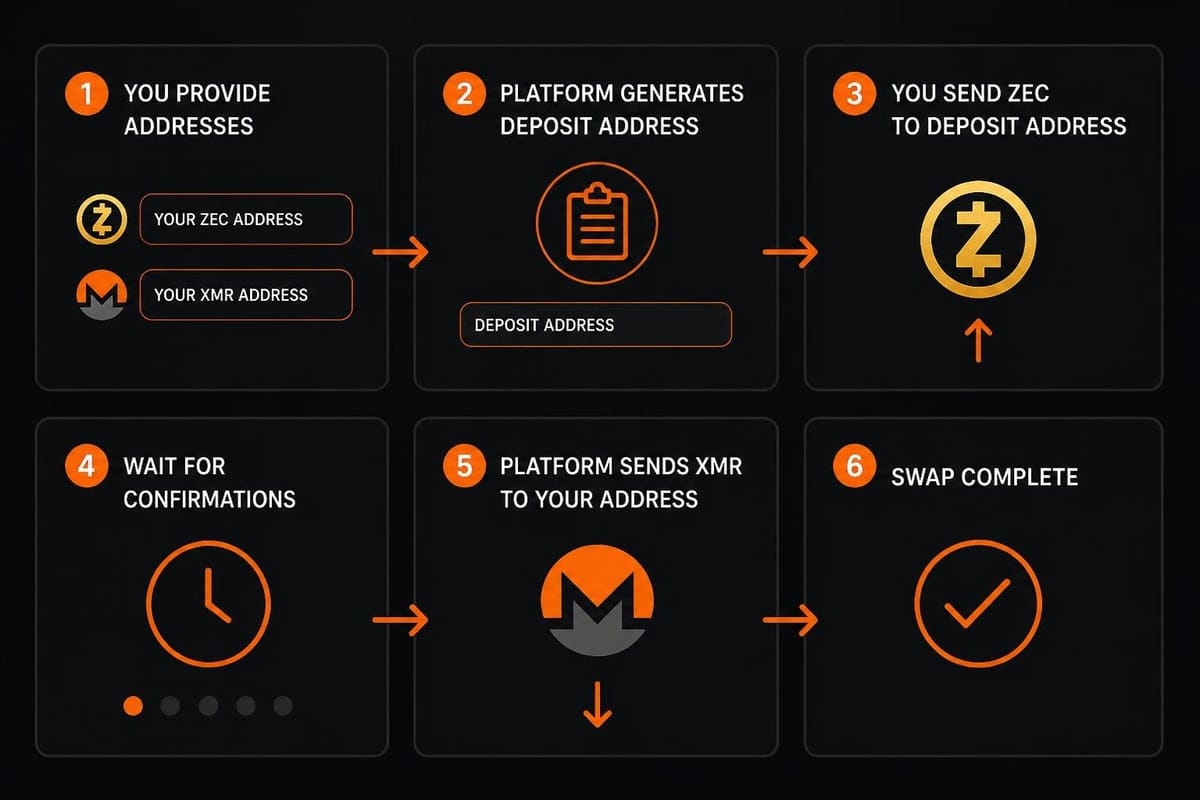
Most platforms offering zcash to monero no registration use instant swap protocols instead. These services act as automated market makers, quoting a fixed rate and executing trades within minutes. You send Zcash to a deposit address, and the platform sends Monero to your destination address.
The platform takes custody risk during the swap window. You trust them to send the Monero after receiving your Zcash. Privacy-focused instant swap services mitigate this by operating non-custodially outside the swap window, publishing their code as open source, and using Tor-compatible infrastructure.
| Feature | Atomic Swaps | Instant Swaps |
|---|---|---|
| Trust model | Trustless | Minimal trust during swap |
| Completion time | 30-90 minutes | 5-15 minutes |
| Rate certainty | Rate can shift during setup | Fixed rate at initiation |
| Technical complexity | High (requires compatible wallets) | Low (any wallet works) |
| Availability | Limited counterparty liquidity | Immediate execution |
MoneroSwap and similar platforms use instant swap protocols to deliver fast execution times while maintaining privacy through no-registration operation and Tor support.
Technical Considerations When Swapping ZEC to XMR
Zcash and Monero use fundamentally different privacy architectures. Understanding these differences helps you navigate the swap process and avoid common mistakes.
Zcash Shielded vs Transparent Pools
Zcash supports two address types. Transparent addresses (starting with 't') work like Bitcoin addresses with full on-chain visibility. Shielded addresses (starting with 'z') use zk-SNARKs to hide transaction amounts and participant addresses.
When performing zcash to monero no registration swaps, send from a z-address when possible. Sending from a t-address exposes your balance and transaction graph on the Zcash blockchain. Many exchanges and swap platforms only support transparent ZEC deposits for technical simplicity, forcing you to first move funds from your shielded address to a temporary t-address.
This transparency window creates a brief link between your shielded activity and the swap. Minimize exposure by:
- Using a fresh t-address for each swap
- Consolidating shielded funds before moving to transparent
- Avoiding address reuse after the swap completes
Monero's Always-Private Design
Every Monero transaction uses ring signatures to obscure the true sender among a group of decoys. Stealth addresses ensure each output goes to a one-time destination address. RingCT hides transaction amounts. These features operate by default on the protocol level.
You don't choose privacy on Monero. The network enforces it. This design means the Monero you receive in a zcash to monero no registration swap arrives with the same privacy guarantees as any other XMR transaction. The receiving address you provide will be converted to a one-time stealth address on-chain, and the amount will remain hidden.
Monero's technical specifications detail how ring signatures, RingCT, and stealth addresses work together. For deep technical understanding, Zero to Monero explains the cryptographic primitives in full.
Choosing a No-Registration Swap Platform
Several factors determine which platform best suits your zcash to monero no registration needs. Not all instant swap services offer the same privacy features or technical infrastructure.
Open Source Code
Closed-source platforms ask you to trust their privacy claims without verification. Open source services publish their code for independent review. You can verify they don't log identifying data, store transaction details, or leak metadata.
MoneroSwap operates as an open source platform, allowing users to inspect the swap logic and confirm no registration data gets collected or retained. Other privacy-focused swaps follow similar transparency models.
Tor Compatibility
Standard HTTPS connections expose your IP address to the swap platform and any network observers. Tor routes traffic through multiple relays to hide your origin. Swap platforms with native Tor onion services let you access their service entirely over Tor without JavaScript fingerprinting or clearnet DNS requests.
Using Tor for zcash to monero no registration swaps adds a critical privacy layer. The platform never sees your real IP address, and your internet provider doesn't know you're using a crypto swap service.
Rate Structure and Liquidity
Registration-free swaps charge a service fee built into the exchange rate. Compare the quoted rate against market prices on centralized exchanges to understand the cost. Instant swap platforms need deep liquidity on both sides to fill orders without slippage.
Evaluate swap platforms on:
- Rate markup (typically 0.5% to 2% above market)
- Minimum and maximum swap amounts
- Availability during high volatility
- Refund policy for failed swaps
- Processing time ranges
Some platforms source liquidity from centralized exchanges in the background while maintaining privacy for end users. Others operate as pure peer-to-peer matching engines. Neither model is inherently better; the key is that your interaction with the platform remains registration-free regardless of their backend structure.
Privacy Risks to Avoid During Swaps
Even when using a no-registration platform, operational mistakes can compromise your privacy. Understanding common failure modes helps you maintain anonymity throughout the swap.
Browser Fingerprinting and Tracking
Accessing a swap platform through a standard browser leaks extensive metadata. Your browser reveals screen resolution, installed fonts, timezone, language preferences, and dozens of other data points that create a unique fingerprint. Combined with IP address logging, this data can track your activity across multiple swaps.
Minimize browser fingerprinting:
- Use Tor Browser with default settings
- Disable JavaScript when possible
- Avoid browser extensions or customization
- Clear cookies and site data after each swap
- Access the platform's onion service directly
Address Reuse and Clustering
Using the same Zcash or Monero addresses across multiple swaps creates linkable on-chain patterns. While Monero's privacy features obscure individual transaction details, repeated interactions with the same swap platform deposit addresses can still suggest common ownership when analyzed over time.
Generate fresh addresses for each swap on both sides. Most Monero wallets create new subaddresses automatically. For Zcash, create new z-addresses when possible or new t-addresses if shielded swaps aren't supported.
Timing Analysis
Completing a zcash to monero no registration swap within minutes creates a timing correlation. An observer watching the Zcash blockchain sees an outbound transaction and, shortly after, can correlate it with Monero network activity if timing is precise and amounts match closely.
This risk is minimal for individual swaps but becomes relevant for users performing frequent exchanges or large amounts. Introducing random delays between receiving Monero and moving it to final destinations can break timing correlations. Similarly, splitting large swaps into multiple smaller transactions at different times reduces the confidence of timing-based clustering.
Regulatory Landscape and Compliance-Free Operation
Privacy coins face ongoing regulatory scrutiny. Exchanges in many jurisdictions have delisted Zcash and Monero in response to anti-money laundering requirements and pressure from regulators. Blockchain analytics firms track privacy coin usage to support compliance and investigations.
The regulatory environment drives demand for zcash to monero no registration swaps. When centralized exchanges require KYC and refuse to list privacy coins, non-custodial platforms become the primary on-ramp and off-ramp for these assets.
Delisting Trends
Major exchanges in the US, EU, and parts of Asia delisted Zcash and Monero between 2020 and 2026. Regulatory frameworks like the EU's Markets in Crypto-Assets (MiCA) regulation and evolving Financial Action Task Force (FATF) guidance pushed platforms toward excluding assets that regulators deem high-risk for money laundering.
Industry research on crypto crime trends shows privacy coins represent a small fraction of illicit transaction volume compared to Bitcoin and stablecoins, but regulatory responses focus on theoretical risks rather than actual usage patterns.
Compliance-Free Infrastructure
Non-registration swap platforms operate outside traditional financial regulations by avoiding custody and not onboarding users. They facilitate peer-to-peer transactions without acting as a money transmitter or financial intermediary in most jurisdictions.
This regulatory position remains legally gray in many countries. Platforms mitigate risk by:
- Operating without corporate structure in regulated jurisdictions
- Avoiding USD or EUR pairs that trigger forex rules
- Publishing code as open source without a formal service entity
- Using decentralized infrastructure and Tor hosting
Users bear responsibility for local tax obligations and reporting requirements. No-registration platforms don't issue tax forms or transaction reports, leaving users to track their own cost basis and gains.
Alternative Privacy Coin Pairs and Swap Routes
While Zcash to Monero is a common privacy pair, users often need to move between other coins as well. Understanding which swap routes preserve privacy helps you plan multi-hop paths when direct pairs aren't available.
Multi-Hop Swaps Through Bitcoin
Some platforms don't offer direct zcash to monero no registration swaps but support both coins paired with Bitcoin. You can execute a two-step swap: ZEC to BTC followed by BTC to XMR.
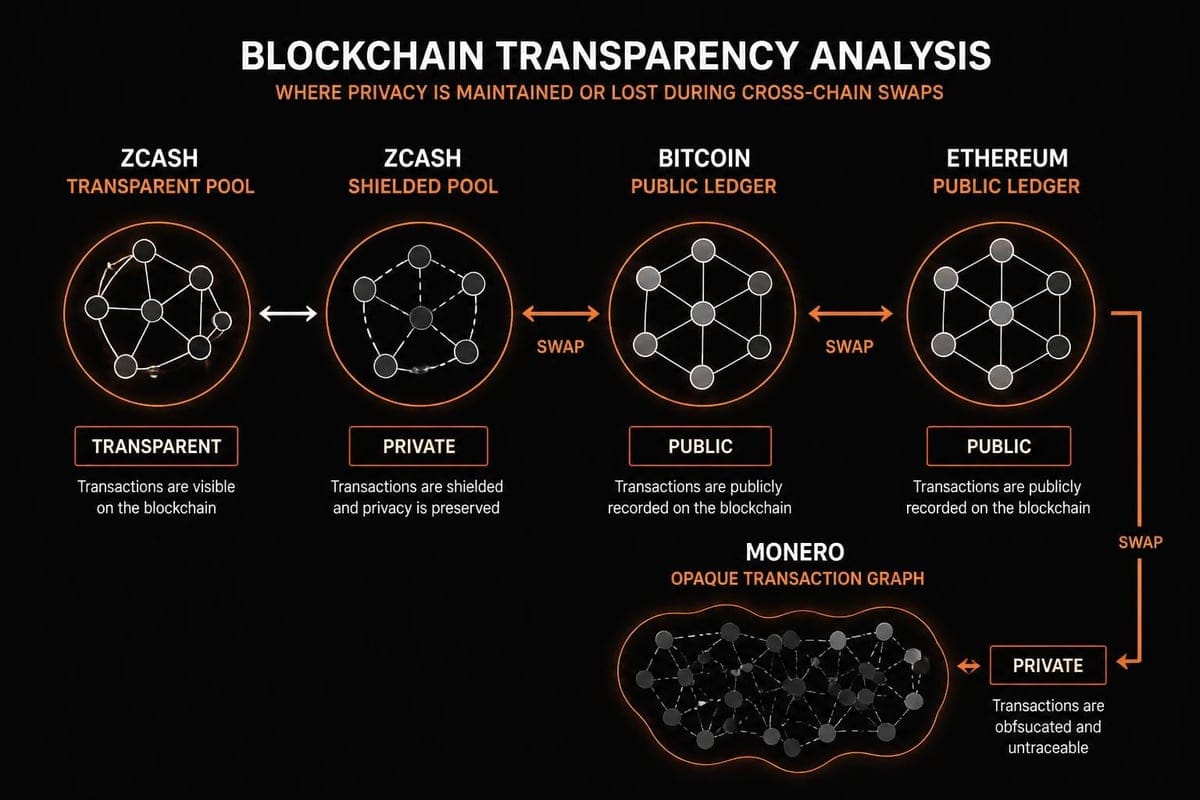
Bitcoin's transparent blockchain creates a privacy leak in this path. The BTC address connecting both swaps becomes visible on-chain. An observer can link your Zcash sending address to the Monero amount you receive by analyzing Bitcoin transaction timing and amounts.
Multi-hop swaps through Bitcoin should use fresh addresses and introduce time delays between legs. Alternatively, platforms that support direct Zcash to Monero pairs eliminate this privacy gap entirely.
Stablecoin Bridges
Moving from privacy coins to stablecoins requires similar no-registration infrastructure. Platforms offering XMR to USDT or XMR to USDC let you exit to fiat-pegged assets without KYC. The stablecoin blockchain (Ethereum, Tron, BSC) exposes all subsequent activity, so privacy ends once you hold transparent stablecoins.
Cross-Chain Privacy Routing
Advanced users combine multiple swaps to route funds through privacy-preserving chains. For example, swapping Ethereum to Monero, holding in XMR while performing other transactions, then swapping Monero to the final destination coin creates temporal and on-chain separation between the source and destination.
| Swap Route | Privacy Level | Complexity | Use Case |
|---|---|---|---|
| ZEC → XMR direct | High | Low | Simple privacy coin migration |
| ZEC → BTC → XMR | Medium | Medium | When direct pairs unavailable |
| ZEC → XMR → BTC | High | Medium | Using XMR as privacy mixer |
| ZEC → XMR → USDT | Medium | Low | Exit to stablecoins with initial privacy |
Each additional hop increases time, cost, and smart contract risk. Direct zcash to monero no registration swaps minimize these tradeoffs while maintaining strong privacy.
Practical Swap Execution Checklist
Executing your first no-registration swap involves several steps. Following a consistent process reduces errors and maintains privacy throughout the transaction.
Before initiating the swap:
- Verify the platform supports Tor or VPN access
- Check current exchange rates across multiple platforms
- Confirm minimum and maximum swap limits fit your amount
- Generate fresh receiving address in your Monero wallet
- Test browser fingerprinting and JavaScript settings
During the swap:
- Navigate to the swap interface over Tor
- Enter swap amount and Monero destination address
- Review quoted rate and estimated completion time
- Note the platform's ZEC deposit address and amount
- Send exact amount from your Zcash wallet
- Save transaction ID and swap reference number
- Monitor swap status without refreshing excessively
After the swap:
- Confirm Monero arrival in your wallet
- Move funds to final destination address if needed
- Clear browser data and close Tor session
- Document trade details for tax purposes separately
- Avoid reusing addresses on future swaps
Most platforms offering zcash to monero no registration complete swaps within 15 minutes during normal network conditions. Delays occur when Zcash or Monero networks experience congestion or if you send an incorrect amount.
If your Monero transaction appears stuck or unconfirmed, check the network confirmation count and your wallet's sync status before assuming the swap failed. Monero's 10-block unlock time means funds show as pending for approximately 20 minutes before becoming spendable.
Network Fees and Swap Economics
Understanding the complete cost structure helps you evaluate whether a no-registration swap makes economic sense for your use case. Total cost includes network fees on both chains plus the platform's service fee.
Zcash Network Fees
Zcash transaction fees remain low, typically under $0.01 for standard transfers. Shielded transactions using z-addresses require more computational work and carry slightly higher fees than transparent transactions, but the difference remains negligible for most users.
When sending ZEC to a swap platform's deposit address, use the standard fee setting. Underpaying fees can cause delays that trigger swap timeouts and refunds.
Monero Network Fees
Monero uses a dynamic fee algorithm that adjusts based on recent block history. Typical fees range from $0.02 to $0.10 depending on network load. Monero's adaptive block size allows the network to handle congestion by increasing block limits rather than forcing fee competition.
The swap platform pays Monero network fees when sending XMR to your destination address. This cost is built into the quoted exchange rate rather than charged separately.
Platform Service Fees
No-registration swap platforms charge 0.5% to 2% above market rates to cover liquidity, operational costs, and profit margins. The fee appears as a less favorable exchange rate rather than a separate line item.
Compare the quoted rate to spot prices on centralized exchanges. A 1% markup on a $1,000 swap costs $10. For users prioritizing privacy, this premium is worthwhile. For large swaps, the absolute fee becomes significant and may warrant splitting into multiple smaller transactions or waiting for better rate conditions.
Technical Support Without Losing Privacy
Traditional customer support asks you to create a ticket with your email, describe the problem, and wait for a response. This model conflicts with no-registration operation where the platform never collects identifying information.
Privacy-focused swap platforms offer support through alternative channels:
- FAQ documentation covering common issues and swap processes
- Anonymous support tickets using only swap transaction IDs
- Community forums on privacy-respecting platforms
- Open source issue trackers for code-level problems
When contacting support about a failed swap, provide only the swap ID and transaction hashes. Never include personal details, email addresses, or information that links multiple swaps to the same user. Platforms like MoneroSwap maintain comprehensive documentation to address most issues without requiring direct support contact.
For disputes or technical failures, non-custodial platforms typically offer refund mechanisms that return your original Zcash if the swap cannot complete. These refunds go to the sending address automatically when timeouts trigger, maintaining the no-registration model throughout the resolution process.
Executing zcash to monero no registration swaps in 2026 requires understanding both coins' privacy architectures and choosing platforms that preserve anonymity throughout the exchange process. Direct swap support, Tor compatibility, and open source operation distinguish genuinely privacy-focused services from platforms claiming no-registration features while logging metadata behind the scenes. Whether you're migrating between privacy coins or routing funds through Monero's opaque blockchain, MoneroSwap provides non-custodial swaps without collecting personal information, creating accounts, or retaining transaction logs, all while maintaining compatibility with Tor for complete anonymity.
Swap into or out of Monero, no KYC
MoneroSwap is a private Monero swap with no account, no KYC, and no logs. Open source and available over Tor. Verify every claim, then swap BTC to Monero, ETH to Monero, USDT to Monero, or see all pairs. New here? Start with the FAQ.
← All guides