Cheapest XMR to USDC Swap: Fee Comparison Guide 2026
The cheapest xmr to usdc swap in 2026 depends on trade size, acceptable slippage, and whether you prioritize custody or privacy. For most users under $5,000, non-custodial instant swaps offer better all-in costs than routing through a centralized exchange due to withdrawal fees and spread markup. Larger trades often see tighter pricing on aggregators that split orders across multiple liquidity sources.
Finding the actual lowest-cost path isn't just about the advertised rate. You need to account for network fees on both chains, the spread between bid and ask, any service or platform fee, and slippage if liquidity is thin. A swap that quotes 0.5% lower can end up costing more once you add Ethereum gas to move USDC and factor in the real execution price.
Why XMR to USDC Routes Differ in Cost
Monero's privacy design makes it incompatible with many smart-contract bridges and automated market makers. You can't wrap XMR on Ethereum the way you wrap BTC, so every swap involves an intermediary or atomic-swap protocol that introduces friction and cost.
Centralized exchanges historically offered the deepest liquidity for XMR pairs, but major platforms delisted Monero starting in early 2024. That shift pushed volume toward instant-swap services and peer-to-peer platforms, fragmenting liquidity and widening spreads. When liquidity is split across ten providers instead of concentrated on one order book, the marginal cost of each trade rises.
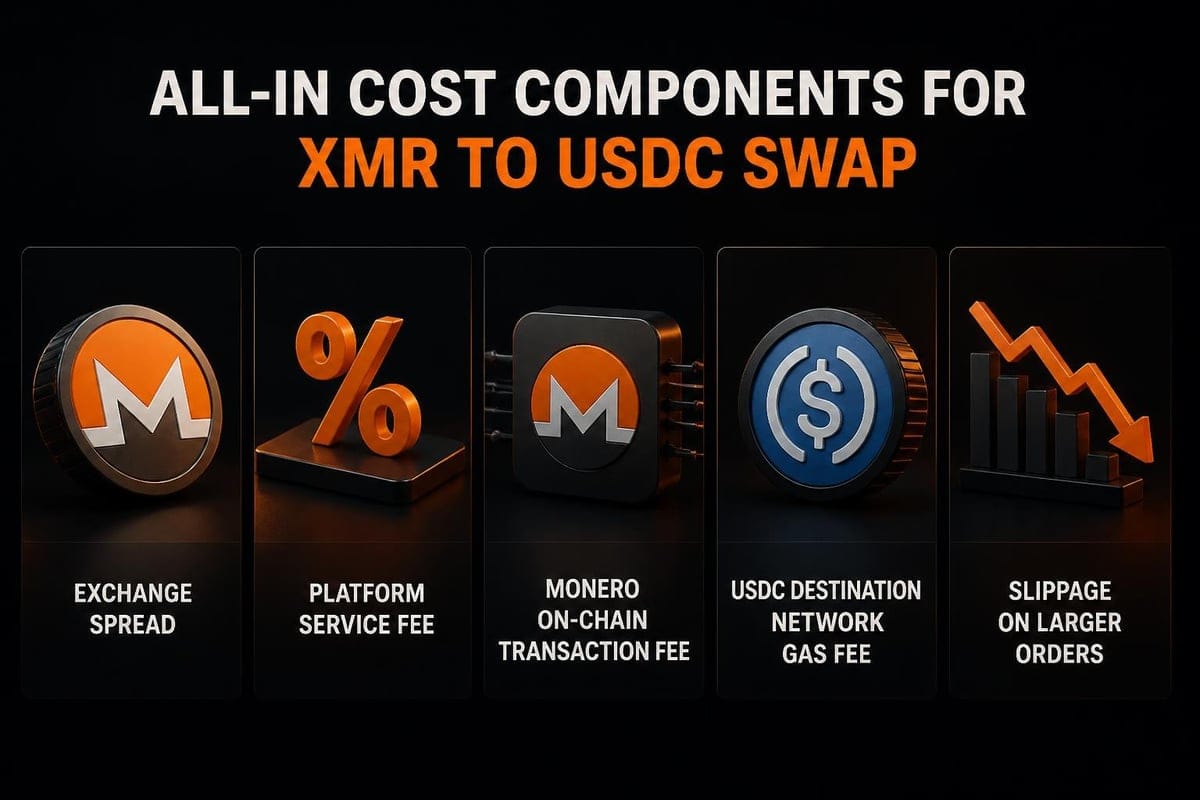
Key cost components in any XMR→USDC swap:
- Exchange-rate spread – the difference between the mid-market rate and the price you actually get
- Service or platform fee – typically 0.5% to 2% of the trade notional
- XMR transaction fee – usually under $0.02 due to Monero's dynamic block size
- USDC network fee – Ethereum mainnet can run $3–$15 in gas; layer-twos and sidechains drop that below $0.50
- Slippage – price movement between quote and execution, especially on trades above $10,000
Non-custodial services bundle most of these into a single quoted rate. Custodial platforms itemize them but often hide spread markup in the displayed price. Comparing quotes requires you to calculate the effective rate including every fee.
Instant-Swap Services vs. Atomic Swaps
Instant swaps are custodial for the duration of the trade. You send XMR to a provider address, they credit an internal balance, execute against their liquidity pool or a partner exchange, and send USDC to your wallet. The entire process takes five to thirty minutes depending on confirmation requirements.
Atomic swaps eliminate custody by locking funds in hashed time-lock contracts on both chains. Recent research on scalable off-chain atomic swap protocols shows promise for reducing on-chain footprint, but XMR swaps still face challenges. Monero's opaque transaction graph makes standard HTLC verification impossible without additional cryptographic machinery. The community proposal for EVM atomic swaps outlines adapter-signature techniques that bridge the gap, though production implementations remain limited in 2026.
Fee Comparison by Method
| Swap Method | Typical Fee | Custody | Privacy | Best For |
|---|---|---|---|---|
| Instant swap (non-KYC) | 0.5–1.5% | Temporary | High | $100–$10,000 |
| CEX (if available) | 0.1–0.5% + withdrawal | Full | Low (KYC) | $10,000+ |
| Atomic swap (protocol) | Network fees only | None | Highest | Any size, technical users |
| DEX aggregator + bridge | 0.3–1% + gas | Varies | Medium | Multi-hop trades |
Atomic swaps in theory offer the cheapest xmr to usdc swap when you measure only protocol fees. In practice, Monero's cryptographic requirements mean most implementations are experimental or require running your own nodes. The time cost and technical overhead outweigh the fee savings unless you're moving five figures or more.
For the majority of swaps, MoneroSwap's XMR to USDC route bundles liquidity sourcing, network-fee handling, and instant execution into a single fixed rate. You don't touch an order book or manage collateral; you get a quote, send XMR, and receive USDC.
Network Choice Matters More Than You'd Expect
USDC exists on Ethereum mainnet, Polygon, Arbitrum, Optimism, Base, BNB Chain, Solana, and half a dozen other networks. The token is identical in value, but the cost to receive and later move it varies by an order of magnitude.
Ethereum mainnet gas averaged $8–$20 per ERC-20 transfer through mid-2026. That's fine if you're swapping $50,000, but it's a 2% overhead on a $500 trade. Layer-two networks drop per-transaction costs to $0.10–$0.50. BNB Chain and Polygon sit in between at $0.30–$1.50 depending on congestion.
Popular USDC networks for XMR swaps:
- Ethereum mainnet – highest liquidity, highest fees, best for large trades or long-term custody
- Arbitrum – sub-dollar fees, deep DeFi integration, moderate on-ramp/off-ramp support via USDC on Arbitrum
- Base – Coinbase-backed, very low fees, growing but less mature ecosystem; see USDC Base swaps
- BNB Chain (BEP-20) – cheap and fast, widely supported by instant swaps, good CEX on-ramps; available via USDC BEP-20
- Polygon – low cost, established bridges, slightly higher congestion than Arbitrum
If you plan to hold USDC in a wallet, any network works. If you want to immediately move it to a centralized exchange, check which networks that platform accepts. Sending USDC on an unsupported chain means bridging back to mainnet or another network, adding another fee and delay.
How to Calculate True All-In Cost
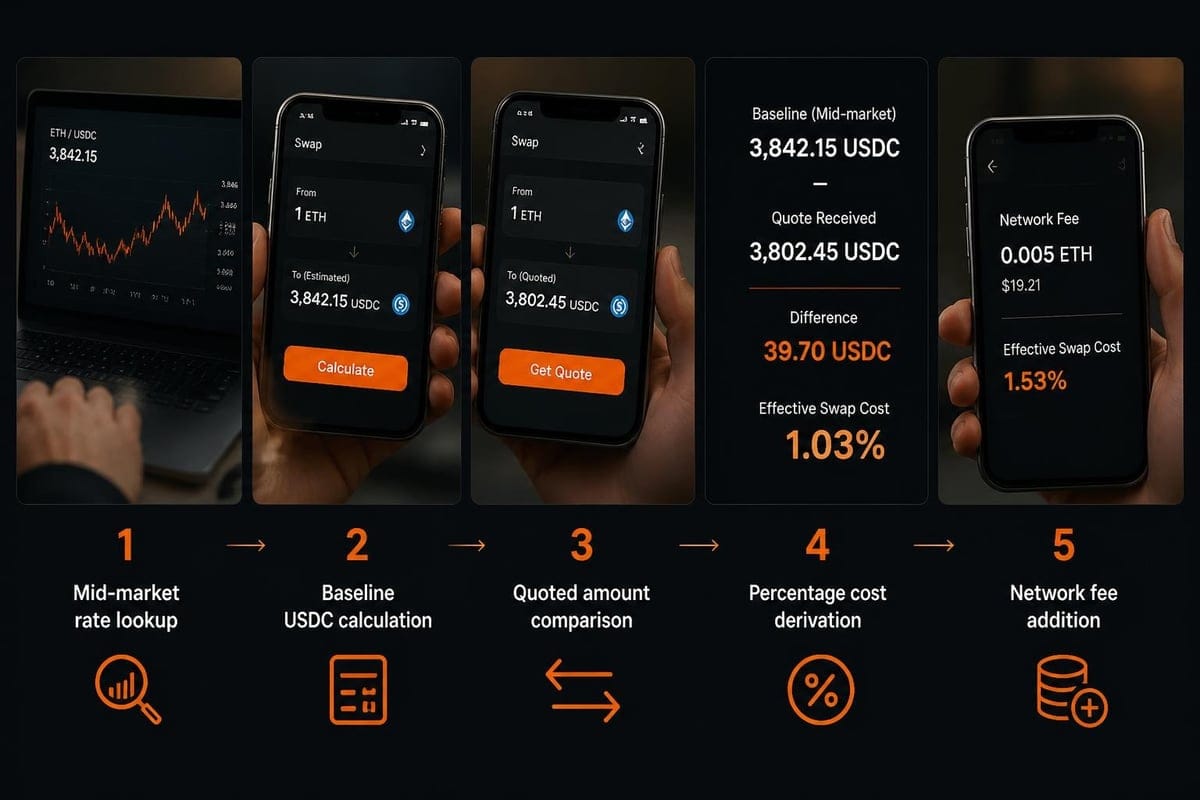
Start with the mid-market XMR/USDC rate from an aggregator like CoinGecko or CoinMarketCap. Compare that to the amount of USDC the swap service quotes for your XMR input. The difference is your effective fee.
Step-by-step cost check:
- Look up the current XMR price in USDC (mid-market).
- Multiply your XMR amount by that price to get the baseline USDC you should receive.
- Get a firm quote from the swap service (not just an estimate).
- Subtract the quoted USDC from your baseline.
- Divide the difference by the baseline and multiply by 100 to get percentage cost.
- Add any network fees you'll pay to move the USDC afterward.
A service advertising "0.5% fee" might apply that to the trade notional, then also embed a 0.3% spread in the quoted rate, then charge $2 in network fees. Your all-in cost is 0.8% plus the flat fee. On a $1,000 swap, that's $8 + $2 = $10 total, or 1% effective. On a $10,000 swap, it's $80 + $2 = $82, or 0.82%.
Slippage becomes material above $10,000. Instant swaps usually source liquidity from a partner exchange or over-the-counter desk. If the desk doesn't have $50,000 of USDC ready to sell at the quoted price, they'll fill part of your order at a worse rate. Ask about minimum and maximum trade sizes, and whether the rate is guaranteed or subject to execution variance.
Liquidity Depth and Market Hours
Unlike traditional forex or equities, crypto markets trade 24/7, but liquidity isn't uniform. XMR volume peaks during European and North American afternoon hours (UTC 14:00–22:00). Swapping during Asian night hours often means thinner order books and wider spreads.
Research on cross-chain crime flows notes that instant-exchange services sometimes batch trades to optimize liquidity costs. If you initiate a swap at 03:00 UTC on a Tuesday, the provider might wait twenty minutes to bundle your order with others, or they'll charge a wider spread to compensate for immediately sourcing thin-market liquidity.
This isn't unique to XMR. Any asset with lower daily volume (XMR typically sees $100–$200 million daily spot volume in 2026) will show time-of-day pricing variation. USDC itself is highly liquid, but the XMR leg drives the spread.
Privacy and Compliance Trade-Offs
Monero exists because people want transaction privacy. Swapping to a transparent stablecoin on a public ledger removes some of that privacy, but how much depends on your swap method.
Non-custodial instant swaps don't require registration, so the provider doesn't link your identity to the USDC receiving address. The USDC transaction itself is public on Ethereum or whichever network you choose, but your XMR wallet history remains opaque. Anyone watching the blockchain sees USDC arriving at your address; they don't see where the XMR came from unless you reuse addresses or doxx yourself elsewhere.
Centralized exchanges that still list XMR force KYC, and delisting trends mean fewer options every quarter. If you must use a CEX, expect to provide a document scan, selfie, and sometimes proof of address. The exchange logs your deposit, trade, and withdrawal. That's a privacy cost on top of any fee difference.
Peer-to-peer platforms like Haveno offer local trades or escrow-mediated swaps. Research into Haveno vulnerabilities shows that imperfect operational security can leak metadata about trade timing and amounts. The cryptographic privacy holds, but network-level analysis and dispute-resolution mechanisms introduce new attack surfaces. Fees on P2P tend to be higher due to escrow overhead and thinner liquidity per individual seller.
Privacy Comparison by Swap Type
| Method | Identity Collection | On-Chain Footprint | Metadata Leakage |
|---|---|---|---|
| Non-KYC instant swap | None | USDC address visible | Minimal (IP if no Tor) |
| KYC exchange | Full (documents, biometrics) | USDC address + CEX records | Complete history |
| Atomic swap (self-hosted) | None | USDC address visible | Minimal (node IP) |
| P2P escrow | Email or handle only | USDC address + platform logs | Timing, trade size |
For users who care about privacy, the cheapest xmr to usdc swap isn't always the one with the lowest percentage fee. Giving up KYC documents to save 0.3% on a $2,000 trade means paying with privacy instead of money. Non-custodial swaps preserve most of the anonymity Monero provides, at a marginal cost premium.
Real-World Fee Examples (October 2026)
We checked live quotes for a 10 XMR → USDC swap (approximately $1,800 at mid-October 2026 prices) across several providers. Rates fluctuate, but the snapshot illustrates cost spreads.
- Non-KYC instant swap A – 1,782 USDC delivered to Arbitrum (0.5% service fee, $0.40 network fee; 1.0% total cost)
- Non-KYC instant swap B – 1,776 USDC delivered to Ethereum mainnet (0.8% service fee, $12 gas; 1.8% total cost)
- CEX (KYC, if available) – 1,791 USDC minus $5 withdrawal to Ethereum mainnet (0.2% trade fee, $5 withdrawal; 0.5% total cost, requires documents)
- Aggregator quote (multi-hop) – 1,770 USDC after bridging fees (1.1% service fee, $8 gas; 2.1% total cost)
The CEX shows the lowest fee percentage, but only one major platform still accepts XMR deposits in late 2026, and it enforces strict KYC. The non-KYC instant swap delivering to Arbitrum came in second on absolute cost and first among private options.
Network choice mattered. The same instant-swap provider quoted $12 less to deliver on Ethereum mainnet versus Arbitrum, entirely due to gas. For a $1,800 trade, that's a 0.7 percentage-point difference.
When to Use a Multi-Step Route
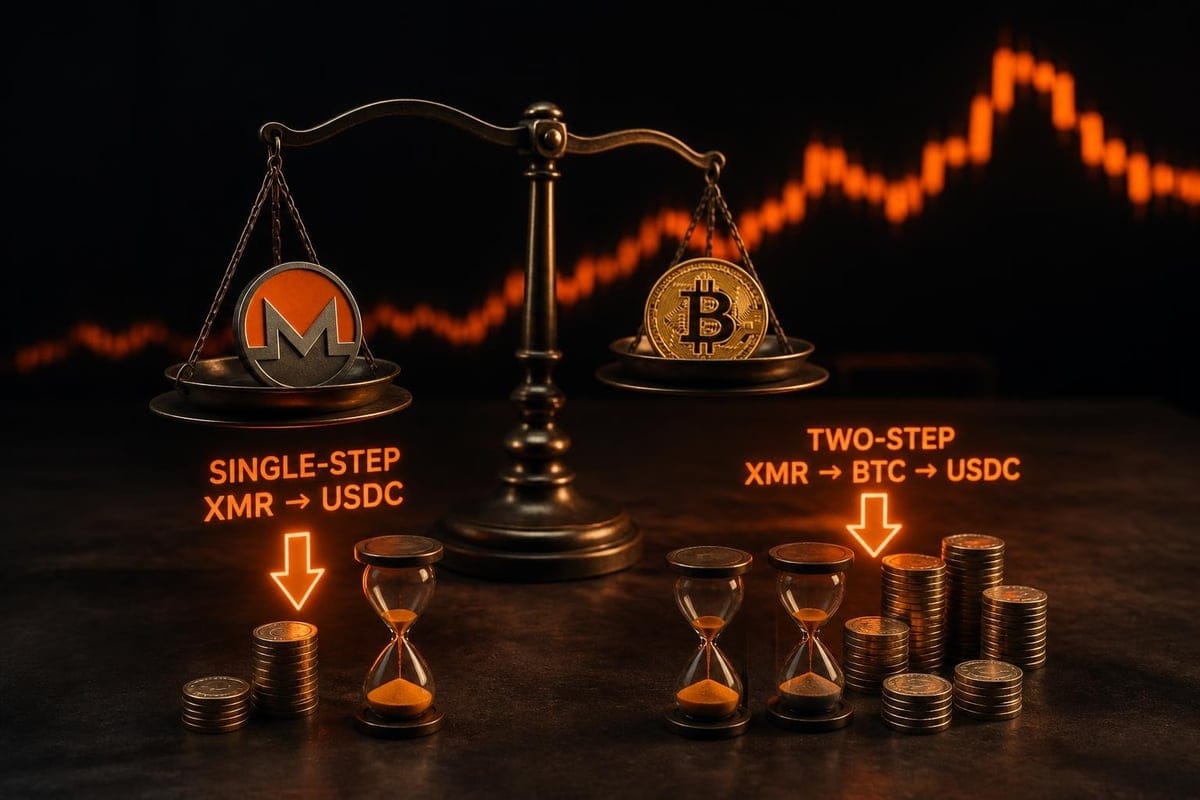
Sometimes the direct XMR → USDC path isn't the cheapest. If you're willing to hold an intermediate asset for a few minutes, routing through BTC or ETH can save on spread.
Example multi-step route:
- Swap XMR → BTC on a platform with deep XMR/BTC liquidity (0.5% fee).
- Swap BTC → USDC on a high-liquidity aggregator (0.2% fee, $3 gas).
- Total cost: 0.7% + $3, versus 1.0–1.5% direct.
This works when XMR/BTC and BTC/USDC pairs both have tight spreads. It fails when one leg is illiquid or when network fees eat the savings. On trades under $3,000, the added complexity and exposure to two separate price quotes usually isn't worth a 0.3% improvement.
You also double your on-chain confirmation wait. XMR needs ten confirmations for most swaps (about twenty minutes). BTC needs one to three (ten to thirty minutes). A two-hop route can take forty-five minutes instead of twenty-five. If price moves against you during that window, you lose more than you saved on fees.
For users who want simplicity, MoneroSwap's direct swap interface handles the entire flow in one transaction. You get a locked-in rate, send XMR, and receive USDC without managing intermediate wallets or timing two separate trades.
Timing and Rate Volatility
XMR's price can move 2–5% in an hour during volatile sessions. USDC is pegged to the dollar, so it's stable, but the XMR leg introduces variability. Most instant swaps lock a rate for five to fifteen minutes. If the provider's upstream liquidity source moves their price, your quote expires and you get a new one.
Rate-lock mechanics:
- Fixed-rate swaps – you get the quoted USDC amount as long as your XMR arrives within the time window (typically fifteen minutes)
- Floating-rate swaps – the final USDC amount adjusts based on market price when your XMR confirms
- Hybrid (best-rate) – the service gives you whichever rate is better at confirmation time
Fixed rates protect you from downside price movement but also cap your upside. If XMR jumps 3% while your transaction confirms, you still get the original quote. Floating rates pass through all volatility. For the cheapest xmr to usdc swap, fixed rates are safer unless you're confident the market will move in your favor.
Academic work on incentive-compatible atomic swaps explores how to align provider and user interests when rates float. The paper's constructions ensure neither party can back out opportunistically, but they require protocol-level support that most instant swaps don't implement. Until those mechanisms mature, fixed-rate quotes remain the standard for non-custodial services.
Hidden Costs: Support and Failed Transactions
A swap that costs 0.2% less but offers no support when your Monero transaction gets stuck can end up more expensive. If the platform has no recovery mechanism and your XMR is locked in limbo for six hours, you miss your target price and potentially pay more on a re-swap.
Reputable services provide transaction monitoring, recovery tools, and support channels. MoneroSwap's recovery page lets you retrieve funds if a swap fails mid-process. That feature has value even if you never use it, because it reduces the expected cost of edge-case failures.
Read the service's policy on stuck transactions, network congestion, and rate disputes. A provider that auto-refunds after thirty minutes of no confirmation is worth a 0.2% fee premium over one that requires a manual ticket and three-day wait.
Regulatory Impact on Pricing
Chainalysis research on instant exchangers highlights how regulatory pressure raises compliance costs for services that handle privacy coins. Platforms operating in jurisdictions with strict AML rules either absorb those costs (reducing profit margin, which can lead to worse rates) or pass them to users as higher fees.
Non-custodial swaps that don't collect user data face less regulatory burden, but they still need liquidity partnerships. If upstream providers charge more due to their own compliance overhead, that cost flows downstream. This dynamic explains why XMR swap fees didn't drop as much as BTC or ETH fees even as DeFi matured.
In 2026, instant-swap services that accept XMR cluster in jurisdictions with lighter KYC regimes or operate as fully decentralized protocols. The latter category remains small, so most liquidity still routes through a handful of offshore entities. Geographic concentration means less competition and higher baseline fees than you'd see in a fully open market.
Optimizing Your Swap Strategy
To consistently get the cheapest xmr to usdc swap, follow a repeatable process instead of picking the first search result.
Optimization checklist:
- Check multiple providers – get quotes from three or more services and compare all-in costs, not just advertised fees.
- Choose the right network – if you don't need mainnet, pick Arbitrum, Base, or BNB Chain to save $5–$15 in gas.
- Time your trade – avoid weekends and low-liquidity hours if you're swapping more than $5,000.
- Use a fixed rate – lock in your quote to eliminate price-movement risk during confirmation.
- Verify the service – check reviews, test with a small amount first, confirm the provider has a track record.
For recurring swaps, track your effective cost over ten trades. If one provider averages 1.1% and another averages 1.4%, the difference compounds. On $50,000 annual volume, that's $150 saved.
Also consider network effects. If you already hold assets on Arbitrum, receiving USDC there avoids a bridge step later. If you're cashing out to a CEX that only accepts Ethereum mainnet USDC, then paying the gas once during the swap is cheaper than paying it twice (swap to Arbitrum, then bridge to mainnet).
Platform Reliability and Liquidity Sources
Instant swaps aggregate liquidity from partner exchanges, OTC desks, or their own reserves. The source affects both price and reliability. A service that routes through a single exchange is fragile; if that exchange goes down or delists XMR, swaps halt.
Better providers maintain relationships with multiple liquidity sources and automatically fail over. Binance's analysis of cross-chain swap mechanics explains how routing decisions happen in milliseconds and how providers balance cost versus execution certainty.
MoneroSwap sources liquidity from a distributed network of partners, which keeps the service running even when individual backends experience downtime. That resilience translates to fewer failed swaps and more consistent pricing, especially during market stress.
Check whether a service publishes uptime stats or has a status page. A provider with 99.5% uptime but 0.5% lower fees is worse than one with 99.9% uptime and slightly higher fees if you're swapping frequently. Failed transactions cost you time and often force you to re-swap at a worse rate.
Additional Considerations for Large Swaps
Above $25,000, you enter a different market. Retail instant swaps cap order size to manage risk, and quotes may not honor the displayed rate. You'll need to contact the provider directly or use an OTC desk.
OTC trades are custodial and require some level of identity verification, even from services that don't enforce full KYC for smaller amounts. The desk wants to know you're not moving illicit funds, and they'll ask for a video call or proof of funds source. In exchange, you get pricing closer to institutional spreads – often 0.2–0.5% versus 1–1.5% retail.
Large swaps also benefit from manual negotiation. If you're converting $100,000 of XMR to USDC, a desk will compete for your business. You can request quotes from three desks, play them off each other, and settle on the best rate. That process takes time but saves percentage points.
For amounts in this range, consider splitting across multiple swaps or using a ladder strategy (swap 20% now, 20% in an hour, etc.) to average out volatility. The per-trade fee overhead is small relative to the price-improvement opportunity.
The cheapest xmr to usdc swap balances fee percentage, network costs, privacy, and reliability. For most users, non-custodial instant swaps on low-fee networks deliver the best all-in price without requiring identity documents or account registration. When you need privacy-preserving conversions with transparent pricing and built-in recovery tools, MoneroSwap offers fixed-rate swaps across multiple USDC networks, ensuring you get the rate you see without hidden markups or KYC friction.
Swap into or out of Monero, no KYC
MoneroSwap is a non-custodial way to swap Monero with no account, no KYC, and no logs. Open source and available over Tor. Verify every claim, then swap BTC to Monero, ETH to Monero, USDT to Monero, or see all pairs. New here? Start with the FAQ.
← All guides