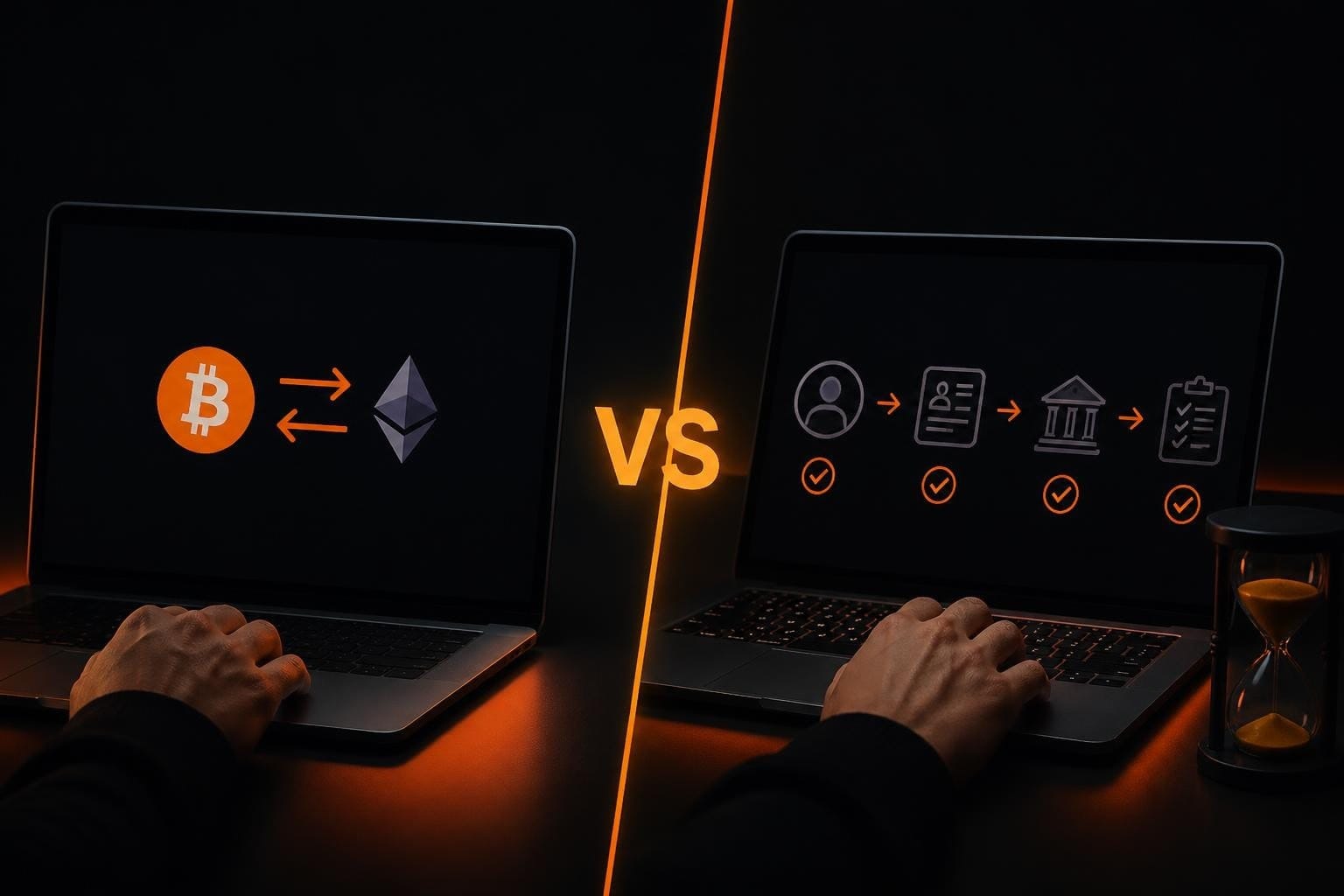
Anonymous Crypto Exchange Guide 2026
An anonymous crypto exchange lets you swap digital assets without submitting identity documents, creating an account, or linking your real-world identity to the transaction. These platforms exist in two main forms: non-custodial swap services that execute atomic or off-chain trades directly between addresses, and centralized platforms that choose not to enforce Know Your Customer (KYC) policies, at least below certain transaction thresholds.
The landscape shifted considerably after 2023, when enforcement actions against mixers and unregistered money service businesses made operating an anonymous crypto exchange riskier in most jurisdictions. Still, demand for privacy-preserving trading remains strong, driven by individuals in surveillance-heavy regions, users concerned about data breaches at centralized exchanges, and anyone who simply prefers financial privacy as a default rather than a privilege.
How Anonymous Crypto Exchanges Actually Work
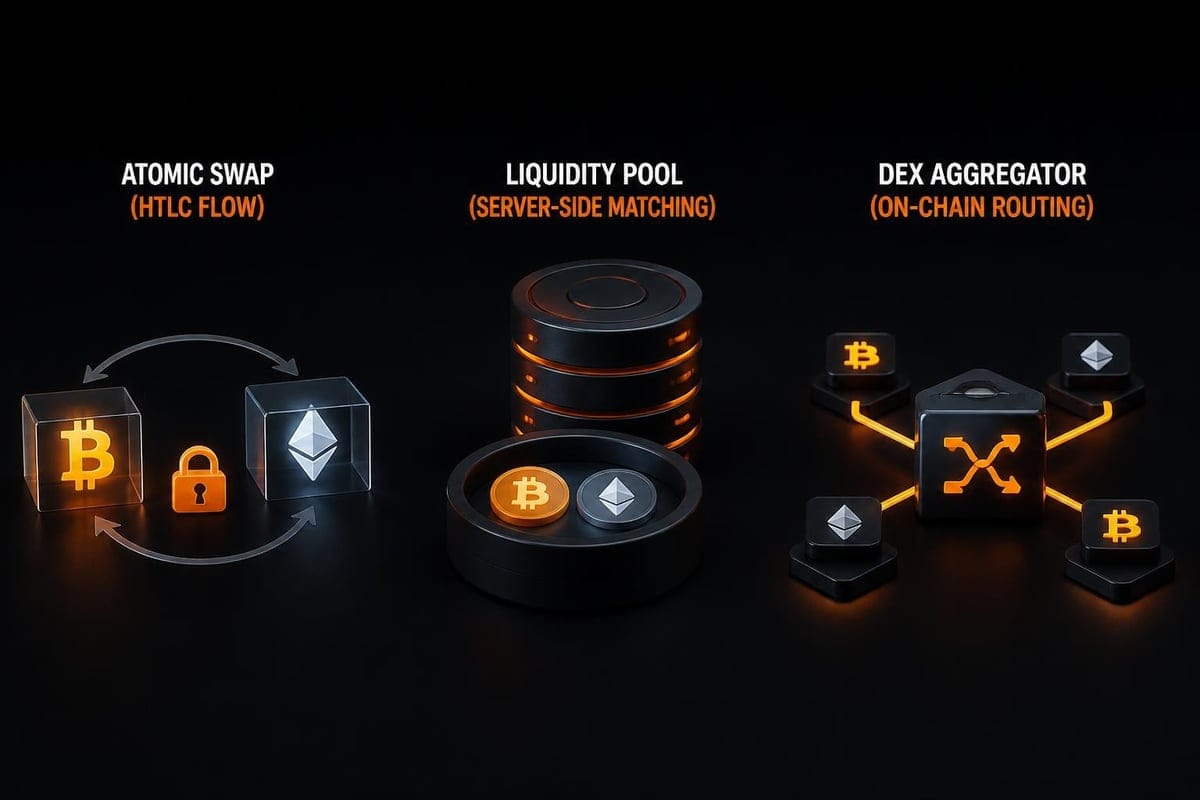
Most anonymous crypto exchange platforms fall into one of three architectural categories. The first type uses atomic swaps, which execute cross-chain trades through hashed time-locked contracts (HTLCs) that either complete fully or refund both parties. The second relies on liquidity pools where the exchange holds reserve balances and processes swaps server-side, similar to a traditional exchange but without identity checks. The third model aggregates liquidity from decentralized exchanges (DEXs) and routes orders through on-chain protocols while presenting a simple front-end interface.
Non-Custodial Versus Custodial Anonymous Services
A non-custodial anonymous crypto exchange never takes possession of your funds during the swap. You send assets to an address controlled by a smart contract or directly to the counterparty's address after cryptographic guarantees lock in the exchange rate and sequence. The platform might coordinate the trade or provide the software, but it can't seize, freeze, or lose your coins because it never holds them.
Custodial anonymous platforms ask you to deposit coins into wallets they control, execute the swap internally, then send the output asset to your withdrawal address. These services skip KYC but still require trust that the operator won't exit-scam, selectively freeze funds, or suffer a security breach. Recent academic research explores architectures that aim to preserve anonymity while still allowing compliance checks, though real-world implementations remain rare in 2026.
The custody distinction matters because regulatory pressure typically focuses on entities that control user funds. A non-custodial service has less surface area for enforcement actions, though authorities can still target the developers, infrastructure providers, or front-end domains.
Privacy Guarantees and Their Limits
Calling a platform an "anonymous crypto exchange" doesn't mean every aspect of the transaction is invisible. Most swaps leave on-chain traces: Bitcoin inputs and outputs are public, Ethereum token transfers appear in block explorers, and even privacy coins like Monero reveal transaction timestamps and amounts (though not sender, receiver, or exact linkage between outputs).
| Privacy Feature | What It Protects | What It Doesn't |
|---|---|---|
| No KYC | Your legal identity from the platform | Your IP address, browser fingerprint, or blockchain metadata |
| Non-custodial | Funds from platform seizure or theft | On-chain analysis if you reuse addresses or consolidate outputs |
| Tor compatibility | Your IP from logs or surveillance | Payment timing correlation or amount-based heuristics |
| No email or account | Contact information from breaches | Transaction graph analysis by chain surveillance firms |
Platforms that convert transparent-chain assets into Monero-like swapping BTC to XMR or ETH to XMR-break the on-chain link at the Monero side because XMR uses ring signatures, stealth addresses, and confidential transactions by default. Going the other direction (XMR to BTC, for example) creates a fresh Bitcoin UTXO with no visible history connecting it to your previous Monero balance, though you still need to manage that UTXO carefully to avoid later linkage.
Blockchain Forensics and Tracking
Chain analysis firms maintain databases of known exchange deposit addresses, mixing service outputs, and other heuristics. Research published in Nature demonstrates that privacy-preserving schemes can be effective when implemented correctly, but naive use of privacy tools often fails under scrutiny. If you send Bitcoin from a KYC exchange directly to an anonymous swap platform, then immediately forward the output coins to another KYC exchange, both endpoints know your identity and can correlate the flow.
Effective privacy requires breaking timing, amount, and address-cluster links. An anonymous crypto exchange handles one part of that chain (the swap itself), but the user must handle coin management before and after. Studies of CoinJoin adoption show that many users misunderstand the threat model and inadvertently leak identity through poor UTXO hygiene.

Regulatory and Legal Context in 2026
Most jurisdictions classify cryptocurrency exchanges as money service businesses or virtual asset service providers, which triggers licensing and KYC obligations. An anonymous crypto exchange operating without these controls exists in a legal gray zone or outright violates local law, depending on where it's incorporated, where its servers are hosted, and where its users reside.
The United States treats unlicensed money transmission as a federal crime, and IRS guidance published by the Joint Chiefs of Global Tax Enforcement explicitly flags anonymity-enhanced transactions as risk indicators for tax evasion and money laundering. European Union member states enforce the Fifth Anti-Money Laundering Directive (5AMLD), which requires exchanges to identify customers and report suspicious activity. Even Switzerland, long considered crypto-friendly, mandates KYC for services that custody funds or facilitate fiat on-ramps.
Enforcement Patterns and Risk
Authorities focus enforcement on three categories: platforms that explicitly advertise money laundering services, those with demonstrated links to sanctioned entities or illicit marketplaces, and high-volume operations that process significant transaction throughput without compliance programs. A small, non-custodial anonymous crypto exchange that processes modest volume and avoids fiat entirely might escape notice, but growth attracts attention.
The 2025 Chainalysis Crypto Crime Report shows that while overall illicit transaction volume declined year-over-year, privacy-focused services and decentralized platforms absorbed a larger share of that remaining activity, making them higher-priority targets for law enforcement. Operators face potential charges ranging from operating an unlicensed money transmission business to conspiracy to launder money, depending on their knowledge of customer activity and the design of their platform.
Choosing an Anonymous Crypto Exchange
Not all anonymous exchanges provide equivalent privacy, security, or reliability. Evaluating a platform requires looking beyond marketing claims to examine architecture, operational practices, and verifiable properties.
Key evaluation criteria:
- Custody model: Does the platform ever control your private keys or require deposits?
- Code transparency: Is the swap mechanism open source and independently auditable?
- Network privacy: Does the service offer Tor onion addresses or I2P endpoints?
- Logging policy: What data (IP addresses, transaction IDs, amounts, timestamps) does the service collect or retain?
- Uptime and liquidity: Can the platform reliably execute swaps at reasonable rates, or do trades frequently fail?
- Supported assets: Does it handle the specific pairs you need, including privacy coins like Monero or Zcash?
A truly privacy-respecting anonymous crypto exchange will answer these questions clearly rather than hiding behind vague assurances. Open-source code allows independent verification that the platform works as claimed. Services that operate Tor-compatible swap interfaces demonstrate commitment to network-level privacy, not just regulatory avoidance.
Common Pitfalls and Red Flags
Some platforms claim to be anonymous but log extensive data, require email registration (which creates an identity anchor), or cooperate quietly with law enforcement while advertising privacy. Others have opaque ownership structures that make it impossible to assess who controls the funds or infrastructure.
Exit scams remain common in the anonymous exchange space because users have little recourse. A custodial platform can disappear overnight with deposited coins, and the pseudonymous nature of the operation makes recovery impossible. Even non-custodial swaps can fail mid-transaction if the service suddenly goes offline, though properly implemented atomic swaps include refund mechanisms if the trade doesn't complete within a specified timeframe.
Technical Implementation Details
The most robust anonymous crypto exchange designs use atomic cross-chain swaps, which require no trusted intermediary and can't result in one party receiving coins while the other gets nothing. Research on atomic swap protocols covers the cryptographic primitives (HTLCs, adaptor signatures, and scriptless scripts) that enable trustless trades between different blockchains.
Atomic Swap Execution Flow
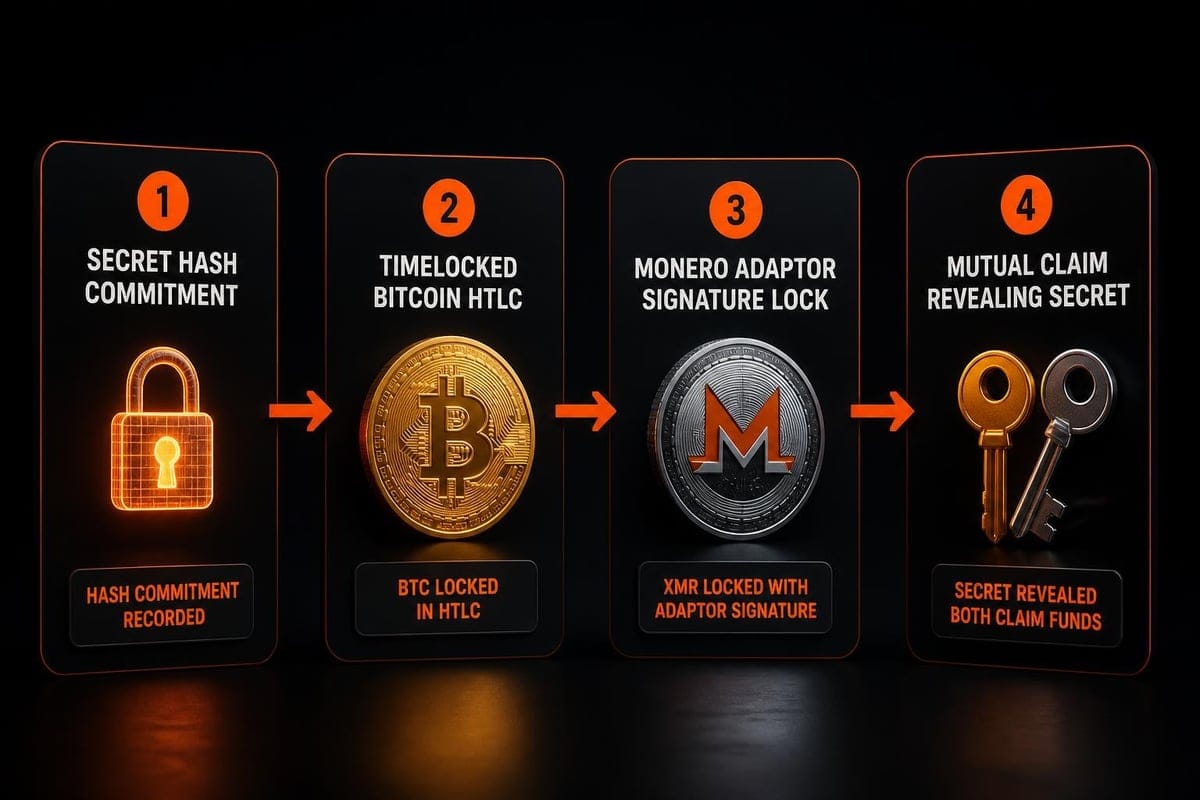
A basic atomic swap between Bitcoin and Monero proceeds through these steps:
- Initiation: Alice (who has BTC) and Bob (who has XMR) agree on an exchange rate and amounts
- Secret generation: Alice generates a random secret and shares its hash with Bob
- Bitcoin lock: Alice creates an HTLC on Bitcoin that pays Bob if he reveals the secret within a timelock, or refunds Alice if the timelock expires
- Monero lock: Bob creates a corresponding Monero transaction locked to the same secret hash
- Claim: Alice claims the XMR by revealing the secret, which simultaneously allows Bob to claim the BTC
- Settlement: Both parties now control their swapped assets, and the trade is irreversibly complete
This sequence guarantees atomicity (both swaps complete or both refund) without requiring either party to trust the other or a third-party escrow. The anonymous crypto exchange in this model is just coordination infrastructure-matching buyers and sellers, communicating offers, and monitoring blockchain states to detect completion.
Privacy Coin Integration
Monero complicates atomic swaps because it doesn't support the same scripting capabilities as Bitcoin. Early implementations used trusted intermediaries or required custom off-chain protocols. Modern solutions use adaptor signatures, where Bob's Monero transaction can only be completed if Alice reveals the secret, but the Monero blockchain itself never sees the secret or hash. This preserves Monero's privacy properties while still enabling atomic execution.
When you swap USDT to XMR or convert USDC to Monero, the exchange typically handles the transparent-chain side (Ethereum or Tron) through standard smart contracts or custodied wallets, then executes the Monero portion through one of these atomic or semi-atomic protocols. The weakest privacy link is usually the transparent blockchain entry point, where amounts and addresses are public.
Anonymous Trading Strategies
Using an anonymous crypto exchange effectively requires thinking through the full transaction chain. Privacy is cumulative-each step either strengthens or weakens your anonymity set.
Before the swap:
- Source coins from a non-KYC method (mining, peer-to-peer trade, previous anonymous swap)
- Avoid sending directly from a KYC exchange or an address cluster known to be yours
- Consider using a privacy tool (CoinJoin, Lightning Network) on the source chain first
During the swap:
- Access the platform over Tor or I2P rather than clearnet
- Avoid creating accounts or providing email addresses
- Use a fresh receiving address that isn't linked to your other holdings
After the swap:
- Don't immediately consolidate outputs or send to a KYC exchange
- If swapping into Monero, take advantage of its default privacy but still practice good wallet hygiene
- If swapping into a transparent coin, consider further privacy steps before final use
The CoinDesk Exchange Benchmark data shows that major centralized platforms process millions of KYC-verified users and maintain compliance programs that feed data to regulators and law enforcement. An anonymous crypto exchange offers an alternative, but only if you don't undermine the privacy gains through poor operational security.
Multi-Hop Swaps
Some users chain multiple swaps to further obscure the flow: BTC to XMR on one platform, then XMR to ETH on another, for example. This breaks the direct link between the entry and exit assets, though it doubles transaction fees and introduces additional timing and amount correlations. Each swap is a potential failure point, and multi-hop strategies only make sense when the privacy gain justifies the added cost and complexity.
Services that support both directions-like XMR to SOL and SOL to XMR-make it easier to move in and out of privacy-preserving assets as needed without maintaining accounts on multiple platforms.
Risks and Threat Models
An anonymous crypto exchange protects you from some threats while leaving you exposed to others. Understanding your specific threat model determines whether anonymous trading is necessary and which platform design fits your needs.
Threats an anonymous exchange mitigates:
- Identity theft or doxxing via exchange data breaches
- Government surveillance or asset seizure based on exchange records
- Correlation of your cryptocurrency holdings with your real-world identity
- Blanket data-sharing agreements between exchanges and authorities
Threats it does not address:
- On-chain analysis by firms like Chainalysis if you mishandle addresses
- Network-level surveillance if you access the service over clearnet
- Malware or phishing that compromises your device or seed phrases
- Counterparty risk in custodial models or improperly implemented atomic swaps
Academic analysis of Bitcoin's privacy properties demonstrates that even sophisticated users struggle to maintain anonymity against well-resourced adversaries. An anonymous crypto exchange is one tool in a broader privacy stack, not a silver bullet.
Comparing Platforms and Features
| Platform Type | Custody | KYC | Typical Assets | Privacy Level | Regulatory Risk |
|---|---|---|---|---|---|
| Non-custodial atomic swap | None | None | BTC, XMR, select others | High (if used correctly) | Low to Medium |
| Custodial no-KYC exchange | Full | None or minimal | Wide range | Medium | High |
| DEX aggregator | None | None | ERC-20, similar tokens | Medium (chain-dependent) | Low |
| Privacy-focused swap | None | None | Monero-centric pairs | Very High | Medium |
| Instant exchanger | Brief | Minimal | 50+ coins | Low to Medium | High |
The privacy-focused swap category, which includes platforms like MoneroSwap, prioritizes Monero integration and builds every component (no registration, no logs, Tor access) around privacy rather than bolting anonymity features onto a traditional exchange. This design philosophy produces stronger privacy guarantees at the cost of narrower asset support compared to platforms that attempt to be everything to everyone.
Practical Considerations for 2026
Operating or using an anonymous crypto exchange in 2026 means navigating a more hostile regulatory environment than existed even two years ago. Infrastructure providers (hosting companies, domain registrars, payment processors) increasingly refuse service to platforms that facilitate anonymous transactions, pushing operations toward bulletproof hosting, decentralized infrastructure, and cryptocurrency-only payment rails.
Users should expect more platforms to disappear suddenly, either from legal pressure, infrastructure deplatforming, or exit scams. Maintaining updated lists of reliable services and verifying platform status through independent verification tools becomes part of due diligence.
Liquidity is the perennial challenge. An anonymous crypto exchange can't partner with major market makers or tap into centralized exchange order books without compromising its privacy model. Rates tend to be slightly worse than KYC platforms, and slippage can be significant for larger trades. Splitting large swaps into smaller transactions (spacing them over time from different addresses) improves both pricing and privacy.
Stablecoin Pairs and Fiat Off-Ramps
Anonymous exchanges typically avoid fiat entirely because banking relationships require KYC and create a paper trail that defeats the purpose. Stablecoins like USDT and USDC serve as fiat proxies, letting users move between volatile and stable assets without leaving the crypto ecosystem.
Converting stablecoins to Monero (USDT to XMR, USDC to XMR) provides an on-ramp into privacy from the transparent Ethereum or Tron ecosystems. The reverse (XMR to USDT, XMR to USDC) gives Monero holders a stable store of value without converting to fiat and exposing their identity.
Cross-Chain and Multi-Network Support
An effective anonymous crypto exchange in 2026 needs to support assets across multiple networks. Users hold Bitcoin, Ethereum ERC-20 tokens, Binance Smart Chain assets, and newer Layer-2 chains. A platform that only handles Bitcoin-to-Monero swaps serves a niche but limits its utility.
Supporting multiple chains introduces technical complexity. Each blockchain requires integration (running nodes, monitoring deposits, constructing transactions), security audits (different signature schemes and smart contract patterns), and liquidity management (maintaining balanced reserves or finding counterparties). Non-custodial atomic swaps work well between Bitcoin-like chains and Monero but require different implementations for account-based chains like Ethereum.
Some platforms solve this by supporting multiple networks for the same stablecoin. For example, offering USDC on Ethereum, USDC on BSC, USDC on Base, and USDC on Arbitrum gives users flexibility to swap from whichever network has the lowest fees or where they already hold balances. The same pattern applies to ETH across networks (mainnet, Base, Arbitrum) and USDT variants.
Long-Term Viability
Anonymous crypto exchanges exist in tension with the regulatory trajectory of most developed nations, which increasingly demand surveillance, reporting, and identity verification for all financial services. This doesn't mean anonymous swaps will disappear, but it does mean they'll remain smaller, more fragmented, and higher-risk than mainstream platforms.
Decentralized technologies (atomic swaps, privacy coins, Tor) make it hard to shut down anonymous exchanges completely, but enforcement against centralized chokepoints (developers, front-ends, fiat on-ramps) limits growth. The viable long-term model is probably fully peer-to-peer software with no central operator, no corporate entity, and no servers to seize. We're not there yet with current user experience expectations, but protocol development continues.
Privacy coin integration will remain central. Chains like Monero provide the only realistic way to break transaction graphs at scale, and any serious anonymous crypto exchange will center its service around Monero swaps as the core privacy primitive.
Anonymous crypto exchanges give you control over your financial privacy in an era when surveillance is the default. The trade-offs include regulatory risk, narrower asset selection, and the need for careful operational security, but for users who prioritize privacy-whether for ideological reasons, personal safety, or simply as a matter of principle-these platforms remain essential infrastructure. If you need to swap cryptocurrencies without KYC, account registration, or log retention, MoneroSwap offers non-custodial swaps with full Tor compatibility and open-source code you can verify yourself.
Swap into or out of Monero, no KYC
MoneroSwap is a non-custodial way to swap Monero with no account, no KYC, and no logs. Open source and available over Tor. Verify every claim, then swap BTC to Monero, ETH to Monero, USDT to Monero, or see all pairs. New here? Start with the FAQ.
← All guides