ZEC to XMR Anonymously: Privacy-First Swap Methods
Converting ZEC to XMR anonymously requires choosing exchange methods that preserve privacy at every step. Non-custodial swaps that skip KYC, avoid account creation, and don't retain transaction logs offer the strongest anonymity when moving between Zcash's shielded pool and Monero's opaque ledger. The technical differences between these privacy coins-and the surveillance infrastructure watching both-make your choice of swap method as important as the coins themselves.
Both Zcash and Monero implement privacy differently. Zcash uses optional shielded addresses with zero-knowledge proofs, while Monero enforces privacy by default across all transactions. This architectural difference creates specific considerations when you want to swap zec to xmr anonymously without introducing metadata leaks or chain-analysis vulnerabilities.
Why Direct ZEC-XMR Swaps Are Technically Complex
No mature atomic swap protocol exists today that directly links Zcash and Monero without intermediaries. The cryptographic primitives differ too much. Zcash relies on zk-SNARKs for shielded transactions. Monero uses ring signatures, stealth addresses, and RingCT. Atomic swap research has focused primarily on Bitcoin-Monero pairs, and extending those constructions to Zcash introduces new cryptographic challenges that haven't been solved in production systems.
That technical gap means you need an intermediary. The question becomes: which intermediary preserves anonymity?
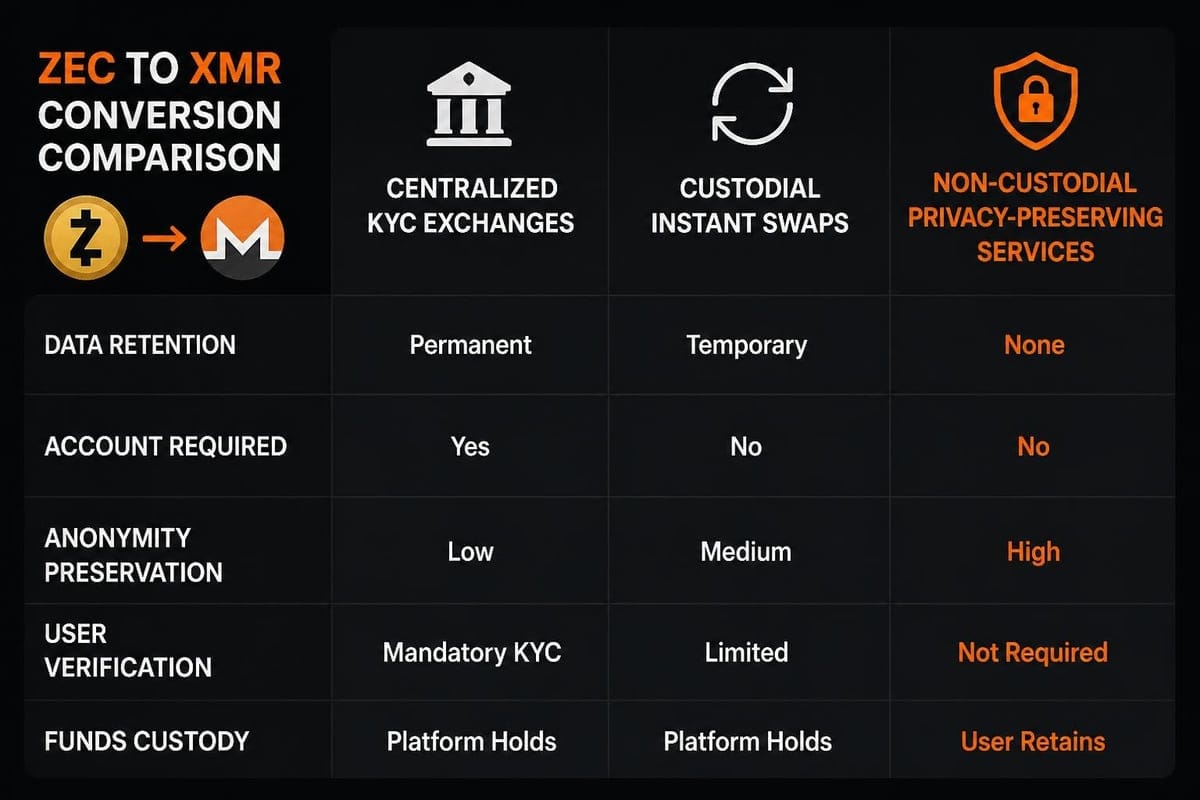
Your options break down into three categories:
- Centralized exchanges with KYC (destroys anonymity entirely)
- Custodial instant exchanges that claim "no KYC" but retain internal logs
- Non-custodial swap services that operate without accounts or persistent data
The first category-traditional exchanges-fails immediately. Binance, Coinbase, and Kraken all demand identity documents, facial scans, and proof of address. They log IP addresses, transaction histories, and wallet addresses. Using a KYC exchange to convert zec to xmr anonymously contradicts itself.
The Shielded Transaction Requirement
Starting your swap from a transparent ZEC address leaks information before you even reach the swap service. Academic analysis of Zcash anonymity shows that most ZEC transactions still use transparent addresses, drastically reducing the effective anonymity set. When you send ZEC from a transparent address, blockchain observers see the amount, sender address, recipient address, and timing.
To swap zec to xmr anonymously, you need:
- ZEC already in a shielded (z-address) balance
- A swap service that accepts shielded deposits
- No requirement to reveal your identity during the swap
- Minimal metadata collection on the service side
Moving ZEC into shielded storage before swapping adds a crucial privacy layer. The Zcash project emphasizes that shielded transactions remain cryptographically sound, but the privacy benefit only applies when you actually use shielded addresses. Transparent-to-transparent transactions offer no privacy advantage over Bitcoin.
Non-Custodial Swaps vs Custodial Instant Exchanges
The difference matters more than most users realize. Custodial services take control of your coins during the swap. You send ZEC to their address, they credit an internal account, execute trades on their own terms, then send XMR to your destination. You're trusting them not to log IP addresses, not to correlate deposits with withdrawals, and not to share data with chain analysis firms or law enforcement.
Non-custodial swaps work differently. The service coordinates the exchange but never controls both sides of the trade. Atomic swap protocols, cross-chain DEX integrations, or carefully structured multi-step swaps ensure you retain control of your funds until the moment of exchange.
| Feature | Custodial Instant Exchange | Non-Custodial Swap |
|---|---|---|
| Funds control | Service holds both assets temporarily | You control assets until swap executes |
| Account creation | Usually not required | Never required |
| IP/metadata logging | Varies by provider, often retained | Minimal to none when properly designed |
| Transaction correlation risk | High (service sees both sides) | Lower (cryptographic protocols limit visibility) |
| Speed | Fast (minutes) | Moderate (depends on confirmations) |
| Privacy ceiling | Limited by service's internal practices | Limited by protocol design |
The Monero community has invested in maturing atomic swap infrastructure specifically because custodial bridges introduce trust and surveillance risks. When you swap zec to xmr anonymously through a properly designed non-custodial service, the operator can't steal your funds mid-swap and can't easily correlate your ZEC input with your XMR output.
Chain Analysis and Privacy Coin Surveillance
Both Chainalysis and Elliptic have developed tools targeting privacy coin users. Their techniques focus on metadata rather than breaking cryptography. They watch for:
- IP addresses connected to wallet software and node connections
- Timing correlations between deposits and withdrawals at services
- Amount matching across chains (sending 10.5 ZEC and receiving equivalent XMR shortly after)
- Clustering addresses based on exchange deposits and withdrawal patterns
These firms track "chain hopping"-the practice of moving value across multiple cryptocurrencies to obscure the trail. A ZEC to XMR swap counts as chain hopping. The DHS assessment of illicit finance specifically mentions privacy coins and cross-chain swaps as emerging challenges for investigators.
Your anonymity depends on minimizing the metadata you leak:
- Use Tor or a trusted VPN for all connections
- Avoid round-number amounts (don't swap exactly 5.0 ZEC)
- Introduce time delays between transactions when practical
- Don't reuse addresses or link wallets across chains
Privacy-Preserving Swap Workflow
Executing a truly anonymous zec to xmr swap requires attention to operational security at each step. The technical privacy features of both coins only protect you if you don't undermine them through careless metadata exposure.
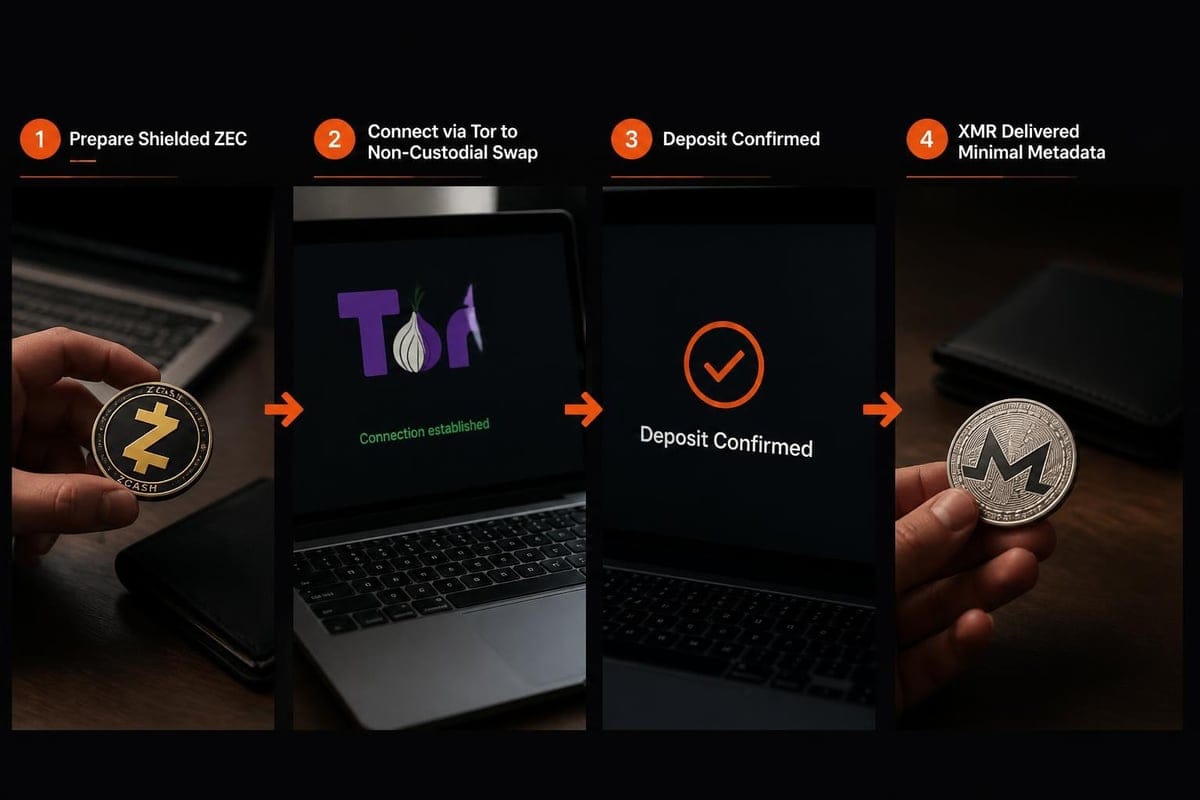
Step 1: Prepare shielded ZEC
Your ZEC needs to already reside in a shielded address. If you currently hold ZEC in a transparent address, move it to a z-address first. Let several blocks confirm before proceeding. This breaks timing correlation between your original ZEC source and the swap.
Step 2: Select a non-custodial swap service
Look for services that:
- Don't require email, phone, or identity documents
- Publish their source code (open source builds trust and allows security audits)
- Offer Tor hidden service endpoints for anonymous connectivity
- Explicitly state they don't retain logs
Services like MoneroSwap specifically design around these requirements. The swap interface accepts shielded ZEC deposits, coordinates the exchange without taking custody of both assets simultaneously, and operates over Tor to prevent IP tracking.
Step 3: Initiate the swap over Tor
Connect to the swap service through Tor Browser or Whonix. Don't use a regular browser with a VPN. VPN providers can log your activity and correlate your real IP with the swap. Tor provides stronger anonymity when used correctly.
When you initiate the swap to convert zec to xmr anonymously, the service generates a unique deposit address. You send your shielded ZEC to that address. The service monitors the blockchain for confirmations, then sends XMR to your specified Monero address.
Step 4: Receive XMR to a fresh subaddress
Never reuse Monero addresses. Generate a new subaddress for each incoming transaction. Monero's privacy protections work best when you avoid address reuse and don't consolidate outputs unnecessarily. The XMR you receive carries no on-chain connection to the ZEC you sent.
Common Mistakes That Leak Metadata
Even when using privacy-focused services, users often expose themselves through operational errors:
- Connecting without Tor: Your ISP sees you visiting the swap service. The service sees your real IP. Chain analysis firms can request logs.
- Round amounts: Swapping exactly 10.0 ZEC makes timing correlation easier. Add or subtract a small random amount.
- Immediate subsequent transactions: Depositing the XMR you just received into an exchange within minutes creates a timing fingerprint.
- Reusing the same swap service repeatedly from the same browser: Even without accounts, browser fingerprinting can track return visits.
The goal isn't paranoia. It's understanding the threat model. If you want to swap zec to xmr anonymously, you need to account for the surveillance infrastructure actively monitoring privacy coin flows.
Comparing Swap Service Privacy Models
Not all "no-KYC" swaps deliver equivalent privacy. Some retain more metadata than others. Some implement better operational security practices.
Open Source vs Closed Source
Open source swap services let you verify their code. You can check whether they actually skip logging, how they handle user data, and whether they implement the cryptographic protocols they claim. Closed source services ask for trust without verification.
MoneroSwap publishes its source code and operates transparently. Users can audit the swap logic, confirm that no user accounts exist in the database schema, and verify that the service doesn't retain transaction histories beyond what's necessary to complete the swap.
Tor Integration
Services that merely allow Tor connections differ from services designed around Tor. A service with a dedicated .onion address commits to supporting anonymous users. It signals that preserving anonymity is a design priority, not an afterthought.
You can access privacy-focused swap infrastructure through dedicated onion endpoints that never touch the clearnet. This eliminates the risk of accidental IP leaks through DNS queries or misconfigured proxies.
Transaction Recovery Without Identity
Even privacy-preserving swaps can fail for technical reasons: network congestion, blockchain forks, or smart contract bugs. Traditional services handle failed transactions by asking users to submit support tickets with email addresses and transaction details.
Privacy-focused services need recovery mechanisms that don't require revealing your identity. Recovery systems that use cryptographic proofs-you demonstrate knowledge of the original transaction parameters without creating an account-let you resolve failed swaps without compromising anonymity.
Legal and Regulatory Considerations
Swapping zec to xmr anonymously exists in a complex legal environment. Privacy itself isn't illegal, but U.S. and European regulators increasingly scrutinize privacy coins and the services that facilitate their use.
The Department of Homeland Security has identified privacy coins as a challenge for anti-money laundering enforcement. Some exchanges have delisted ZEC and XMR entirely in response to regulatory pressure. Others have implemented invasive KYC specifically for privacy coin transactions.
This creates a few practical realities:
- Large centralized exchanges increasingly refuse privacy coin deposits
- Regulators view privacy-preserving swaps with suspicion
- Using privacy tools doesn't imply illegal activity, but it triggers scrutiny
Your legal obligations depend on jurisdiction and the nature of your transactions. Privacy and compliance aren't inherently opposed. Many legitimate users value financial privacy: journalists, activists, businesses protecting trade secrets, or individuals avoiding targeted theft.
Risk Mitigation Strategies
If you operate in a jurisdiction with strict cryptocurrency regulations, consider:
- Understanding your local tax obligations. Privacy doesn't exempt you from tax reporting. Many jurisdictions require reporting cryptocurrency gains regardless of privacy features.
- Documenting legitimate use cases. If you use privacy coins for legal purposes, maintaining your own private records protects you if questions arise later.
- Avoiding services with sketchy reputations. Some "no-KYC" swaps actively cater to criminal activity. Using mainstream privacy-focused services reduces legal risk.
Technical Limitations and Future Improvements
The current state of cross-chain privacy swaps remains imperfect. Direct atomic swaps between ZEC and XMR don't exist in production. You still rely on service operators to some degree, even when using non-custodial protocols.
Current limitations include:
- Liquidity constraints: Privacy-preserving swaps sometimes have lower liquidity than major exchanges, leading to worse rates.
- Confirmation times: Waiting for sufficient blockchain confirmations on both chains slows swaps compared to centralized services.
- No perfect trustlessness: Even non-custodial swaps involve some level of trust in the service operator's infrastructure.
The Monero community continues to develop better atomic swap protocols. As these mature, truly trustless ZEC-XMR swaps might become possible. Until then, choosing services that minimize trust and maximize privacy remains the best available approach.
The Role of Zcash's Shielded Pool
Zcash's privacy features have evolved significantly since launch. The Orchard shielded pool, introduced in recent protocol upgrades, offers stronger privacy guarantees than earlier Sapling addresses. But the privacy only works if you use shielded addresses throughout the transaction chain.
When you swap zec to xmr anonymously, starting from a shielded address and sending to a swap service that accepts shielded deposits maximizes your privacy. Mixing transparent and shielded transactions undermines the cryptographic protections both coins offer.
Practical Recommendations for 2026
Privacy technology keeps evolving. Chain analysis gets more sophisticated. Regulatory frameworks shift. What works today might need adjustment tomorrow.
For swapping zec to xmr anonymously in 2026, prioritize:
- Services that don't require accounts, emails, or identity verification
- Open source platforms where you can verify the code
- Tor accessibility through dedicated .onion addresses
- Operators with clear policies against data retention
- Community-vetted services with established track records
Tools like MoneroSwap meet these criteria by design. The platform handles various cryptocurrency swaps without collecting user data, retaining logs, or requiring registration. Each swap executes independently without creating a persistent user profile.
Beyond choosing the right service, your operational security determines your actual privacy. Use Tor, avoid timing patterns, don't reuse addresses, and understand the metadata each step might leak. Technical privacy features only protect you when you use them correctly.
The ecosystem around privacy-preserving swaps continues maturing. New protocols reduce trust requirements. Better tooling makes anonymous swaps more accessible. But the fundamentals remain: privacy requires deliberate choices at every step, not just using coins labeled "private."
Converting ZEC to XMR anonymously in 2026 requires selecting swap services that match your privacy requirements and using them correctly. Non-custodial platforms that skip KYC, operate over Tor, and don't retain transaction logs offer the strongest anonymity when moving between privacy coins. If you need to swap cryptocurrencies while preserving privacy, MoneroSwap provides open source, non-custodial exchanges with no accounts, no KYC, and no data retention.
Swap into or out of Monero, no KYC
MoneroSwap is a Monero swap with no account with no account, no KYC, and no logs. Open source and available over Tor. Verify every claim, then swap BTC to Monero, ETH to Monero, USDT to Monero, or see all pairs. New here? Start with the FAQ.
← All guides