USDT Arbitrum to Monero: Complete Privacy Swap Guide
Converting USDT Arbitrum to Monero requires either a direct swap service or a multi-step process through intermediate chains. Most non-custodial swap platforms support USDT on Arbitrum and execute the conversion without requiring identity verification, preserving the privacy benefits of transacting in Monero.
The mechanics differ from simple token swaps because you're moving from an Ethereum layer-2 network to a distinct blockchain with fundamentally different architecture. Arbitrum uses optimistic rollups to scale Ethereum, while Monero operates as an independent chain with privacy-first design. Understanding these technical constraints helps you choose the right approach and avoid common pitfalls.
Why Arbitrum USDT Needs Special Handling
USDT on Arbitrum exists as an ERC-20 token on a layer-2 rollup. The official Tether supported protocols list confirms USDT operates on Arbitrum One using the same smart contract standards as Ethereum mainnet. When you hold USDT on Arbitrum, you're holding a representation of value locked in bridge contracts, not native chain tokens.
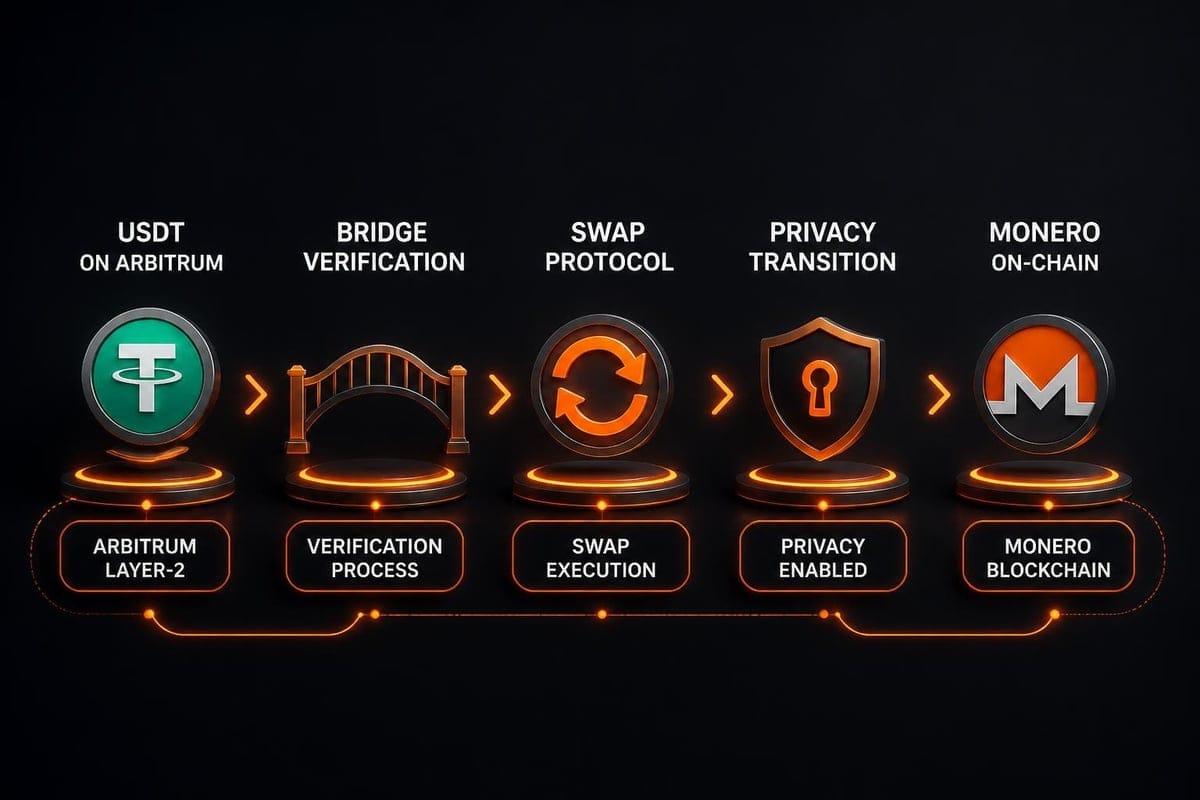
This matters for swaps because any service executing USDT Arbitrum to Monero conversions needs either direct support for Arbitrum deposits or requires you to bridge tokens first. Direct support means the swap service monitors Arbitrum's network, validates your deposit on layer-2, and initiates the Monero payout. Without direct support, you'll bridge USDT back to Ethereum mainnet, then swap to XMR from there.
Arbitrum Token Bridge Mechanics
The Arbitrum token bridge uses a lock-and-mint mechanism. Your USDT on Arbitrum represents tokens locked in the L1 gateway contract. When bridging out, you burn the Arbitrum tokens and unlock the equivalent amount on Ethereum. The process takes roughly 7 days for withdrawals due to the challenge period built into optimistic rollups.
That withdrawal delay creates friction for anyone wanting fast USDT Arbitrum to Monero conversions. Waiting a week to access liquidity defeats the purpose of using layer-2 networks. Services that accept Arbitrum deposits directly solve this by taking on the bridge timing risk themselves. They credit your swap immediately and handle the delayed withdrawal in the background.
Key bridge considerations:
- Withdrawal delay: ~7 days from Arbitrum to Ethereum mainnet
- Gas costs: Cheaper on Arbitrum, but still present
- Bridge contracts: Centralized trust in Offchain Labs infrastructure
- Fast exit options: Third-party liquidity providers offer quick exits for a fee
Direct Swap Routes for USDT Arbitrum to Monero
Non-custodial swap services that support both Arbitrum and Monero provide the cleanest path. You deposit USDT on the Arbitrum network, the service locks it, and XMR appears in your Monero wallet. The entire process happens without creating an account or submitting identification documents.
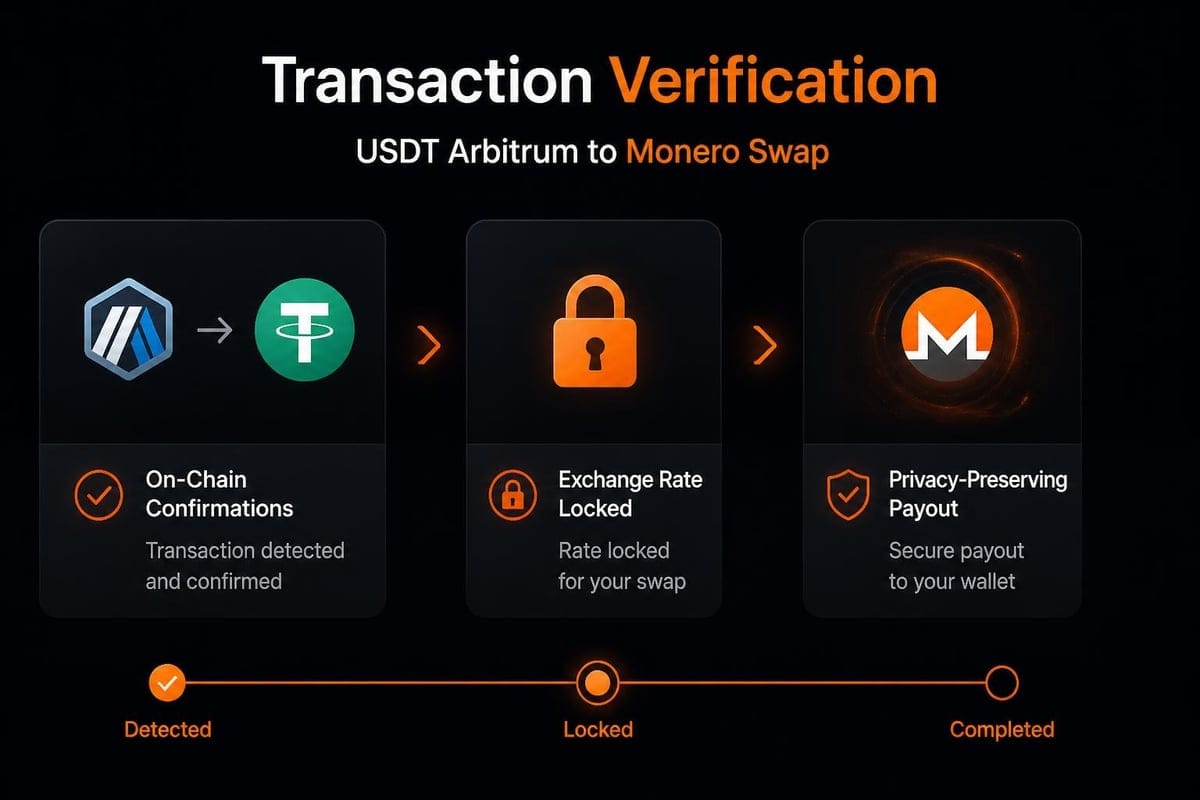
MoneroSwap's USDT to XMR swap handles Arbitrum USDT alongside other networks. The platform generates a unique deposit address, monitors the Arbitrum network for your transaction, and releases Monero once confirmations complete. Because it's non-custodial, you control the destination wallet and the service never holds your private keys.
| Swap Method | Time to Complete | Privacy Level | Technical Complexity |
|---|---|---|---|
| Direct swap service | 15-45 minutes | High (no KYC) | Low (one transaction) |
| Bridge then swap | 7+ days | Medium (chain analysis possible) | Medium (multiple steps) |
| Centralized exchange | 1-2 hours | Low (KYC required) | Low (simple interface) |
| Atomic swap protocol | 30-90 minutes | Highest (trustless) | High (technical setup) |
Choosing a Swap Provider
Evaluate swap services based on their technical architecture, not marketing claims. Open-source platforms allow you to verify the code matches their privacy promises. Tor compatibility prevents IP address leakage. No registration requirement means no email or personal data stored.
Check which specific networks a service supports. Some platforms list "USDT" without specifying chains. Others explicitly support ERC-20, BEP-20, TRC-20, and layer-2 variants. Confirm Arbitrum appears in the supported network list before initiating a swap.
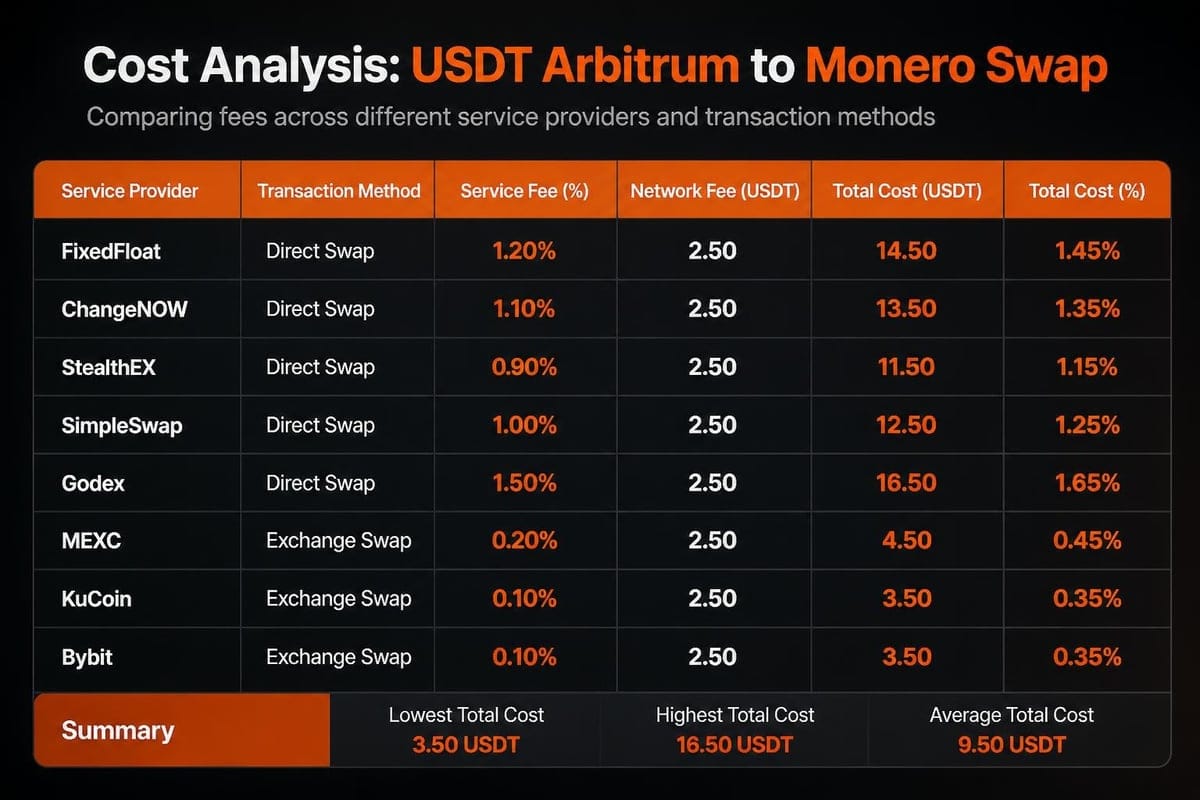
Pricing structures vary. Some services charge a percentage fee (typically 0.5-2%), others add spread to the exchange rate, and many combine both approaches. Calculate the total cost including network fees for the Arbitrum transaction and potential Monero mining fees.
Technical Process Walkthrough
Executing USDT Arbitrum to Monero through a non-custodial service follows a consistent pattern. The exact interface differs by platform, but the underlying steps remain similar.
Step-by-step swap process:
- Select USDT (Arbitrum network) as source currency
- Enter Monero as destination currency
- Input the amount you want to convert
- Provide your XMR wallet address (never share view keys)
- Review exchange rate and total fees
- Send USDT to the provided Arbitrum address
- Wait for Arbitrum network confirmations (typically 1-2 minutes)
- Monitor swap progress through provided transaction ID
- Receive XMR in your wallet (10-20 confirmations recommended)
The Arbitrum transaction itself requires gas in ETH. Keep a small amount of ETH on Arbitrum to pay transaction fees, usually $0.05-0.50 depending on network congestion. Without ETH for gas, your USDT remains stuck even though you hold it.
Handling Failed or Stuck Swaps
Swaps fail for predictable reasons. Insufficient gas causes the Arbitrum transaction to fail before reaching the swap service. Incorrect destination addresses result in lost funds since Monero transactions are irreversible. Network congestion delays confirmations beyond the quoted exchange rate window.
Most reputable services implement refund mechanisms. If the swap cannot complete, they return USDT to your originating address minus network fees. Some platforms offer recovery options for transactions that encounter technical issues mid-process.
Similar to stuck Monero transactions, delayed swaps typically resolve as networks clear backlogs. Patience prevents compounding errors. Avoid sending multiple transactions to "speed up" a swap that's already processing.
Privacy Considerations for Cross-Chain Swaps
Converting USDT Arbitrum to Monero improves privacy but doesn't eliminate all traces. The Arbitrum transaction remains permanently visible on the layer-2 network. Your wallet address, transaction amount, and timestamp appear in public block explorers. Anyone who knows your Arbitrum address can see you sent USDT to a particular destination.
The privacy gain happens on the Monero side. Once XMR enters your wallet, amounts and recipient addresses become opaque. Ring signatures, stealth addresses, and RingCT hide transaction details from blockchain observers. The Monero atomic swap research explains how the protocol's privacy features extend to cross-chain exchanges.
Privacy best practices:
- Use a fresh Arbitrum address for each swap
- Never reuse Monero addresses across multiple swaps
- Access swap services through Tor to prevent IP logging
- Avoid centralized exchanges that link identities to transactions
- Wait for sufficient Monero confirmations before spending (10+ blocks)
Blockchain Analysis Limitations
Chain surveillance firms track USDT movements across networks including Arbitrum. They cluster addresses, identify exchange deposits, and flag suspicious patterns. A 2024 Chainalysis report documented increased monitoring of layer-2 networks as adoption grows.
The analysis breaks at the swap point. Observers see USDT leave your Arbitrum address and arrive at a swap service. They cannot determine the Monero amount received, the destination wallet, or whether you control that XMR. This creates plausible deniability and severs the transaction graph.
Academic research on Monero P2P exchanges identified deanonymization risks when users expose metadata through repeated patterns or linked services. Avoid connecting the same email, payment method, or personal identifier to both your transparent and private chain activities.
Alternative Approaches to USDT Arbitrum Conversions
Centralized exchanges offer the fastest USDT Arbitrum to Monero conversion but require identity verification. You deposit USDT, complete KYC, trade to XMR, and withdraw to your wallet. The exchange knows your identity, sees both sides of the transaction, and reports to regulators in most jurisdictions.
Decentralized exchanges (DEXs) on Arbitrum let you swap USDT for other tokens without KYC. You could convert USDT to ETH on a DEX, then use ETH in a ETH to XMR swap. This adds steps and trading fees but provides routing flexibility if direct USDT Arbitrum to Monero services are unavailable.
Atomic Swap Protocol Development
True trustless swaps between EVM chains like Arbitrum and Monero remain under development. The Monero community CCS proposal for EVM atomic swaps outlines ongoing work to enable direct protocol-level exchanges without intermediary services.
Current atomic swap implementations work for Bitcoin to Monero but face technical constraints with Ethereum-based chains. Monero's UTXO model and privacy features create cryptographic challenges when coordinating with account-based networks. The MRL research on cross-chain swaps details these limitations and potential solutions.
When mature, atomic swaps would let you execute USDT Arbitrum to Monero conversions entirely on-chain. No swap service sees your transaction. No custodial risk exists. No KYC applies. The technology requires sophisticated cryptographic protocols and significant development before reaching production readiness.
Network Fee Optimization
Arbitrum's layer-2 design dramatically reduces transaction costs compared to Ethereum mainnet. A USDT transfer on Arbitrum costs $0.05-0.50 versus $5-50 on mainnet during typical conditions. This makes smaller swaps economically viable.
Time your transactions during low network activity for minimal fees. Arbitrum processes blocks continuously but gas prices fluctuate based on demand. Late-night UTC hours typically see reduced congestion and cheaper transactions.
Fee breakdown for typical swap:
| Fee Component | Estimated Cost | Who Receives It |
|---|---|---|
| Arbitrum gas fee | $0.10-0.50 | Arbitrum validators |
| Swap service fee | 0.5-2% of amount | Swap platform |
| Monero network fee | $0.01-0.05 | XMR miners |
| Price spread | 0.1-0.5% | Liquidity providers |
The swap service fee usually dominates total costs on larger amounts. A 1.5% fee on a $1,000 swap costs $15, far exceeding network fees. Compare multiple services before committing to significant conversions.
Security Checklist for Arbitrum to Monero Swaps
Verify the swap service operates transparently before sending funds. Open-source code on GitHub allows independent security audits. Community discussion on forums and social media reveals user experiences. Avoid platforms with anonymous teams, no public code, or suspiciously high fees.
Test small amounts first. Send $20-50 worth of USDT Arbitrum before committing thousands. Confirm the XMR arrives in your wallet and the exchange rate matches the quote. This discovery transaction costs minimal fees but prevents catastrophic losses from fraudulent services.
Pre-swap verification steps:
- Confirm the service supports Arbitrum USDT specifically
- Check that your Monero wallet address is correct (test with small amount first)
- Verify you have ETH for gas on Arbitrum
- Review current exchange rates on multiple platforms
- Ensure your Monero wallet is synced and ready to receive
Double-check destination addresses. Monero addresses are long alphanumeric strings (95-106 characters) starting with "4" or "8". A single character error sends XMR to an unrecoverable address. Copy-paste and verify the first and last characters at minimum.
Browser extensions and clipboard managers can inject malicious addresses. Manually compare several characters in the middle of the address, not just the beginning and end. Hardware wallet users should verify the address on the device screen, not just the computer display.
Regulatory and Compliance Context
USDT Arbitrum to Monero swaps exist in a complex regulatory environment. Most jurisdictions treat cryptocurrency swaps as taxable events. You owe capital gains tax on any appreciation between acquiring USDT and swapping it for XMR. The non-custodial nature of the swap doesn't exempt you from tax obligations.
Privacy-focused swaps aren't illegal in most regions but they attract regulatory scrutiny. Financial authorities view Monero's privacy features with concern due to potential money laundering use. Using non-KYC swap services is legal for individuals in the US, EU, and most jurisdictions, but businesses face stricter requirements.
Exchange operators implementing KYC bypass regulations face legal risks. The service provider bears compliance burden, not individual users. Reputable non-custodial platforms operate in jurisdictions with favorable legal frameworks and limit services to permitted regions.
Comparing Multi-Chain Stablecoin Options
USDT exists on multiple networks beyond Arbitrum. You could hold USDT on Ethereum mainnet, Binance Smart Chain (BEP-20), Tron (TRC-20), or other layer-2s like Base. Each network offers different tradeoffs for USDT Arbitrum to Monero conversions.
USDT BEP-20 to XMR swaps might have lower fees due to Binance Smart Chain's cheaper transactions. However, BSC involves more centralization risk through validator control. Arbitrum provides stronger decentralization guarantees through its connection to Ethereum's security model.
The Arbitrum bridge documentation explains migration paths between networks. If you hold USDT on Ethereum mainnet, bridging to Arbitrum before swapping to XMR saves on fees. The bridge transaction costs less than a direct Ethereum mainnet swap would.
| Network | Typical Fee | Decentralization | Swap Support |
|---|---|---|---|
| Ethereum mainnet | $5-50 | Highest | Excellent |
| Arbitrum | $0.10-0.50 | High | Good |
| Binance Smart Chain | $0.20-0.80 | Medium | Excellent |
| Tron | $0.50-2.00 | Medium | Good |
Consider total journey costs when choosing networks. A cheaper bridge to Arbitrum followed by a swap might cost less than a direct swap from Ethereum mainnet, even accounting for the extra transaction.
Monero Wallet Considerations
Receive USDT Arbitrum to Monero swaps only in wallets you control. Web wallets hosted by third parties introduce custodial risk. The service could freeze your account, require KYC retroactively, or suffer a security breach exposing your XMR.
Desktop wallets like Monero GUI or CLI provide full control. Mobile wallets such as Monerujo (Android) or Cake Wallet (iOS) offer convenience with reasonable security. Hardware wallet support for Monero exists through Ledger devices, though the implementation differs from Ethereum tokens.
Your Monero wallet needs to be synced before receiving a swap. Synchronization downloads and verifies the blockchain history, which can take hours on first setup. Plan ahead and ensure your wallet is ready before initiating USDT Arbitrum to Monero conversions.
Timing and Market Volatility Management
Exchange rates fluctuate during the swap process. You lock in a rate when initiating the transaction, but most services allow 10-30 minutes for the rate guarantee. If your Arbitrum confirmation takes longer due to network issues, the rate might expire and recalculate at current market prices.
Volatile market conditions amplify this risk. A rapid XMR price movement could mean you receive significantly less than expected if the rate expires. Fast Arbitrum confirmations (typically 1-2 minutes) minimize this window compared to slower chains.
Some services offer fixed-rate swaps that guarantee the output amount regardless of how long confirmations take. Others use floating rates that adjust to current market conditions throughout the process. Fixed rates charge a slight premium but eliminate timing risk.
Building a Private Financial Stack
Converting USDT Arbitrum to Monero forms part of a broader privacy strategy. You might acquire USDT through P2P trading, earn it from crypto-native work, or receive it as payment for goods and services. Swapping to XMR breaks the chain analysis trail before using funds.
The reverse path matters too. XMR to USDT conversions let you move private funds back to transparent networks when needed. This might be necessary for paying bills, buying goods from merchants who don't accept XMR, or moving value to exchanges that delisted privacy coins.
Layer-2 networks like Arbitrum reduce costs for frequent conversions. A trader moving between private and transparent assets multiple times per month saves significantly by using Arbitrum instead of Ethereum mainnet. The cost difference compounds over repeated transactions.
Think of USDT Arbitrum as your efficient transparent layer and Monero as your private store of value. Convert between them based on transaction needs. Use USDT for interacting with DeFi, buying assets on centralized platforms, or anything requiring transparent proof of funds. Hold XMR for savings, private payments, and transactions where you value financial confidentiality.
Converting USDT from Arbitrum to Monero preserves privacy while maintaining access to both transparent DeFi ecosystems and confidential transactions. Non-custodial swap services provide the cleanest path by avoiding identity requirements and blockchain analysis exposure. If you're looking to execute USDT Arbitrum to Monero swaps without KYC or account registration, MoneroSwap offers open-source, privacy-focused conversions with Tor compatibility and no log retention throughout the entire process.
Swap into or out of Monero, no KYC
MoneroSwap is a no-KYC Monero swap with no account, no KYC, and no logs. Open source and available over Tor. Verify every claim, then swap BTC to Monero, ETH to Monero, USDT to Monero, or see all pairs. New here? Start with the FAQ.
← All guides