Trade USDC for XMR: Complete Guide (2026)
You can trade USDC for XMR through non-custodial swap services that execute the exchange directly from your wallet without requiring accounts, KYC verification, or custody of your funds. These services work across multiple blockchain networks where USDC exists (Ethereum mainnet, Base, Arbitrum, BNB Chain) and route the transaction to deliver Monero to your wallet address while you retain full control throughout the process.
The mechanics differ from typical exchange trades because USDC lives on smart-contract platforms while Monero operates on a privacy-focused blockchain without native smart contract support. This fundamental incompatibility means you cannot execute a trustless atomic swap between USDC and XMR using the same cryptographic techniques that work for Bitcoin-Monero pairs. Instead, modern swap services employ intermediate settlement mechanisms or rely on liquidity providers who assume the cross-chain execution risk.
Why People Trade USDC for XMR
Stablecoin holders convert to Monero for several practical reasons. USDC maintains a 1:1 peg with the US dollar, which makes it useful for preserving value during volatile market conditions, but every USDC transaction on Ethereum or other public ledgers creates a permanent, transparent record linking addresses and amounts.
Privacy needs drive many conversions:
- Merchants who accept USDC but want to store value privately
- Users who received payment in stablecoins and prefer opaque balance storage
- Traders repositioning portfolio allocations away from transparent assets
- Individuals in restrictive jurisdictions seeking censorship-resistant money
Monero solves the transparency problem through ring signatures, stealth addresses, and RingCT (Ring Confidential Transactions). When you trade USDC for XMR, the resulting Monero balance becomes unlinkable to the source stablecoin address. No observer can determine how much XMR you hold or trace future spending patterns.
The tax treatment varies by jurisdiction. In the United States, converting USDC to XMR constitutes a taxable disposal of property. The IRS treats stablecoins as property for tax purposes, and the IRS guidance on digital asset reporting requires calculating capital gains or losses based on your cost basis in the USDC and its fair market value at the moment of exchange. Most holders acquire USDC at roughly $1.00 per token, so gains or losses typically remain minimal unless purchased during brief de-peg events.
Network Selection for USDC
USDC exists as a native token on multiple blockchain networks. Your choice affects transaction fees, confirmation speed, and which swap services support the route.
| Network | Typical Fee (2026) | Confirmation Time | Swap Support |
|---|---|---|---|
| Ethereum mainnet | $2-15 | 1-2 minutes | Universal |
| Base | $0.01-0.05 | 30 seconds | Growing |
| Arbitrum | $0.05-0.20 | 30 seconds | Common |
| BNB Chain | $0.10-0.50 | 3 seconds | Widespread |
| Polygon | $0.01-0.05 | 2 seconds | Moderate |
Ethereum mainnet carries the highest fees but offers the deepest liquidity and broadest compatibility. If you're holding USDC on Base or Arbitrum, you'll find dedicated swap routes that work directly with those networks rather than forcing a bridge to mainnet first.
BNB Chain presents an interesting middle ground with reasonable fees and fast finality. Services like USDC BEP20 to XMR swaps handle the BNB Chain variant of USDC, which operates under different token standards than the ERC-20 Ethereum version but maintains the same dollar backing.
How Non-Custodial USDC-to-XMR Swaps Work
Non-custodial services don't take possession of your coins. You send USDC from your wallet to a time-locked smart contract or designated address, the service detects the deposit, and Monero gets sent to your XMR address from the service's liquidity pool.
The process breaks down into distinct steps:
- Initiate the swap by specifying the USDC amount and providing your Monero wallet address
- Receive a deposit address (often a smart contract on Ethereum/Base/Arbitrum or a standard address on BNB Chain)
- Send USDC from your wallet using MetaMask, Trust Wallet, or any compatible wallet
- Wait for confirmation (network-dependent, 1-12 block confirmations typical)
- Service detects deposit and initiates the XMR transfer from its reserves
- Receive XMR in your Monero wallet within 2-20 minutes depending on service responsiveness
The technical challenge emerges because USDC and XMR cannot interact directly. Research into atomic swap protocols for dissimilar blockchains explores cryptographic techniques for trustless cross-chain transfers, but practical USDC-XMR swaps in 2026 still rely on a trusted intermediary or liquidity provider to bridge the gap.
Some services use an intermediate asset (like converting USDC → BTC → XMR through two sequential swaps), while others maintain XMR liquidity pools and execute the conversion in a single user-facing transaction. The single-transaction approach proves faster and simpler for users who don't want to manage intermediate assets.
Trust Models and Security Considerations
When you trade USDC for XMR through a swap service, you're trusting the service to complete the second leg of the transaction after you've sent USDC. Different services mitigate this trust requirement differently.
Escrow-based services lock your USDC in a smart contract that releases funds to the operator only after proof of XMR delivery appears on-chain. The challenge is that Monero's privacy features make on-chain proof difficult to verify programmatically without revealing transaction details to a third party.
Reputation-based services operate openly, maintain consistent uptime, and build trust through volume and history. The Monero community maintains a list of trusted options that includes both centralized exchanges and non-custodial alternatives.
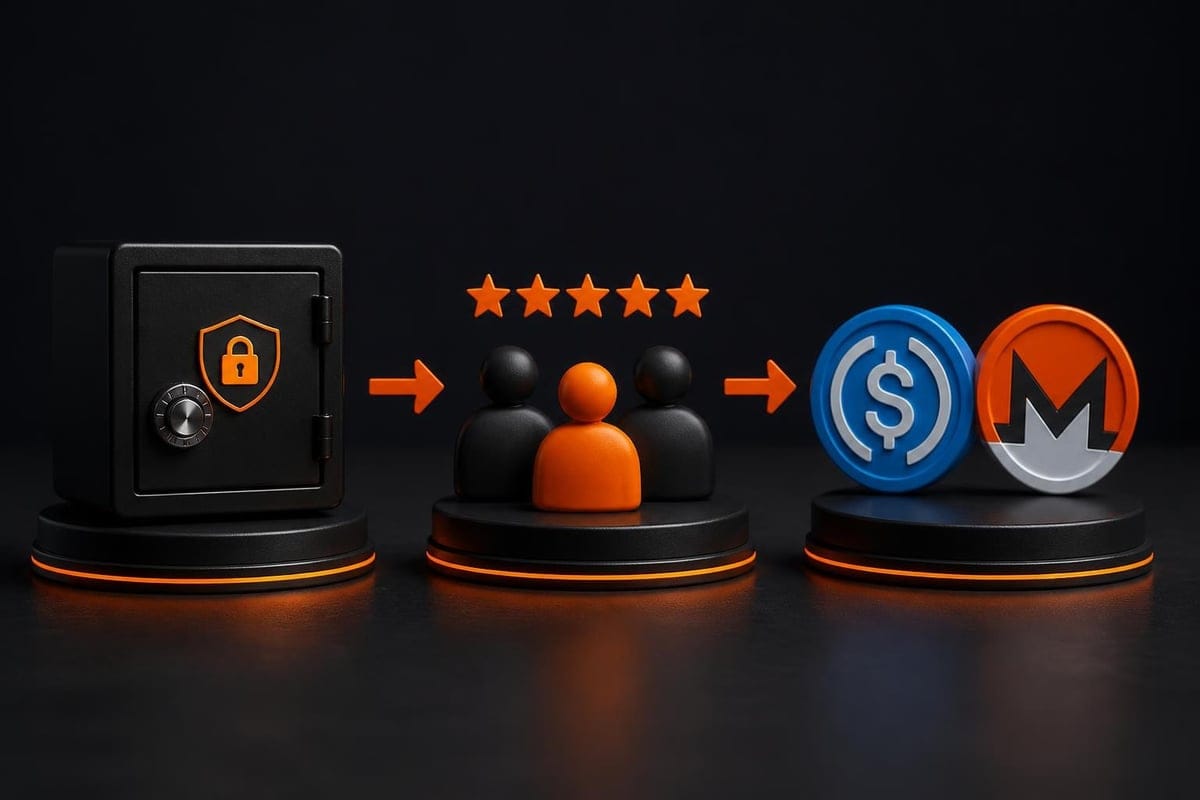
Open-source implementations provide another trust layer. When swap code is publicly auditable, you can verify the service operates as claimed. Projects working on atomic swap protocols between Bitcoin and Monero have published reference implementations, and some of these techniques are being adapted for USDC-XMR routes through intermediate conversions.
Practical Steps to Trade USDC for XMR
The actual process requires three prerequisites: USDC in a compatible wallet, a Monero wallet address to receive XMR, and access to a swap service.
Preparing Your Wallets
Your USDC must be in a non-custodial wallet you control. Exchange-held USDC doesn't work because you cannot send directly from an exchange internal balance to a swap service. Move USDC to MetaMask, Rainbow, Coinbase Wallet, Trust Wallet, or any self-custody option that lets you execute token transfers.
For Monero, you need a wallet that generates standard XMR addresses. Cake Wallet, Monerujo (Android), Feather Wallet (desktop), and the official Monero GUI all work. Generate a new wallet if you don't have one, then copy the primary address (starts with a 4).
Check your USDC balance and network. If you hold USDC on Coinbase and withdraw to your wallet, you can select which network during withdrawal. Choose Ethereum mainnet for maximum compatibility or Base for minimal fees if your swap service supports it.
Executing the Swap
Navigate to a non-custodial swap service that supports USDC-to-XMR conversion. Services like MoneroSwap's USDC to XMR route provide a simple interface where you enter the amount and destination address.
Enter your details:
- USDC amount (minimum varies by service, typically 20-100 USDC)
- Monero wallet address (verify carefully; XMR transactions cannot be reversed)
- Optional refund address (if swap fails, USDC returns here)
The service calculates the exchange rate including any fees and shows the expected XMR you'll receive. Rates fluctuate based on market conditions and liquidity availability. The displayed rate remains fixed for a brief window (usually 10-15 minutes) to prevent slippage during confirmation delays.
You'll receive a deposit address or smart contract address. Open your USDC wallet, create a new transaction to that address, and send the exact amount specified. Do not send from an exchange; many swap services reject exchange-originated transactions due to compliance concerns.
Monitoring and Receiving
After sending USDC, the swap service monitors the blockchain for your deposit. Ethereum transactions require 12 confirmations (about 2-3 minutes), Base needs 30-50 confirmations (around 1 minute), and BNB Chain typically wants 15 confirmations (under 1 minute).
Once confirmed, the service initiates the XMR transfer. Monero transactions appear in your wallet within 1-2 blocks (about 2-4 minutes) but need 10 confirmations (roughly 20 minutes) before the wallet considers them spendable.
If something goes wrong (wrong address, network issues, liquidity problems), the service's refund mechanism activates. Most non-custodial services automatically refund USDC to your original sending address or the specified refund address if the XMR transfer cannot complete.
Some swaps take longer than expected due to Monero network congestion. If your Monero transaction appears stuck or unconfirmed, the issue usually resolves automatically as new blocks are mined and the transaction pool clears.
Comparing Swap Services and Routes
Not all services offer identical rates, speeds, or privacy properties. Centralized exchanges that support both USDC and XMR provide one option, but they require account registration, KYC documents (passport or driver's license plus selfie), and maintain permanent records of your trades.
Non-custodial alternatives eliminate those requirements. You connect your wallet, execute the swap, and receive XMR without creating accounts or submitting identity documents. The trade-off is slightly wider spreads (the difference between buy and sell prices) because non-custodial services cannot access the deep order books centralized exchanges maintain.
Comparison of swap approaches:
| Method | Privacy Level | Required Info | Typical Spread | Speed |
|---|---|---|---|---|
| Centralized exchange | Low (full KYC) | ID, selfie, proof of address | 0.1-0.3% | Instant |
| Non-custodial service | High (no accounts) | Wallet address only | 0.5-2% | 5-20 minutes |
| Atomic swap (experimental) | Highest (trustless) | Wallet addresses | Variable | 30-60 minutes |
Centralized exchanges provide the tightest spreads but the worst privacy. Every trade connects your verified identity to specific wallet addresses for both USDC (sent in) and XMR (withdrawn). The exchange stores this data indefinitely and may share it with regulators or comply with subpoenas.
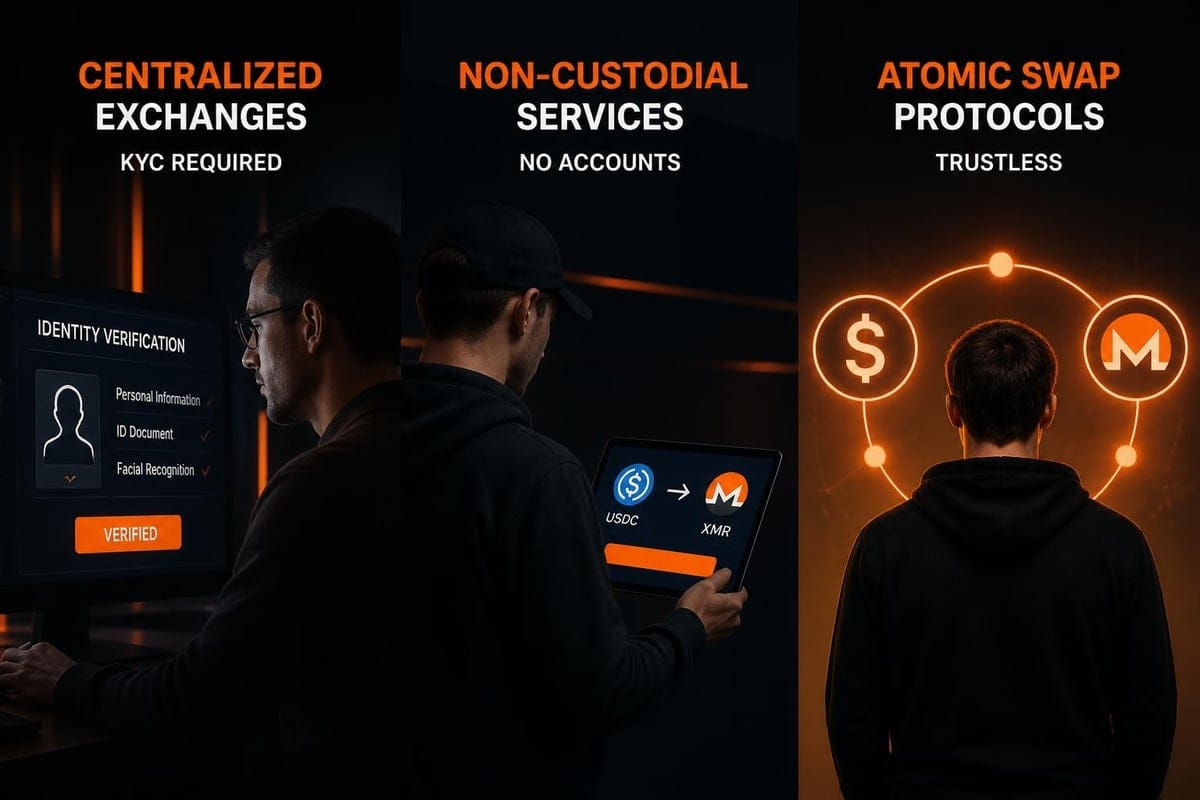
The research into atomic cross-chain swap security and design explores how to eliminate trust entirely through cryptographic protocols that guarantee either both sides of the swap complete or both sides refund. While this works for Bitcoin-Monero pairs (see AthanorLabs' protocol documentation), extending it to USDC requires additional complexity because USDC exists on multiple networks and relies on smart contracts rather than base-layer protocol features.
Network-Specific Considerations
If you hold USDC on Arbitrum rather than Ethereum mainnet, you'll want a service that supports USDC Arbitrum to XMR swaps directly. Bridging from Arbitrum to Ethereum mainnet first adds an extra step, additional fees, and a 7-day withdrawal window if using the canonical bridge.
Base network users benefit from extremely low fees (often under $0.02 per transaction) but slightly less liquidity depth. Most major non-custodial services added Base support throughout 2025-2026 as adoption grew.
For users in regions where Tor access matters, services that provide onion routing or native Tor compatibility enable entirely anonymous swaps. You can access these services through the Tor browser without revealing your IP address, send USDC from a wallet connected through Tor, and receive XMR without any network observer connecting the transaction to your location.
Fee Structure and Economics
When you trade USDC for XMR, you pay three types of costs: network fees (gas), the service's spread or commission, and potentially exchange rate slippage if the market moves during your transaction.
Network fees depend on which blockchain hosts your USDC. Ethereum mainnet transactions currently cost $2-15 in gas depending on network congestion. Base transactions run under $0.05. BNB Chain sits in the $0.10-0.50 range. You pay this fee when sending USDC to the swap service's deposit address.
Service spreads represent the difference between the mid-market USDC/XMR rate and the rate you receive. Non-custodial services typically build in a 0.5-2% spread to cover operational costs, liquidity risk, and profit margins. A $1,000 USDC swap with a 1% spread costs $10 in service fees.
Slippage occurs when the XMR price moves between when you initiate the swap and when it executes. Most services lock in the rate for 10-15 minutes, so slippage only affects you if you take longer than that window to send USDC. In stable market conditions, slippage is negligible for retail-sized trades ($100-$10,000).
The total cost to trade USDC for XMR might look like this:
- Starting amount: 1,000 USDC
- Ethereum gas fee: $8
- Service spread (1.2%): $12
- Net USDC swapped: $980
- XMR received at $152/XMR: 6.447 XMR
- Effective cost: 2% of starting amount
Compare this to centralized exchange routes where you'd pay a 0.2% trading fee but must first deposit USDC (possible free transfer within some exchange ecosystems), then withdraw XMR (usually 0.0001-0.001 XMR fixed fee). The monetary cost might be lower, but you've created permanent identity records and given the exchange custody during the process.
Multi-Hop Swaps and Alternatives
Some users trade USDC for XMR indirectly through intermediate assets. Common paths include USDC → ETH → XMR or USDC → BTC → XMR. This approach makes sense when direct USDC-XMR liquidity is thin or when you want to take advantage of better rates on high-volume pairs.
The Monero community's merchant and exchange list includes decentralized options where you might find better USDT-XMR or BTC-XMR liquidity than USDC-XMR. If you're willing to manage two swaps, convert USDC to USDT (usually near-zero spread since both are dollar stablecoins), then trade USDT for XMR through a service with deeper USDT liquidity.
Services offering USDT to XMR swaps often maintain larger liquidity pools because USDT has higher trading volume than USDC across the broader crypto market. The combined spread from USDC → USDT → XMR might actually be lower than a direct USDC → XMR route if liquidity imbalances are significant.
Another alternative involves decentralized exchange (DEX) aggregators that route your USDC through optimal paths automatically. These services check multiple liquidity sources and execute the trade through whichever route offers the best effective rate after fees.
Privacy Chain Analysis
When you trade USDC for XMR, the USDC transaction remains transparent on whichever network you used. Ethereum, Base, Arbitrum, and BNB Chain all maintain public ledgers where anyone can see that your address sent X amount of USDC to the swap service's address.
The privacy benefit emerges on the Monero side. Once you receive XMR, the link breaks. Observers can see USDC left your address but cannot determine:
- How much XMR you received (ring signatures hide amounts)
- Which XMR address received the funds (stealth addresses break address linkage)
- How you spend the XMR later (ring signatures mix your transaction with others)
This one-way privacy barrier makes the USDC-to-XMR trade valuable for users who need transparent asset exposure to convert into opaque storage. You're not hiding the fact that you traded; you're preventing future surveillance of how you hold and spend the resulting value.
For maximum privacy, use a fresh USDC address funded through a DEX or atomic swap rather than a KYC exchange withdrawal. Trade that USDC for XMR through a non-custodial service accessed via Tor. The resulting XMR has no direct link to your identity or prior transaction history.
Technical Implementation Details
Developers building applications that trade USDC for XMR face several technical challenges. The cryptographic incompatibility between EVM-based smart contract platforms and Monero's privacy-focused transaction structure prevents direct atomic swaps without trusted components.
Current implementations use one of three approaches:
- Custodial bridges: Service controls both USDC and XMR wallets, executes trades through internal accounting
- Hashed timelock contracts (HTLC) with trusted oracle: Smart contract locks USDC until oracle confirms XMR delivery
- Liquidity provider model: Service maintains XMR reserves and executes instant swaps, managing price risk internally
The Monero community's CCS proposal on maturing atomic swap ecosystems outlines work to expand trustless swap capabilities, but progress focuses primarily on Bitcoin-Monero pairs due to their cryptographic compatibility (both use elliptic curve signatures accessible through adaptor signatures).
Extending these techniques to USDC requires either wrapping XMR on an EVM chain (negating privacy benefits) or building complex multi-signature schemes that can verify Monero transaction keys within Ethereum smart contracts. Research continues, but production systems in 2026 rely on semi-trusted models where the service's reputation and open-source code provide assurance rather than pure cryptographic guarantees.
Trading USDC for XMR provides a practical path from transparent stablecoins to privacy-preserving cryptocurrency without the identity verification and surveillance that centralized exchanges impose. Non-custodial services execute these swaps quickly and with reasonable fees while preserving user anonymity throughout the process. If you need to trade USDC for XMR without creating accounts or submitting documents, MoneroSwap handles the conversion directly from your wallet with full Tor compatibility and no transaction logs, letting you move from transparent stablecoins to private value storage in minutes.
Swap into or out of Monero, no KYC
MoneroSwap is a non-custodial way to swap Monero with no account, no KYC, and no logs. Open source and available over Tor. Verify every claim, then swap BTC to Monero, ETH to Monero, USDT to Monero, or see all pairs. New here? Start with the FAQ.
← All guides