What Is a Swap Exchange and How Does It Work?
A swap exchange is a platform or protocol that enables direct cryptocurrency-to-cryptocurrency trades without requiring users to deposit funds into a custodial account. Instead of matching buy and sell orders through a traditional order book, a swap exchange uses automated market makers (AMMs), atomic swap protocols, or hybrid routing to execute trades peer-to-peer or against liquidity pools. These systems let you exchange BTC for XMR, ETH for USDT, or any supported pair without surrendering control of your private keys during the transaction.
The defining feature of a swap exchange is that it eliminates the middleman custody step. Traditional exchanges hold your coins in their wallets while you trade. A swap exchange coordinates the transfer directly between your wallet and either another user's wallet or a smart contract pool. That distinction matters for privacy, security, and regulatory exposure.
How Swap Exchanges Execute Trades
Most swap exchanges fall into two broad categories: on-chain AMM platforms and cross-chain atomic swap services. AMM-based exchanges like Uniswap run entirely on a single blockchain and rely on liquidity pools where users deposit token pairs. When you initiate a token swap, the smart contract calculates the exchange rate based on pool reserves and executes the trade instantly. Price slippage and fees depend on pool depth and transaction size, but the process is deterministic and transparent.
Cross-chain atomic swap protocols operate differently. They use hashed timelock contracts (HTLCs) to lock funds on two separate blockchains and release them simultaneously only when both parties fulfill cryptographic conditions. If either side fails to complete the swap within the timelock window, the funds return to their original owners. This mechanism ensures trustless execution across chains that don't natively communicate.
On-Chain AMM Mechanics
The Uniswap protocol introduced concentrated liquidity, which lets liquidity providers allocate capital within specific price ranges rather than across the entire curve. This innovation improved capital efficiency and reduced slippage for traders. When you swap on an AMM, the contract adjusts the pool ratio according to a constant-product formula (x × y = k). Each trade shifts the balance, which changes the marginal price for the next transaction.
Key characteristics of AMM swap exchanges:
- Liquidity pools replace order books
- Anyone can become a liquidity provider
- Fees are distributed proportionally to pool shares
- Price discovery happens algorithmically, not through limit orders
- Front-running and sandwich attacks remain risks due to public mempools
The economic design of AMMs incentivizes liquidity provision through trading fees, but providers face impermanent loss when asset prices diverge. Concentrated liquidity exacerbates this risk because narrow ranges amplify exposure to volatility. Still, AMMs have become the dominant swap model for ERC-20 tokens and most Ethereum-compatible chains.

Atomic Swaps for Cross-Chain Privacy
Atomic swaps solve a harder problem: exchanging assets across blockchains that can't run shared smart contracts. Bitcoin and Monero, for example, operate on entirely different codebases and consensus rules. An atomic swap between BTC and XMR requires both chains to support compatible timelock and hashing functions. Recent research on secure atomic swap designs addresses lingering issues around miner collusion and incentive misalignment that can make certain swap configurations vulnerable.
The swap process involves four on-chain transactions. Alice locks BTC in a contract controlled by a secret hash. Bob locks XMR in a similar contract referencing the same hash. Alice reveals the secret to claim Bob's XMR, which simultaneously allows Bob to claim Alice's BTC using the now-public secret. If Alice never reveals the secret, both timelocks expire and funds revert. The coordination happens off-chain through peer-to-peer messaging or a coordination layer like a swap exchange interface.
Privacy-focused swap exchanges that facilitate BTC to XMR or XMR to BTC trades rely on this atomic swap foundation. Monero's privacy properties mean that once the swap completes, the XMR side is fully confidential. No observer can trace the amount, sender, or recipient on the Monero blockchain. This makes atomic swap exchanges especially valuable for users who prioritize transaction privacy over speed or convenience.
Coordination Layers and Swap Protocols
While atomic swaps are trustless at the protocol level, someone needs to match counterparties and provide liquidity. Some swap exchanges operate as decentralized order books where makers post offers and takers accept them. Others maintain their own liquidity reserves and act as the counterparty for every trade, effectively functioning as a non-custodial market maker.
A non-custodial swap exchange doesn't take possession of user funds, but it does coordinate the multi-step swap process. The service monitors both blockchains, verifies that contracts are correctly constructed, and relays signed transactions. If the exchange goes offline mid-swap, the timelock ensures funds aren't lost. Users can always recover by manually claiming the contract expiration.
| Feature | AMM Swap Exchange | Atomic Swap Exchange |
|---|---|---|
| Custody model | Non-custodial pool | Fully non-custodial |
| Speed | Instant (single tx) | Minutes to hours (multi-tx) |
| Cross-chain support | Bridges or wrapped tokens | Native asset swap |
| Privacy | On-chain transparent | Can preserve privacy |
| Slippage | Pool-dependent | Fixed rate or negotiated |
| Smart contract risk | Yes (pool contract) | Yes (HTLC script) |
Privacy and KYC Considerations
Traditional centralized exchanges require identity verification before allowing any trades. You submit documents, wait for approval, and trust the exchange to secure your personal data. A swap exchange bypasses this entirely because it never holds your funds. There's no regulatory obligation to collect KYC when you're not acting as a custodian or money transmitter.
Non-KYC swap exchanges operate in a gray area. They provide software that lets users coordinate trades, but they don't facilitate fiat on-ramps or off-ramps. Since both sides of the swap involve cryptocurrency, the transaction happens peer-to-peer or pool-to-peer without the exchange controlling either leg. Some jurisdictions treat this as a software service rather than a regulated financial activity.
Advantages of swap exchanges for privacy-conscious users:
- No account registration or email required
- No log retention of IP addresses or transaction metadata
- Compatible with Tor and VPN connections
- Open-source code allows independent verification
- No risk of exchange data breaches exposing user identities
Services like MoneroSwap emphasize these privacy features. The platform doesn't track users, doesn't store swap history tied to identifiable information, and runs as an onion service accessible through Tor. This design mirrors the ethos of Monero itself: financial privacy as a default, not an opt-in feature.
Technical Implementation Challenges
Building a reliable swap exchange requires solving several hard problems. Blockchains have different confirmation times, mempool behaviors, and fee markets. A swap exchange needs to estimate appropriate fees on both chains, monitor for reorganizations, and handle edge cases where one chain confirms much faster than the other.
Network congestion can break swap assumptions. If Bitcoin fees spike during the swap window, Alice might not be able to claim her XMR in time. The timelock would expire and the swap would fail, even though both parties acted honestly. Swap exchanges mitigate this by setting conservative timelock durations (often 24-48 hours), but that slows the overall process.
Cross-chain abstraction research, including work on atomicity methods for blockchain interactions, proposes new primitives that could make swaps faster and safer. These academic explorations tackle problems like chain halt scenarios, where one blockchain stops producing blocks mid-swap, and partial failure recovery when only one leg executes.
Liquidity and Pricing
Swap exchanges need liquidity to function. AMM pools get liquidity from passive providers who earn fees. Atomic swap exchanges require either a market maker willing to take the other side of every trade or a network of peer offers. Thin liquidity leads to poor pricing and long wait times.
Pricing models vary. Some exchanges calculate rates based on external oracles that aggregate data from centralized exchanges. Others use internal AMM formulas. Atomic swap platforms often offer fixed-rate swaps where the exchange locks a price for the duration of the transaction. This protects users from volatility during the multi-hour confirmation process but exposes the liquidity provider to market risk.
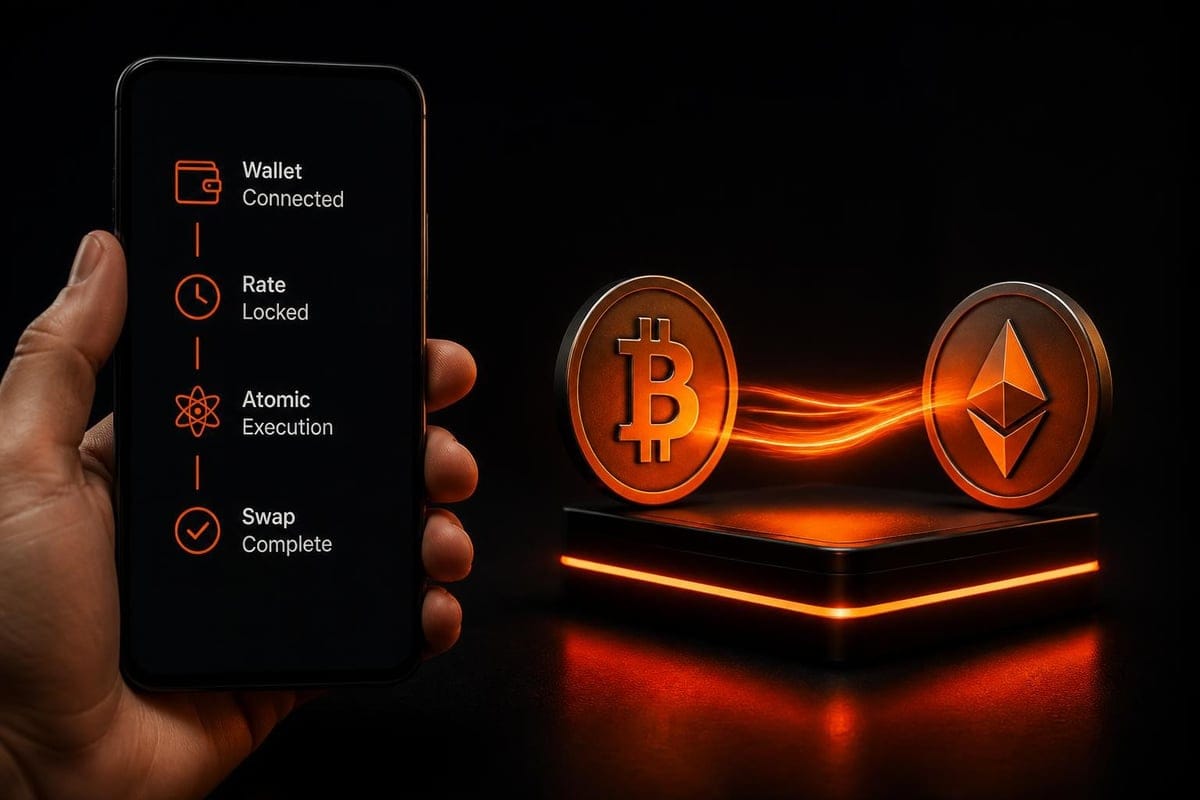
- User initiates swap and receives a rate quote
- Swap exchange locks liquidity at that rate for a time window
- User sends funds to the HTLC address
- Exchange monitors for sufficient confirmations
- Exchange releases counterparty funds once verified
- User claims received funds using the secret
This workflow combines the trustlessness of atomic swaps with the convenience of instant pricing. The exchange takes on price risk in exchange for a spread, but it never takes custody of the funds.
Swap Exchanges vs. Traditional Derivatives
The term "swap" originates in traditional finance, where it refers to derivative contracts between parties exchanging cash flows. Interest rate swaps, the most common type, let institutions exchange fixed-rate payments for floating-rate payments to manage exposure. These are bilateral contracts settled over time, often managed through ISDA master agreements.
Cryptocurrency swap exchanges share the name but operate on entirely different mechanics. A crypto swap is a spot trade, not a derivative. You're exchanging actual assets, not cash flows derived from those assets. The confusion arises because "swap" in crypto contexts simply means "exchange one thing for another," while in traditional markets it specifically denotes a derivative instrument.
Some DeFi protocols do offer crypto derivatives that resemble traditional swaps. Perpetual swap contracts on platforms like dYdX or Synthetix let traders bet on price movements without expiry dates, simulating traditional futures but with funding rate mechanisms. These are distinct from the instant asset exchange that a swap exchange provides.
Comparison of swap terminology across markets:
| Context | Definition | Settlement | Purpose |
|---|---|---|---|
| Traditional finance | OTC derivative contract | Periodic cash flows | Hedge or speculate on rates, FX |
| Cryptocurrency spot | Asset exchange transaction | Immediate or atomic | Acquire different token |
| DeFi derivatives | Synthetic exposure contract | Continuous funding or expiry | Leverage or short exposure |
Use Cases for Swap Exchanges
Privacy-conscious users form the core audience for non-custodial swap exchanges. If you hold BTC and want XMR to make confidential payments, a swap exchange lets you convert without linking your identity to the transaction. Services offering ETH to XMR or USDT to XMR conversions enable users to enter the Monero ecosystem from any major cryptocurrency.
Traders who refuse to undergo KYC for ideological or practical reasons also rely on swap exchanges. Some jurisdictions have onerous compliance requirements or restrict access to certain exchanges. A swap exchange provides an alternative that works globally without gatekeepers.
Common scenarios where swap exchanges excel:
- Converting mining payouts into privacy coins
- Diversifying holdings across chains without centralized exchange accounts
- Accessing tokens not listed on major platforms
- Reducing counterparty risk by eliminating custodial deposits
- Preserving anonymity in jurisdictions with hostile regulations
Cross-chain liquidity provision is another use case. Users who hold assets on multiple chains can supply liquidity to swap pools or act as market makers on atomic swap platforms. The fees and spreads compensate for price risk and capital lockup.
Security and Trust Assumptions
Every swap exchange makes tradeoffs between convenience and trustlessness. Pure on-chain AMMs are fully trustless but limited to a single chain. Wrapped tokens and bridges extend reach but introduce new trust assumptions around the wrapping custodian. Atomic swaps are trustless across chains but slow and operationally complex.
Non-custodial doesn't mean risk-free. Smart contract bugs can drain AMM pools. Malicious or buggy atomic swap coordinators can construct invalid HTLCs. Users need to verify contract addresses and inspect transactions before signing. Open-source swap exchanges let technically capable users audit the code and run their own instances, reducing reliance on any single operator.
The Uniswap v3 whitepaper provides detailed security analysis for concentrated liquidity AMMs, including potential attack vectors and mitigation strategies. Atomic swap protocols have fewer documented exploits, but they're also less battle-tested at scale. Edge cases around chain reorganizations and fee estimation remain active research areas.
Regulatory Landscape in 2026
As of 2026, most jurisdictions still treat non-custodial swap exchanges as software tools rather than regulated financial services. The distinction hinges on custody. Platforms that never control user funds generally fall outside money transmitter and exchange regulations. This creates a compliance advantage over traditional exchanges, which face licensing requirements, capital reserves, and ongoing reporting obligations.
Some governments have attempted to extend AML rules to non-custodial services by arguing they "facilitate" transactions. Enforcement is spotty and legal theories remain untested in many courts. Swap exchanges that don't collect user data can't comply with KYC mandates even if ordered to, which pushes the burden onto users or makes the service impossible to operate in certain markets.
Privacy-focused swap platforms often operate as decentralized autonomous organizations or publish their code without a legal entity attached. This makes regulatory enforcement difficult. Even if authorities shut down a website, the protocol continues to function through community-run instances and Tor hidden services.
Choosing a Swap Exchange
When evaluating swap exchanges, check the custody model first. Does the platform ever control your private keys? If yes, it's not truly non-custodial regardless of marketing claims. Look for services where you sign every transaction in your own wallet.
Next, verify the swap mechanism. AMM platforms are fast but expose you to slippage and smart contract risk. Atomic swap services take longer but eliminate pool-based vulnerabilities. Some exchanges hybrid approaches, using AMMs for same-chain swaps and atomic protocols for cross-chain trades.
Checklist for assessing swap exchanges:
- Open-source codebase with public audit history
- No registration, email, or KYC requirements
- Clear fee structure disclosed upfront
- Support for Tor or privacy-preserving network access
- Active development and responsive community
- Transparent on-chain transaction records
- Recovery mechanisms if the service goes offline mid-swap
For Monero users, compatibility with XMR's privacy features is critical. Not all swap exchanges support confidential transactions or ring signatures properly. Platforms purpose-built for Monero, like those offering XMR to ETH or XMR to USDT routes, typically handle these nuances correctly.
Fee transparency separates good swap exchanges from mediocre ones. You should see the network fee estimate, the platform spread or protocol fee, and the final amount you'll receive before confirming any transaction. Hidden fees or opaque pricing suggest a custodial intermediary taking a cut somewhere in the stack.
Future Developments in Swap Technology
Interoperability protocols under development in 2026 promise to make cross-chain swaps faster and more efficient. Zero-knowledge proofs could enable swaps that verify blockchain state without revealing transaction details. Threshold signature schemes might replace HTLCs with more flexible cryptographic constructions that reduce on-chain footprint.
Layer-2 networks and rollups are also changing the swap exchange landscape. Lightning Network channels allow near-instant Bitcoin swaps. Ethereum rollups batch hundreds of AMM trades into single Layer-1 transactions. These scaling solutions reduce fees and latency but introduce new trust assumptions around sequencers and data availability.
Privacy tech continues to evolve. Confidential transactions, stealth addresses, and decoy routing make it harder to trace swaps on privacy-focused chains. Mixing services and CoinJoin protocols complement swap exchanges by breaking the link between pre-swap and post-swap addresses. Combining these tools creates strong anonymity sets that resist chain analysis.
Swap exchanges represent the intersection of privacy, self-custody, and interoperability in cryptocurrency. By eliminating custodial intermediaries and KYC barriers, they let users trade across blockchains without sacrificing control or anonymity. Whether you need to convert BTC to XMR for confidential payments or swap stablecoins without identity verification, non-custodial atomic swap protocols offer a trustless alternative to traditional exchanges. MoneroSwap provides exactly this service-open-source, non-custodial swaps focused on Monero, with no registration, no logs, and full Tor compatibility for users who demand maximum privacy in their cryptocurrency transactions.
Swap into or out of Monero, no KYC
MoneroSwap is a private Monero swap with no account, no KYC, and no logs. Open source and available over Tor. Verify every claim, then swap BTC to Monero, ETH to Monero, USDT to Monero, or see all pairs. New here? Start with the FAQ.
← All guides