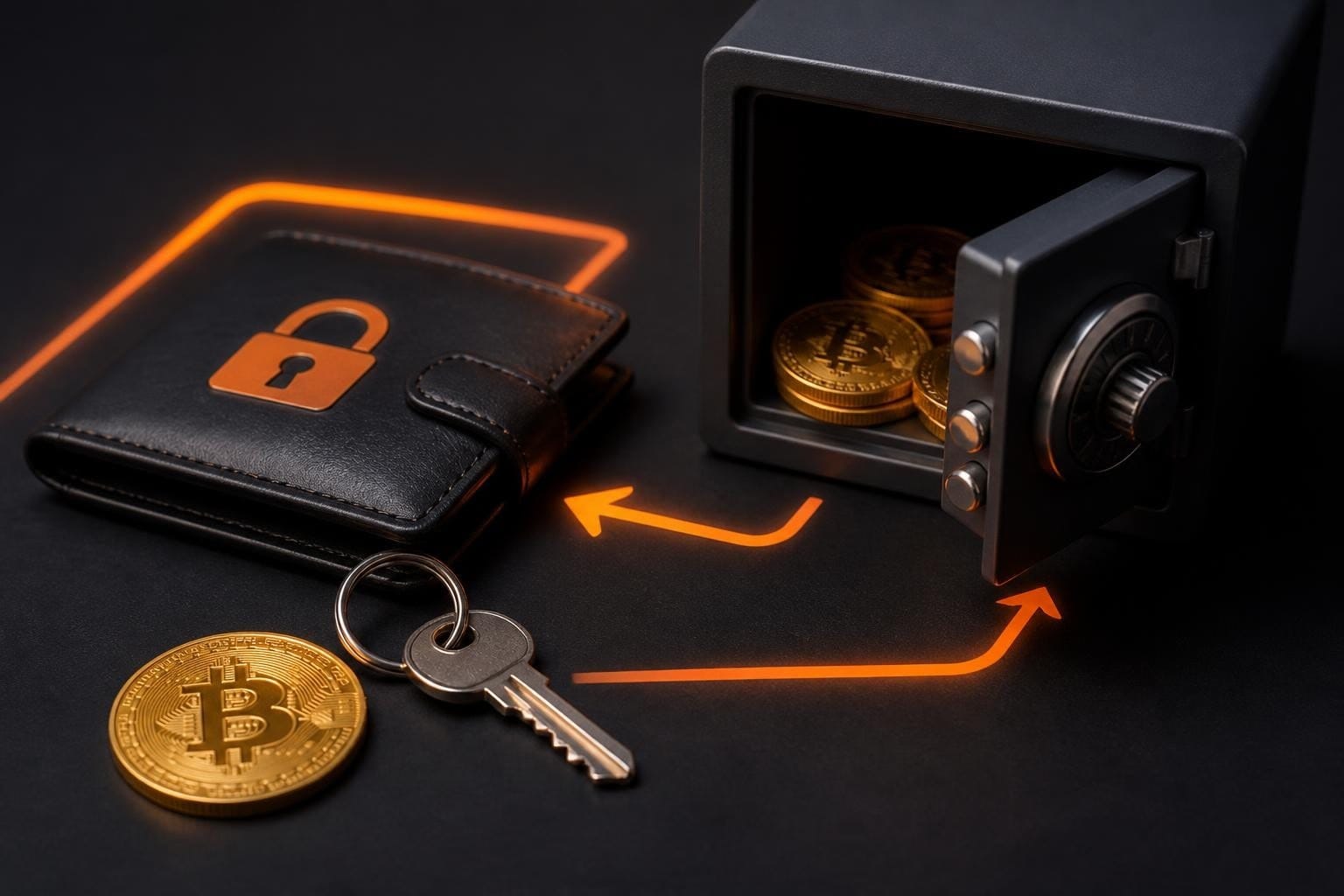
Non Custodial: Definition, Benefits, and How It Works
Non custodial means you control your private keys and cryptocurrency directly, without a third party holding your assets. In a non custodial system, no exchange, wallet provider, or intermediary can freeze, seize, or restrict access to your funds because they never possess your keys in the first place. This model contrasts sharply with custodial services like centralized exchanges, where the platform holds your private keys and effectively owns your assets until you withdraw them.
The distinction matters because custody determines who bears the risk, who must comply with regulations, and who can stop you from accessing your money. When you use a custodial exchange, you're trusting that company to safeguard your keys, maintain reserves, resist hacks, and process your withdrawal requests. A non custodial architecture removes those dependencies by design.
How Non Custodial Systems Work
A non custodial wallet or service never takes possession of your private keys. You generate the keys on your device, sign transactions locally, and broadcast them to the blockchain yourself. The service might help route the transaction or provide a user interface, but it cannot move your funds without your explicit cryptographic signature.
Most non custodial wallets present you with a twelve- or twenty-four-word recovery phrase during setup. That phrase encodes your private key and represents complete control over the associated addresses. Anyone with the phrase controls the funds. Anyone without it cannot.

Private Key Management
The core technical implementation revolves around key derivation and storage. When you create a non custodial wallet, the software uses a cryptographically secure random-number generator to produce entropy, then derives keys according to standards like BIP39 and BIP32. The keys live only on your hardware or in encrypted local storage, never on a remote server.
Hardware wallets take this further by isolating the key-generation and signing process on a dedicated chip. The Ledger Recovery Key white paper describes one vendor's approach to secure self-custody tooling and the architectural tradeoffs involved in recovery solutions. Even when a hardware wallet connects to a computer or phone, the private key never leaves the secure element.
Software wallets store encrypted key material on disk or in a device's secure enclave. The encryption password or biometric unlock controls access. If someone clones your hard drive but lacks your password, they cannot sign transactions. The system remains non custodial because the service provider cannot decrypt your keys remotely.
Atomic Swaps and Non Custodial Exchanges
Non custodial swap services coordinate trades without holding your coins. Atomic swap protocols use hash time-locked contracts (HTLCs) to ensure both parties either complete the exchange or get refunded. The contracts lock funds on-chain with a cryptographic hash; revealing the preimage unlocks one side, and the other party uses that same preimage to unlock theirs.
MoneroSwap's swap interface exemplifies this model. You send Monero or another cryptocurrency directly from your wallet to a time-locked address. Once the counterparty's deposit confirms, the protocol reveals the secret and both sides claim their coins. The swap service never holds your private keys or controls the locked funds; it only facilitates the cryptographic handshake.
This architecture means the service cannot exit-scam by disappearing with user deposits, because it never has custody. It also cannot comply with an asset-seizure order, because there are no pooled funds to seize. Each swap involves distinct on-chain contracts that self-execute or self-refund.
Benefits of Non Custodial Services
Control and ownership: You retain unilateral authority over your assets at all times. No approval process, no withdrawal queue, no risk of the platform freezing accounts.
Privacy by design: Custodial platforms collect personal data because regulations demand it. Non custodial services can often operate without mandatory identity verification, logging, or reporting.
Censorship resistance: If a custodial exchange dislikes your transaction history or jurisdiction, it can refuse service. A non custodial protocol processes valid signatures regardless of origin.
Reduced counterparty risk: Exchange insolvencies and hacks have destroyed billions in user funds. When you self-custody, those failures don't affect you.
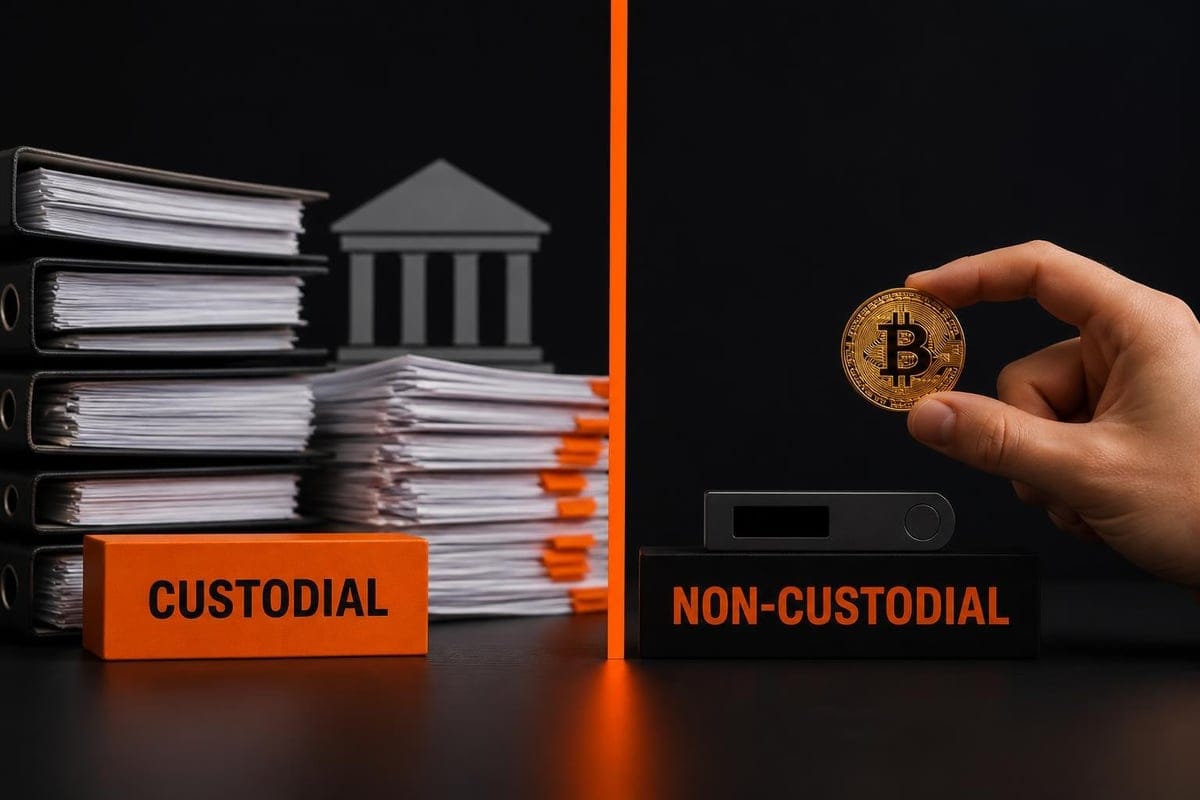
| Aspect | Custodial | Non Custodial |
|---|---|---|
| Key control | Platform holds keys | User holds keys |
| KYC requirements | Usually mandatory | Often optional or absent |
| Withdrawal limits | Set by platform | None (network fees only) |
| Hack exposure | Pooled funds are targets | Individual wallets only |
| Regulatory compliance | Platform must comply | User responsible |
The trade-off is responsibility. If you lose your recovery phrase, no customer-support team can reset your password. If you send funds to the wrong address, no one can reverse the transaction. The same properties that eliminate intermediary risk also eliminate intermediary rescue.
Regulatory Considerations
European regulations like MiCA create legal distinctions between custodial and non custodial arrangements. Custodial services trigger licensing requirements, consumer-protection rules, and reporting obligations. Non custodial software generally falls outside those frameworks because the provider never holds client assets.
In the United States, the FDIC and other agencies have issued guidance on risk-management considerations for crypto-asset safekeeping. Banks and regulated institutions face strict custody standards when they hold digital assets on behalf of customers. Non custodial models shift that burden to end users, which regulatory bodies view as reducing systemic risk but increasing individual loss potential.
Privacy-focused users often prefer non custodial services precisely because they avoid the identification and surveillance that custodial platforms entail. When you swap BTC to XMR through a non custodial service, you provide no email, phone number, or identity document. The transaction occurs between blockchain addresses, not registered accounts.
Non Custodial Wallet Types
Software Wallets
Mobile and desktop wallets generate and store keys on your device. Popular open-source examples include Electrum for Bitcoin, MyMonero for Monero, and MetaMask for Ethereum. These applications remain non custodial as long as you control the recovery phrase and the software doesn't transmit private keys to a remote server.
Browser-extension wallets like MetaMask connect to decentralized applications via protocols such as WalletConnect, which defines standards for non custodial wallet-to-dapp connectivity. The user approves each transaction in the wallet interface; the dapp never sees the private key.
Hardware Wallets
Dedicated devices like Trezor and Ledger isolate key operations on tamper-resistant chips. You initialize the device offline, write down the recovery phrase, and use it to sign transactions presented by a companion app. The private key never touches an internet-connected computer.
Security researchers continuously probe these devices. Trezor's chip vulnerability disclosure demonstrates how vendors handle and mitigate hardware threats while maintaining non custodial architecture. Even when vulnerabilities surface, the attacker usually needs physical access to the device and sophisticated equipment. Remote hacks remain infeasible because the keys never leave the hardware.
Smart Contract Wallets
Ethereum and compatible chains support multisignature wallets and smart-account patterns that enforce non custodial, multi-party key management. Gnosis Safe popularized this model: a smart contract holds funds and requires M-of-N signatures to execute transactions.
Treasuries, DAOs, and teams use these wallets to distribute control without introducing a custodian. Each signer holds their own private key; the smart contract enforces the threshold. No single party can unilaterally move funds, yet no external custodian holds the keys either.
Privacy Advantages in Non Custodial Swaps
Custodial exchanges create permanent data trails. They log your deposit addresses, withdrawal destinations, IP addresses, trading patterns, and identity documents. Governments and chain-analysis firms routinely subpoena that data or purchase it from vendors.
Non custodial swap services minimize or eliminate such records. MoneroSwap's design avoids account creation, email collection, and log retention. You provide a destination address, the service quotes a rate, and the atomic swap executes. No profile links your Monero address to your Ethereum address in a centralized database.
When you route traffic through Tor-compatible infrastructure, even IP-level surveillance becomes impractical. The service cannot correlate your network identity with your transaction because it never learns your IP in the first place. This layered privacy model complements Monero's on-chain obfuscation and Bitcoin's pseudonymity.
Key privacy features in non custodial swaps:
- No email or phone signup
- No identity-document upload
- No persistent user accounts
- No transaction-history dashboard tied to your identity
- Optional Tor routing to obscure IP addresses
- Minimal data retention (often only ephemeral swap state)
These characteristics matter for users in restrictive jurisdictions, activists, journalists, and anyone who values financial privacy as a fundamental right. Custodial platforms cannot offer the same guarantees because their business model depends on linking identity to transaction data.
Risks and Mitigations
User Error
The most common failure mode in non custodial systems is user mistake. Losing a recovery phrase, sending funds to an incompatible address, or misconfiguring a swap parameter can result in permanent loss. There is no password-reset flow and no support ticket that can undo a blockchain transaction.
Mitigations include:
- Writing recovery phrases on paper or metal, storing copies in secure locations
- Testing small amounts before large transfers
- Double-checking addresses character-by-character or using QR codes
- Using wallet software with address validation and warning prompts
- Reading FAQ documentation to understand swap flows and edge cases
Smart Contract Bugs
Non custodial swap protocols rely on code. If the contract contains a vulnerability, funds can become stuck or exploitable. Open-source audits, formal verification, and bug bounties reduce but do not eliminate this risk.
MoneroSwap's open-source codebase allows independent review and community scrutiny. Transparency helps surface bugs before attackers exploit them, but users should still understand that code risk exists in any automated system.
Phishing and Malware
Because you control your keys, phishing attacks target you directly rather than the service. Fake wallet apps, clipboard hijackers, and phishing sites attempt to steal recovery phrases or redirect transactions.
- Download wallet software only from official sources or verified repositories.
- Verify checksums or digital signatures before installing.
- Bookmark legitimate service URLs and navigate only from bookmarks.
- Use hardware wallets for high-value holdings to isolate keys from compromised computers.
- Enable two-factor authentication on any accounts that gate access to recovery-phrase backups.
Essential security practices for non custodial users: recovery phrase backup, address verification, hardware wallet usage, phishing prevention, and software integrity checks
Non Custodial Swaps Across Chains
Cross-chain atomic swaps require compatible scripting capabilities or trusted relays. Bitcoin and Monero atomic swaps use adaptor signatures and time locks to coordinate trades without custody. Ethereum-to-Monero swaps often involve intermediate steps or liquidity pools, but the underlying principle remains: the service never holds both sides of the trade simultaneously.
When you swap ETH to XMR, the protocol locks your Ethereum in a smart contract while the counterparty locks Monero in a time-locked transaction. Revealing the hash preimage allows both parties to claim their coins. If either side fails to act within the timeout, the funds return to the sender. The swap service coordinates the process but cannot abscond with the locked assets.
| Swap Pair | Typical Method | Custody Model |
|---|---|---|
| BTC ↔ XMR | Adaptor signatures + HTLC | Fully non custodial |
| ETH ↔ XMR | Smart contract + HTLC | Fully non custodial |
| USDT ↔ XMR | ERC-20 lock + HTLC | Fully non custodial |
| SOL ↔ XMR | Token lock + HTLC | Fully non custodial |
Non custodial swap services support numerous pairs, from USDT to XMR and SOL to XMR to more niche tokens. The technical mechanisms vary by blockchain capabilities, but the custody model stays consistent: users control keys, contracts enforce atomicity, and the service provider never holds funds.
Verifying Non Custodial Claims
Marketing claims are cheap; code and blockchain state are verifiable. To confirm a service is truly non custodial:
- Review the source code (if open source) to see whether the platform ever receives private keys.
- Check on-chain contracts to confirm funds move directly from user addresses to protocol addresses, not to platform-controlled wallets.
- Look for time-locked transactions and hash-locked contracts that enforce atomic execution.
- Test the service with a small amount and verify you sign transactions in your own wallet, not on a web form.
MoneroSwap provides verification tools to inspect swap states and confirm that locked funds follow protocol rules. Transparency mechanisms let you audit the process without trusting the operator's word.
Practical Workflow for Non Custodial Swaps
Using a non custodial swap service typically follows this sequence:
- Select your pair: Choose the asset you want to send and the asset you want to receive.
- Generate a destination address: Open your non custodial wallet for the receiving asset and copy a fresh address.
- Initiate the swap: Paste the destination address into the swap interface. The service quotes a rate and provides a deposit address.
- Send funds from your wallet: Use your wallet app to send the exact amount to the provided address. You sign this transaction with your private key.
- Wait for confirmation: The swap service monitors the blockchain for your deposit. Once confirmed, it initiates the counterparty leg.
- Receive your coins: The destination asset arrives at the address you provided. You control it immediately because you hold the private key.
At no point did you surrender custody. You signed the outgoing transaction yourself, and the incoming transaction delivered coins directly to an address you control. The service facilitated matching and coordination but never held both sides simultaneously.
If the swap fails or times out, your funds return to your wallet after the time-lock expires. The recovery process relies on the same cryptographic guarantees, not on contacting support. The protocol enforces refunds automatically.
Why Non Custodial Matters for Monero Users
Monero's value proposition centers on privacy and fungibility. Using a custodial exchange undermines that proposition because the exchange links your real-world identity to your Monero addresses. When you withdraw, the exchange knows the destination address. When you deposit, it knows the source. Chain analysis becomes trivial at the exchange boundary.
Non custodial swaps preserve the privacy Monero provides. You send Bitcoin or Ethereum from a pseudonymous address, receive Monero at a fresh address, and the swap service logs nothing tying the two together. This workflow keeps your Monero stack unlinkable and your transaction graph opaque.
Conversely, swapping XMR to BTC or XMR to USDT through a non custodial service avoids creating a permanent record of which Monero outputs funded which transparent-chain addresses. Privacy-conscious users who occasionally need to convert Monero to another asset prioritize non custodial options for exactly this reason.
The Philosophical Dimension
Beyond technical and regulatory arguments, non custodial architecture reflects a philosophy of self-sovereignty. Early Bitcoin adopters emphasized "be your own bank" and "not your keys, not your coins." Those slogans capture the idea that cryptocurrency's core innovation is disintermediation, not just digital payment rails.
Custodial services reintroduce the intermediaries that Bitcoin was designed to eliminate. They offer convenience and familiar user experiences but sacrifice the trustless guarantees that make cryptocurrency distinct from PayPal. Non custodial systems embrace the original vision: peer-to-peer transactions, cryptographic proof instead of institutional trust, and individual responsibility over paternalistic safety nets.
This philosophy appeals to users who value autonomy, resist surveillance, or operate in environments where trusted institutions are unavailable or adversarial. It also resonates with anyone who witnessed the collapse of FTX, Mt. Gox, or other custodial platforms and concluded that self-custody, despite its demands, beats trusting a third party.
Non custodial systems return control and privacy to users willing to manage their own keys. The architecture eliminates intermediary risk, avoids mandatory surveillance, and enforces trustless execution through cryptography rather than reputation. MoneroSwap delivers this model for cross-chain swaps, letting you trade Bitcoin, Ethereum, stablecoins, and other assets for Monero without accounts, KYC, or custody. Start a swap today to experience true peer-to-peer exchange.
Swap into or out of Monero, no KYC
MoneroSwap is a non-custodial way to swap Monero with no account, no KYC, and no logs. Open source and available over Tor. Verify every claim, then swap BTC to Monero, ETH to Monero, USDT to Monero, or see all pairs. New here? Start with the FAQ.
← All guides