No KYC Crypto Exchange: What You Need to Know in 2026
A no KYC crypto exchange allows you to trade digital assets without submitting identity documents, selfies, or personal information. These platforms execute swaps directly from wallet to wallet, skipping the account registration and verification process that centralized exchanges require.
The distinction matters because traditional exchanges collect passport scans, proof of address, and sometimes video verification before letting you trade. A no KYC crypto exchange removes those barriers. You send crypto to an address, specify your destination, and receive your swapped coins within minutes. No database stores your name, location, or transaction history.
How No KYC Exchanges Actually Work
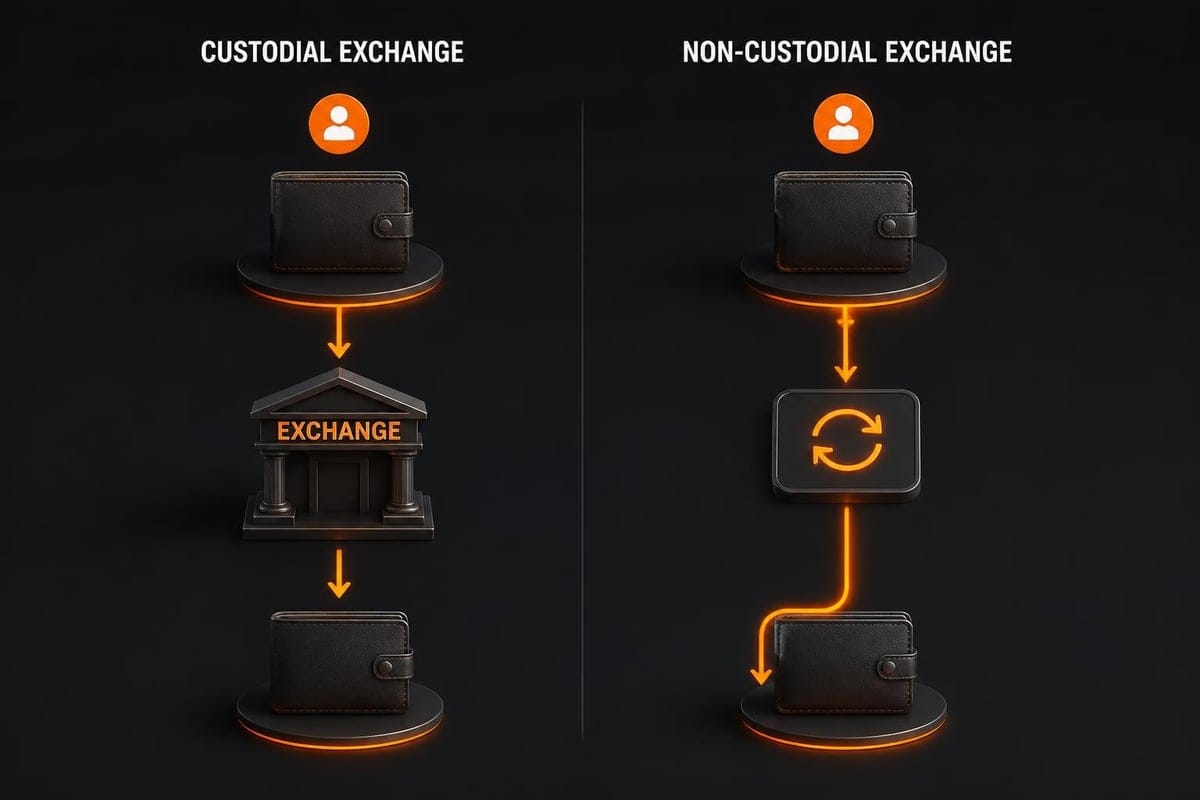
Most no KYC crypto exchange platforms operate on a non-custodial model. You initiate a swap by selecting your input and output currencies. The platform generates a unique deposit address for that specific transaction. You send your coins to that address, the exchange executes the trade, and the swapped funds land in the wallet you specified.
The technical implementation varies. Some services use automated market makers on-chain. Others route orders through liquidity pools or partner exchanges. A few operate as front-ends for decentralized exchange protocols. The common thread is that none of them create persistent user accounts or link trades to verified identities.
Non-Custodial vs. Custodial Models
Traditional exchanges hold your funds in their wallets. You deposit Bitcoin, they credit your account balance, and they control the private keys until you withdraw. A no KYC crypto exchange following the non-custodial approach never holds your funds beyond the swap duration. Once the transaction completes, no balance remains.
Key differences include:
- Control: You maintain private key ownership throughout the swap
- Risk: Exchange hacks or insolvency can't freeze your long-term holdings
- Privacy: No persistent balance history ties transactions together
- Recovery: Limited recourse if you send to the wrong address or network
Some platforms that call themselves "no KYC" still hold funds briefly during the swap window. The distinction between truly non-custodial and temporarily custodial matters for both security and privacy.
Regulatory Changes in 2026
The regulatory landscape shifted significantly this year. In October 2026, FinCEN withdrew its proposed rule that would have required reporting for transactions involving unhosted wallets above certain thresholds. The Federal Register notice marked a retreat from earlier attempts to force intermediaries to collect counterparty information even on non-custodial swaps.
That withdrawal doesn't mean no KYC crypto exchange platforms operate in a legal vacuum. Different jurisdictions apply different rules. The EU continues to expand Travel Rule requirements. Some Asian jurisdictions ban anonymous trading entirely. Others take a hands-off approach unless a platform handles fiat currencies.
The IRS separately clarified definitions of hosted versus unhosted wallets in Revenue Bulletin 2024-31, creating tax reporting obligations that apply regardless of whether an exchange collects identity documents. You're responsible for reporting capital gains on crypto-to-crypto swaps even when the platform doesn't know who you are.
Geographic Restrictions and VPN Use
Most no KYC crypto exchange services block users from specific countries. They typically restrict access based on IP address rather than identity verification. Users from sanctioned jurisdictions or locations with strict crypto bans find themselves unable to load the swap interface.
Some people route connections through VPNs or Tor to bypass geographic filters. Platforms vary in how they handle this. A few explicitly support Tor access through .onion mirrors. Others actively block known VPN IP ranges. The practice creates legal ambiguity since you're circumventing a restriction the platform implemented to manage its own regulatory exposure.
| Jurisdiction Type | Typical Restrictions | Access Method |
|---|---|---|
| U.S. (varies by state) | IP blocks, no fiat rails | VPN or Tor |
| EU | IP blocks post-MiCA | Clear web if compliant |
| Sanctioned countries | Hard blocks | Tor required |
| Southeast Asia (permissive) | No blocks | Clear web |
Privacy Coins and Enhanced Anonymity
Swapping into privacy coins like Monero amplifies the anonymity a no KYC crypto exchange provides. Bitcoin transactions appear on a public ledger. Blockchain analysis firms trace those flows between addresses and sometimes link them to real identities through exchange withdrawal patterns. Chainalysis research demonstrates how illicit actors use instant exchanges combined with privacy coins to break transaction trails.
When you swap BTC to XMR, the on-chain trail ends at the exchange's deposit address. The Monero network's ring signatures, stealth addresses, and RingCT obscure the subsequent flow. Later swapping XMR to USDT creates a fresh starting point with no visible link to the original Bitcoin source.
Multi-Hop Swaps
Some users chain multiple swaps across different platforms. They might convert ETH to XMR on one service, hold the Monero in a wallet for days or weeks, then swap XMR to USDC on another platform. Each hop adds a privacy layer while also multiplying transaction fees and exchange rate spreads.
Common multi-hop patterns:
- Transparent coin → privacy coin on Platform A
- Hold privacy coin in personal wallet (time delay)
- Privacy coin → different transparent coin on Platform B
- Optional: Repeat with different platforms and coins
This approach trades cost and complexity for privacy. You pay swap fees twice, absorb slippage on both trades, and need to manage multiple wallet types. The benefit is breaking deterministic links between the first and last asset.
Security Considerations
A no KYC crypto exchange introduces different risks than a custodial platform. You can't call support to freeze your account if someone gains access to your email. No identity verification also means no identity recovery. If you lose access to your destination wallet's private keys, the swapped funds are gone.
Smart contract risk applies to platforms built on decentralized protocols. A bug in the swap contract can drain liquidity pools. Unlike centralized exchanges that can roll back transactions after a hack, on-chain swaps are irreversible once confirmed.
Phishing and Clone Sites
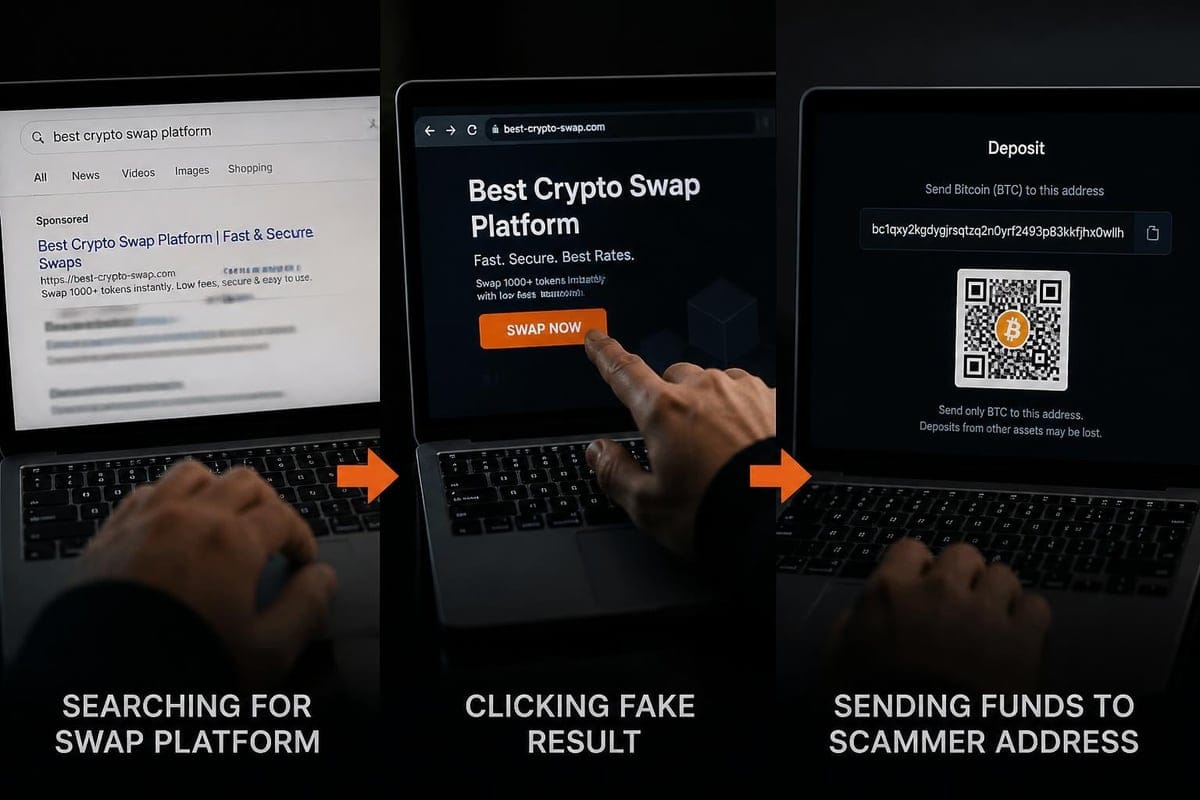
Scammers create fake versions of popular no KYC crypto exchange platforms. They copy the design, use similar domain names, and rank in search results. Users send funds to the fake platform's address, and the scammers simply keep the coins. No transaction executes, and no recourse exists.
The lack of accounts makes this easier. On a traditional exchange, you log in to a familiar interface and see your transaction history. With a no KYC crypto exchange, every swap starts fresh. You visit a URL, it looks right, you send funds. Verifying you're on the legitimate site requires checking the domain carefully, using bookmarks, or accessing an .onion address through Tor.
Liquidity and Pricing
No KYC crypto exchange platforms usually offer worse rates than major centralized exchanges. They aggregate liquidity from multiple sources, adding their fee on top of the underlying market rate. The spread between buying and selling prices widens to compensate for the convenience and privacy.
For popular pairs like BTC to XMR, the rate gap might be 1-2%. For less liquid pairs, spreads can hit 5% or more. You're paying a premium to avoid identity verification and account creation.
Slippage on Large Orders
Small swaps usually execute at the quoted rate. Larger orders move the market, especially on platforms with limited liquidity. A $500 swap might get you 0.98% of the mid-market rate. A $50,000 swap on the same platform could drop to 0.92% as it exhausts available liquidity at favorable prices.
| Order Size | Typical Rate (% of mid-market) | Execution Time |
|---|---|---|
| Under $500 | 98.5-99.5% | 5-15 minutes |
| $500-$5,000 | 97.5-98.5% | 10-20 minutes |
| $5,000-$25,000 | 96.0-97.5% | 15-30 minutes |
| Over $25,000 | 94.0-96.0% | 30-60+ minutes |
Some platforms set maximum swap amounts to manage liquidity risk. You might need to split a large order across multiple transactions or different services.
Transaction Speed and Confirmation Requirements
A no KYC crypto exchange typically requires more blockchain confirmations than a custodial platform before executing your swap. Centralized exchanges control their hot wallets and can credit your account after 1-2 confirmations, sometimes instantly. Non-custodial swaps wait for enough confirmations to make a double-spend attack economically unfeasible.
Bitcoin swaps often require 3-6 confirmations (30-60 minutes). Ethereum might need 12-30 confirmations (3-6 minutes with current block times). Smaller cap coins with lower hash rates sometimes require 50+ confirmations, extending swap times to hours.
The exchange executes your swap after confirmations complete, then sends the output currency to your destination address. That second transaction also needs confirmations before you can spend those funds. Total time from initiating a swap to having spendable coins in your wallet ranges from 15 minutes to several hours depending on network congestion and confirmation requirements.
Compliance and Tax Obligations
Using a no KYC crypto exchange doesn't exempt you from tax reporting. The IRS treats crypto-to-crypto swaps as taxable events. You owe capital gains tax on the difference between your cost basis and the value at the time of the swap. The exchange doesn't report the transaction, but you're legally obligated to.
Enforcement remains inconsistent. Tax authorities lack comprehensive visibility into non-custodial swap activity. They can sometimes identify suspicious patterns through blockchain analysis or by subpoenaing records from services you use before or after the swap. Europol's 2024 cybercrime report highlights law enforcement challenges when dealing with unhosted counterparties and anonymous exchange services.
Record Keeping
Without exchange-generated tax forms, you need to maintain your own records. Save screenshots of swap confirmations, note timestamps, record exchange rates at the time of the transaction, and document your cost basis for the input currency. Reconstructing this information months later for tax filing proves difficult or impossible.
Essential records to maintain:
- Transaction ID or hash from the blockchain
- Timestamp of the swap initiation and completion
- Amount of input currency sent and output currency received
- USD value of both currencies at the time of swap
- Fees paid (network fees and exchange fees)
- Source of the input currency (cost basis documentation)
Privacy vs. Anonymity
A no KYC crypto exchange provides privacy by not collecting personal information. It doesn't guarantee anonymity. Blockchain analysis can still link addresses, correlate transaction patterns, and sometimes identify users through other data points.
If you swap ETH to XMR but sourced the ETH from a centralized exchange that knows your identity, investigators can trace the ETH from the custodial withdrawal to the swap service deposit address. They know you swapped to Monero at a specific time. They can't see where the Monero went, but they know you hold it.
The privacy model depends on breaking links between your identity and your on-chain activity. Using a no KYC crypto exchange is one step. Sourcing input funds from non-KYC sources, using Tor to prevent IP logging, managing wallets carefully to avoid address reuse, and selecting privacy-preserving output currencies all combine to create anonymity.
Technical Architecture Variations
Different no KYC crypto exchange implementations make different security and privacy tradeoffs. Some run entirely on smart contracts with no server-side logic. Others use centralized order books but never log user data. A few operate as interfaces to peer-to-peer protocols.
Smart Contract DEXs
Fully on-chain decentralized exchanges execute swaps through smart contracts. You interact directly with the blockchain. The platform provides a UI but doesn't intermediate the transaction. Privacy depends on the blockchain's properties. Ethereum DEX swaps are fully traceable. Research on DEX security examines how these platforms handle unfair trading and the practical limits of decentralization.
Hybrid Platforms
Many services blend centralized matching with non-custodial settlement. They maintain an order book server-side but never take custody of funds. You deposit to a unique address generated per swap, the platform matches your order against liquidity sources, and settlement happens on-chain or through pre-signed transactions.
P2P Protocols
Peer-to-peer exchanges connect buyers and sellers directly. The platform facilitates discovery and sometimes provides escrow, but funds move between users without touching a central entity. Analysis of Monero P2P exchanges systematizes how these networks function and identifies their unique privacy and regulatory risk vectors.
Choosing a Platform
Evaluating a no KYC crypto exchange requires checking factors beyond price. Security track record, liquidity depth, supported coins, and operational transparency all matter.
Key evaluation criteria:
- Open source code: Can you audit the swap logic and verify no logging occurs?
- Tor compatibility: Does the platform offer an .onion mirror for IP privacy?
- Supported pairs: Which input/output combinations are available?
- Liquidity sources: Where does the platform source its liquidity?
- Fee structure: What's the total cost including network fees and exchange spread?
- Confirmation requirements: How long until your swap executes?
- Customer support: Is there any recourse if a swap fails?
MoneroSwap demonstrates the privacy-focused approach with open source code, Tor compatibility, and explicit no-logging guarantees. The platform focuses on Monero pairs, making it straightforward to swap between privacy coins and transparent cryptocurrencies.
Common Use Cases
People use a no KYC crypto exchange for various reasons. Some prioritize financial privacy as a principle. Others need to access cryptocurrencies in jurisdictions where centralized exchanges won't serve them. A few are specifically trying to break on-chain analysis trails.
Merchants accepting cryptocurrency sometimes swap received payments into stablecoins without wanting to link business transaction volume to personal identity verification on an exchange. Individuals in countries with capital controls use no KYC platforms to move value across borders. Privacy advocates swap into Monero simply to exercise financial autonomy.
The Bank for International Settlements analysis of DeFi risks notes that AML/KYC gaps in decentralized and no-KYC venues create policy challenges, but also acknowledges the demand for financial privacy tools.
Scenarios Where No KYC Makes Sense
- Privacy preservation: You don't want your transaction history linked to your real identity
- Geographic restrictions: Local regulations prevent centralized exchange access
- Small amounts: KYC overhead isn't worth it for tiny swaps
- Speed: You need immediate access without waiting for verification approval
- Unbanked situations: You lack the identity documents traditional exchanges require
Risk Management Strategies
Using a no KYC crypto exchange safely requires deliberate practices. Start with small test transactions to verify the platform works as expected. Bookmark the legitimate URL and always navigate directly rather than through search results. Use Tor if the platform supports it to prevent IP logging.
Verify the destination address multiple times before initiating a swap. Many platforms display a QR code and text address. Cross-check both. Sending coins to the wrong network (sending USDT on Ethereum when the platform expects Tron, for example) usually results in permanent loss.
Monitor blockchain confirmations yourself rather than relying solely on the platform's status updates. Use a block explorer to verify your deposit transaction confirmed and watch for the output transaction to appear. If a swap takes significantly longer than the estimated time, investigate before assuming it failed.
When to Avoid No KYC Platforms
Some situations call for the regulatory protections and recourse centralized exchanges provide. If you're swapping amounts you can't afford to lose, the lack of customer support and transaction reversibility makes no KYC platforms risky. For very large orders, liquidity constraints and poor pricing might outweigh the privacy benefits.
If legal compliance matters for your use case (business accounting, estate planning, demonstrating source of funds to a bank), the documentation and reporting traditional exchanges provide becomes valuable. The privacy of a no KYC crypto exchange can actually create problems in these contexts.
Future Outlook
Regulatory pressure on anonymous financial tools continues to increase globally. The 2026 FinCEN withdrawal temporarily relieved one pressure point in the U.S., but other jurisdictions are moving the opposite direction. The EU's Markets in Crypto-Assets regulation phases in stricter requirements through 2027.
Technology development pushes the other way. Zero-knowledge proofs might eventually enable compliance verification without revealing user identities. Layer 2 networks and cross-chain protocols could make censorship-resistant swaps cheaper and faster. Privacy coin development continues despite regulatory headwinds and exchange delistings.
The no KYC crypto exchange model will likely persist in some form. Demand for privacy-preserving financial tools exists regardless of regulatory frameworks. The platforms that survive will need to navigate an increasingly complex legal landscape while maintaining the core value proposition of anonymous trading.
A no KYC crypto exchange fills a specific niche for users who prioritize privacy, operate in restrictive jurisdictions, or simply prefer not to share identity documents with every platform they use. The tradeoffs involve pricing, liquidity, and legal complexity, but for many use cases those costs are acceptable. If you need to swap cryptocurrencies without KYC, particularly involving Monero, platforms like MoneroSwap offer non-custodial swaps with open source code and no log retention, giving you control over your financial privacy while accessing the pairs you need.
Swap into or out of Monero, no KYC
MoneroSwap is a no-KYC Monero swap with no account, no KYC, and no logs. Open source and available over Tor. Verify every claim, then swap BTC to Monero, ETH to Monero, USDT to Monero, or see all pairs. New here? Start with the FAQ.
← All guides