
Crypto Exchange No KYC: Privacy Trading in 2026
A crypto exchange no KYC is a platform that lets you trade cryptocurrency without submitting identity documents, selfies, or personal information. These services exist because some users prioritize financial privacy or live in jurisdictions where accessing traditional exchanges is difficult. The landscape has changed significantly since 2024, when major regulatory frameworks began forcing even small platforms to collect user data. Understanding how no-KYC exchanges function and what trade-offs they involve helps you decide whether they fit your situation.
Most people encounter KYC (know-your-customer) requirements when they first try to buy Bitcoin or Ethereum on a mainstream exchange. The platform asks for a passport scan, a utility bill, and a selfie holding your ID. You wait hours or days for approval. That friction exists because regulated financial institutions must verify customer identities under anti-money-laundering laws. A crypto exchange no KYC skips that entire process, typically using one of three models: non-custodial atomic swaps, peer-to-peer escrow, or privacy-coin intermediaries like Monero. Each approach has different technical, legal, and security characteristics.
Why Exchanges Require KYC
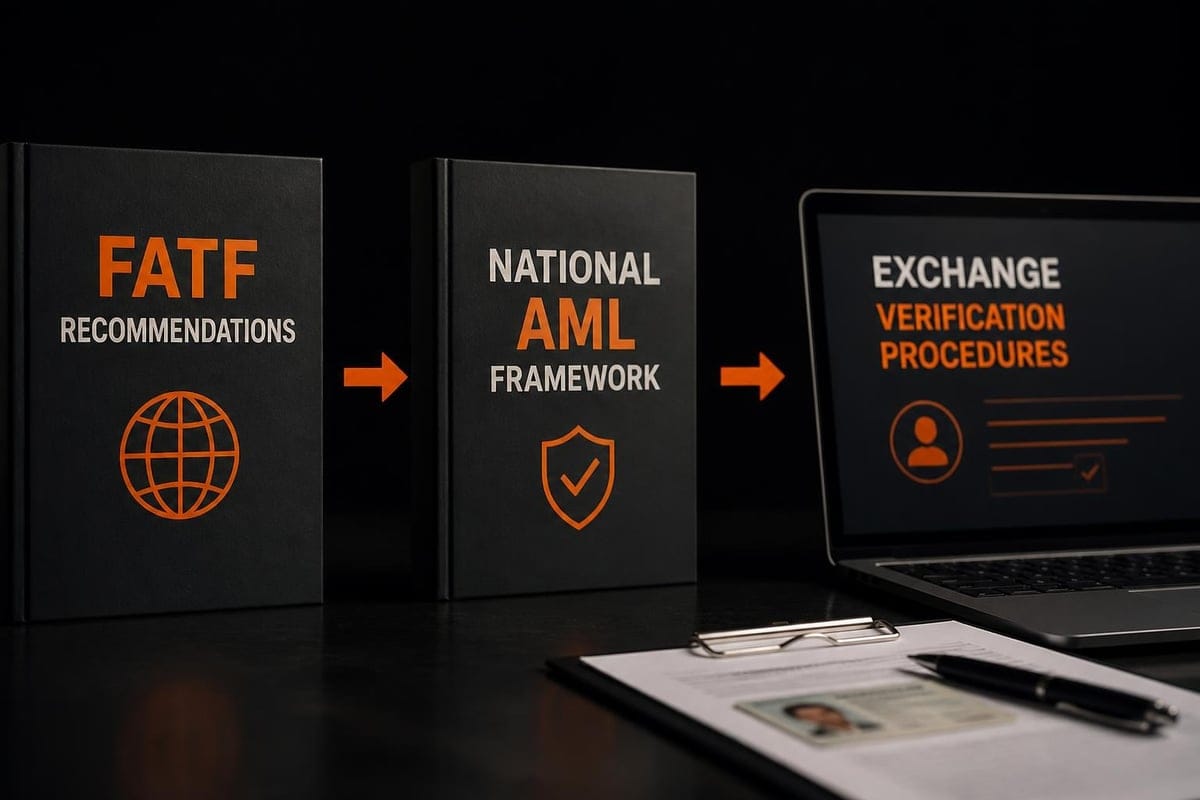
Financial regulators across the US, EU, and Asia classify most cryptocurrency exchanges as money service businesses or virtual asset service providers. Those labels trigger AML and counter-terrorist-financing obligations. An exchange operating under those rules must collect and verify customer identity, monitor transactions for suspicious patterns, and report large or unusual activity to government agencies.
The European Banking Authority guidance on crypto-asset service providers clarifies how these requirements apply even to platforms that only handle cryptocurrency and never touch fiat. The EU's Travel Rule, mirrored in other jurisdictions, requires exchanges to share sender and recipient information for transactions above a threshold. Compliance is expensive: identity verification vendors, transaction monitoring software, and legal staff add costs that smaller platforms cannot absorb.
The OECD Crypto-Asset Reporting Framework
In 2026 the OECD Crypto-Asset Reporting Framework entered full effect in dozens of countries. This framework requires exchanges to automatically report customer holdings and transactions to tax authorities, which then share that data with other countries. For users in high-tax jurisdictions or countries with capital controls, this reporting creates a strong incentive to find a crypto exchange no KYC.
The CARF defines "Reporting Crypto-Asset Service Providers" to include centralized exchanges, some brokers, and custodians. Non-custodial wallets and fully decentralized protocols fall outside that definition, at least for now. A service like MoneroSwap avoids CARF reporting obligations because it never takes custody of user funds and does not maintain accounts. Each swap is an isolated, atomic transaction with no persistent record linking identity to holdings.
How No-KYC Exchanges Operate
Three main architectures power crypto exchange no KYC services today.
Non-custodial atomic swaps use time-locked smart contracts or hashed time-lock contracts (HTLCs) to exchange coins directly between two parties. Neither user sends funds to the platform. The swap completes on-chain when both parties fulfill cryptographic conditions. If one party fails to act within the time window, the contract refunds both sides automatically.
Peer-to-peer escrow platforms match buyers and sellers, then hold funds in escrow until both confirm the transaction. The platform itself does not verify identities, though it might require a deposit or reputation score to prevent fraud. These platforms work well for fiat-to-crypto trades where one side involves a bank transfer or cash meeting.
Privacy-coin intermediary swaps convert your input coin into a privacy coin like Monero, which breaks the on-chain link, then convert the Monero into your desired output coin. This two-step process obscures the connection between sender and receiver. A BTC to XMR swap followed by an XMR to USDT swap achieves the same result as a direct BTC-to-USDT trade, but the Monero step adds a privacy layer that on-chain analysis cannot penetrate.
| Architecture Type | Custody Model | Privacy Level | Speed | Fiat Support |
|---|---|---|---|---|
| Atomic Swaps | Non-custodial | High | Medium (on-chain) | No |
| P2P Escrow | Custodial (temporary) | Medium | Varies | Yes |
| Privacy Intermediary | Non-custodial | Very High | Medium | No |
Security Considerations
Using a crypto exchange no KYC shifts certain risks from the platform to you. Custodial exchanges with KYC can reverse fraudulent transactions, freeze accounts, and cooperate with law enforcement to recover stolen funds. A non-custodial platform cannot do any of that because it never holds your coins.
You need to verify contract addresses, double-check recipient addresses, and understand that a mistaken transaction is usually irreversible. Many no-KYC platforms publish open-source code so you can audit the smart contracts yourself or rely on community audits. MoneroSwap, for example, maintains an open-source codebase and provides a verification tool to check that the software running on the server matches the published source.
Phishing is another risk. Because no-KYC platforms do not require accounts, they also do not send password-reset emails or maintain customer-support ticket histories. An attacker can spin up a clone site with a similar domain. Always bookmark the correct URL, use the official Tor onion address when available, and verify SSL certificates.
Legal and Regulatory Gray Zones
Operating a crypto exchange no KYC is legal in some jurisdictions and prohibited in others. The United States has prosecuted individuals running unlicensed money-transmitting businesses even when those platforms only handled cryptocurrency. The IC3 public service alert on crypto services without KYC highlights law enforcement's view that such platforms facilitate fraud, ransomware payments, and sanctions evasion.
In practice, most enforcement focuses on large platforms with clear US nexus: US-based servers, US customers, or US dollar banking relationships. A fully decentralized protocol with no company behind it presents a harder enforcement target. Regulators have struggled to apply traditional licensing frameworks to software that runs autonomously.
Compliance Gaps and Crime
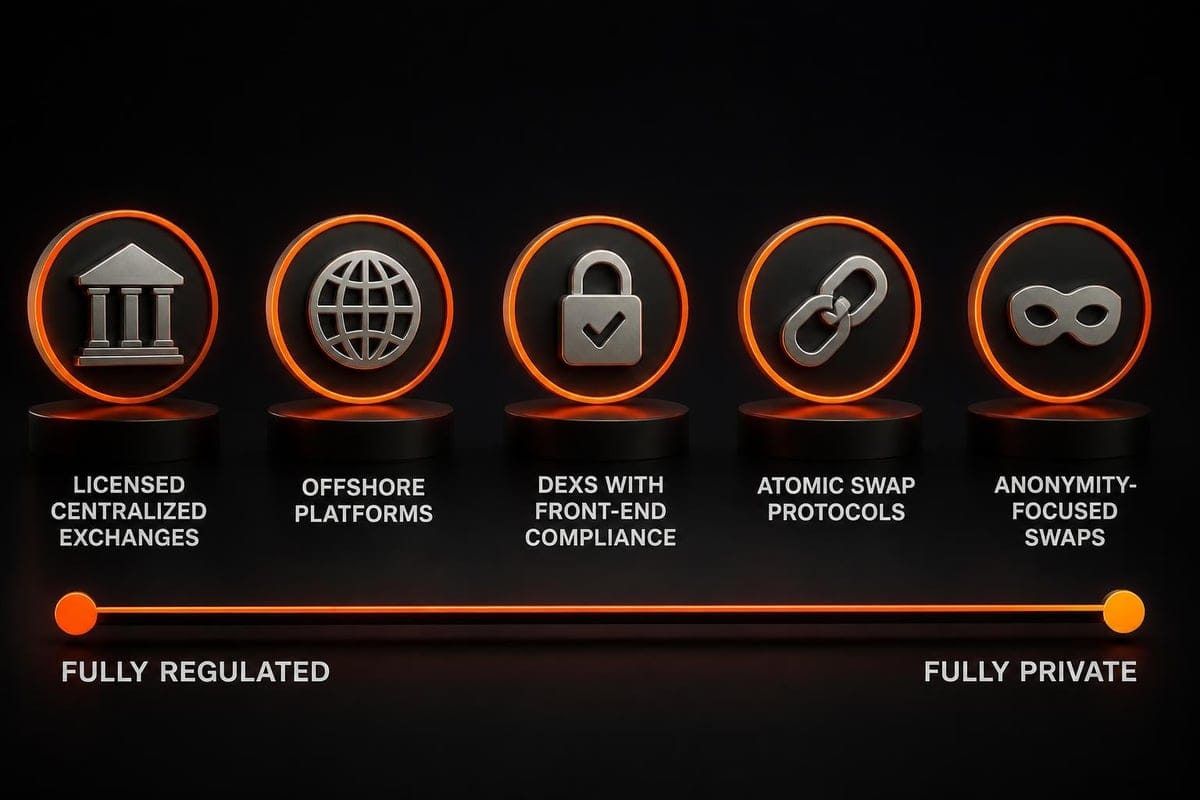
No-KYC venues play a measurable role in money laundering, according to Chainalysis' 2025 Crypto Crime Report. The report finds that illicit funds flowing out of sanctioned entities, darknet markets, and ransomware groups often pass through instant exchanges and cross-chain swaps that do not collect identity data. However, the same report notes that the majority of cryptocurrency transaction volume occurs on compliant platforms and that mixers and privacy coins account for a small fraction of total illicit flows.
The TokenInsight Crypto Exchange Compliance Report (2024) documents how mid-tier exchanges in lenient jurisdictions advertise "no KYC up to 2 BTC per day" but implement weak or nonexistent verification. These platforms create a compliance gap: they claim to follow regulations but in practice allow large volumes of anonymous transactions. A genuinely non-custodial, privacy-focused service operates in a different category because it cannot collect data even if compelled to do so.
When No-KYC Makes Sense
Using a crypto exchange no KYC is a deliberate choice. You trade regulatory protections and customer support for privacy and accessibility. Here are scenarios where that trade-off favors no-KYC:
- You already hold cryptocurrency and want to swap one coin for another without creating an account. An ETH to XMR swap or a SOL to XMR trade happens in minutes without uploading documents.
- You live in a country where major exchanges have exited or imposed restrictions. Some platforms block users from dozens of countries. A decentralized swap remains accessible from anywhere with internet.
- You value financial privacy. You do not want your transaction history sold to data brokers, shared with tax authorities in multiple countries, or subpoenaed in future legal disputes. Swapping through a privacy coin breaks the on-chain trail.
- You need censorship resistance. An exchange with KYC can freeze your account if your activity triggers automated flags or if a government requests it. Non-custodial tools do not have that power.
If you're new to cryptocurrency and need to convert fiat currency into crypto, a no-KYC platform is harder to use. You'll need to buy Bitcoin or another liquid coin on a P2P platform or from an ATM, then swap into your desired asset. That adds steps and fees but preserves anonymity from the start.
Practical Examples
Someone earning income in Bitcoin might want to convert a portion into a stablecoin for spending without revealing their entire BTC wallet history to an exchange. A BTC to USDC swap through Monero as an intermediary accomplishes that goal. The exchange never learns the source wallet address or the destination.
A traveler in a country with strict capital controls might use a crypto exchange no KYC to move value across borders. They buy a privacy coin with local currency through a P2P platform, swap it into a stablecoin, then convert that stablecoin back into local currency in the destination country. Each step uses a different platform and no single entity sees the full chain.
Businesses operating in legal-but-stigmatized industries sometimes find their bank accounts closed and their exchange accounts frozen without explanation. A non-custodial swap lets them accept cryptocurrency payments and convert into needed assets without platform risk.
Fees and Liquidity Trade-offs
Crypto exchange no KYC platforms typically charge higher fees than major centralized exchanges. Centralized platforms pool liquidity and use market makers to tighten spreads. A no-KYC atomic swap pulls liquidity from decentralized sources or acts as a simple taker, so you pay wider spreads and higher network fees.
Expect to pay 1-3% in combined fees and slippage on a typical swap, compared to 0.1-0.5% on a centralized exchange. For small transactions under a few hundred dollars, the privacy premium is manageable. For large swaps, the cost becomes significant. Some platforms offer better rates for certain pairs. A USDT to XMR swap might have tighter pricing than a less-common pair like LINK to XMR because USDT-XMR has deeper liquidity.
Speed and Confirmation Times
Non-custodial swaps settle on-chain, which means you wait for block confirmations. A Bitcoin transaction needs at least one confirmation, usually 10 minutes but sometimes longer during network congestion. An Ethereum swap is faster, around 15 seconds per block, but you might wait for multiple confirmations to ensure finality. Monero has a 20-minute confirmation window to account for its privacy features.
If you're swapping across chains, the total time is the sum of both networks' confirmation requirements. A DAI to XMR swap involves Ethereum confirmations (a few minutes) plus Monero confirmations (20 minutes). Budget 30-60 minutes for a typical cross-chain swap. Centralized exchanges can credit your account instantly because they operate internal databases, but you've traded speed for custody risk and privacy loss.
Choosing a Platform
Not all platforms calling themselves "no-KYC" actually avoid identity collection. Some store IP addresses, email addresses, or browser fingerprints. Others comply with law-enforcement requests by freezing funds mid-swap or sharing transaction details.
When evaluating a crypto exchange no KYC, check these factors:
- Open-source code: Can you or a third party audit the platform's contracts and backend? Closed-source platforms can implement hidden logging or backdoors.
- No account requirement: Does the platform let you initiate a swap without creating an account or providing an email? Account-based platforms can link multiple swaps to the same user.
- Network privacy support: Does the service work over Tor or I2P? A platform that blocks Tor is not serious about privacy.
- No log retention: Does the platform's privacy policy (if it has one) commit to deleting swap data after completion? Some platforms claim not to collect data but still store IP logs or transaction records for weeks.
- Community reputation: How long has the platform operated? What do users on privacy-focused forums say about it?
MoneroSwap meets all five criteria: open-source software, no account registration, full Tor compatibility via its onion address, no log retention, and a track record in the Monero community. For questions about how swaps work, the FAQ covers technical details and common issues.

Common Mistakes
First-time users of crypto exchange no KYC platforms often make the same errors.
Sending the wrong coin or using the wrong network. If a platform expects USDT on Ethereum and you send USDT on Binance Smart Chain, your funds go to an address the platform does not control. There is no support team to reverse the transaction. Always verify the network and token address.
Ignoring the time lock. Atomic swaps include a time limit. If you do not complete your side within the window (often 1-3 hours), the contract refunds both parties. But you've wasted network fees. Start a swap only when you can monitor it through completion.
Reusing addresses. If you use the same destination address for multiple swaps, anyone watching that address can link your transactions. Generate a fresh address for each swap when possible.
Overlooking network fees. The displayed swap fee might be 1%, but network fees can add another $5-$50 depending on the blockchain. A small swap might lose 10% to combined fees. Batch your swaps or choose low-fee networks when possible.
If something goes wrong mid-swap, non-custodial platforms usually provide a recovery tool that lets you reclaim funds using the swap's cryptographic proof. Save the swap ID and any transaction hashes.
Privacy Beyond the Swap
Using a crypto exchange no KYC is one step in a broader privacy practice. If you swap Bitcoin for Monero on a no-KYC platform but then send that Monero to an exchange that requires KYC, you have linked your identity to the Monero. The swap itself was private, but the endpoint was not.
To maintain privacy, plan the full path your funds will take:
- Source: Acquire initial coins through a P2P platform, mining, or earning them. Avoid buying on a KYC exchange if privacy is the goal.
- Swap: Use a no-KYC platform and route through a privacy coin.
- Destination: Send to a wallet you control, not another exchange. If you must use an exchange, understand that the subsequent KYC creates a new data point.
- Spending: Use the coins directly where accepted, or convert to cash via P2P. Sending back to a bank account tied to your identity defeats earlier privacy steps.
Network-level privacy matters too. Your internet provider or a network observer can see that you visited a swap platform, even if the platform does not log your IP. Use a VPN or Tor for all cryptocurrency activity if you want to obscure your location and browsing patterns.
Future Regulatory Pressure
Governments are tightening rules around crypto exchange no KYC services. The Financial Action Task Force (FATF) continuously revises its recommendations to close gaps. Proposals in 2026 include requiring KYC for all on-ramps and off-ramps, even informal peer-to-peer trades, and mandating that wallet software collect user data before broadcasting transactions.
Some countries have moved faster. A few have banned cryptocurrency entirely. Others require exchanges to obtain licenses that include KYC mandates, effectively outlawing no-KYC venues. The global trend is toward more regulation, not less.
Non-custodial protocols are harder to regulate because there is no company to sanction. A decentralized smart contract running on a blockchain cannot be compelled to collect data it was not designed to collect. Regulators respond by targeting front-ends, developers, and liquidity providers. Some jurisdictions criminalize writing or publishing code that facilitates anonymous transactions.
Privacy-focused users will likely see continued innovation in decentralized tools, but also increasing friction as compliant platforms are forced to block certain addresses or refuse certain transactions. The crypto exchange no KYC niche will shrink in mainstream visibility while growing in importance for users who genuinely need privacy.
Balancing Tradeoffs
There is no single answer to whether you should use a crypto exchange no KYC. It depends on your threat model, your jurisdiction, and your technical comfort. A professional managing a diversified portfolio on a centralized exchange with insurance and tax reporting is making a different choice than someone in a country experiencing hyperinflation who needs to preserve wealth outside the banking system.
The decision involves trade-offs: privacy versus convenience, self-custody versus customer support, lower fees versus regulatory protection. Most users find a hybrid approach works best. Keep long-term holdings in self-custody wallets, use a KYC exchange for large fiat conversions where protection is needed, and use a no-KYC swap for smaller transactions where privacy is worth the cost.
Understanding how these platforms work and what risks they carry lets you use them effectively when they fit your situation. Blindly avoiding all KYC platforms is impractical for most people. Blindly trusting centralized platforms with all your activity exposes you to data breaches, regulatory seizures, and privacy loss. The skill is knowing when each tool is appropriate.
A crypto exchange no KYC gives you privacy and access when traditional platforms cannot or will not serve you. The regulatory landscape in 2026 makes these tools more important for users who value financial sovereignty, but also more scrutinized by governments. If you need to swap cryptocurrencies without submitting identity documents, MoneroSwap provides non-custodial, open-source swaps with no account registration and no log retention. Start a swap over Tor to keep your transaction history private from the start.
Swap into or out of Monero, no KYC
MoneroSwap is a no-KYC Monero swap with no account, no KYC, and no logs. Open source and available over Tor. Verify every claim, then swap BTC to Monero, ETH to Monero, USDT to Monero, or see all pairs. New here? Start with the FAQ.
← All guides