Best Way to Swap ZEC to XMR (Privacy-First Guide 2026)
The best way to swap ZEC to XMR uses a non-custodial service that doesn't require identity verification and preserves the privacy characteristics of both coins. You send shielded ZEC, the service atomically swaps it for XMR, and you receive freshly mined or ring-signature-obfuscated Monero with no permanent record linking the two transactions.
Both Zcash and Monero prioritize privacy but implement it differently. Zcash offers optional shielded transactions through zero-knowledge proofs, while Monero enforces privacy by default with ring signatures, stealth addresses, and RingCT. When you move from one to the other, the swap itself becomes a privacy junction point that can either strengthen or weaken your operational security depending on how you execute it.
Why Swap Between Two Privacy Coins
Users hold both ZEC and XMR for different technical and practical reasons. Zcash's selective disclosure feature lets you prove transaction details to auditors or regulators when needed, while Monero's mandatory privacy ensures every transaction looks identical on-chain. Some jurisdictions or exchanges still list ZEC but have delisted XMR, making ZEC a more liquid entry point that you later convert.
The 2026 regulatory environment has pushed many centralized exchanges to delist privacy coins entirely or restrict them to verified accounts with enhanced due diligence. Privacy coins face different traceability challenges depending on their design, which affects how compliance teams and chain analysis firms approach them. ZEC with transparent transactions offers less privacy than shielded ZEC, and significantly less than XMR.
Key reasons for the swap:
- Enhanced privacy: Moving to XMR ensures every subsequent transaction benefits from mandatory privacy features
- Regulatory arbitrage: Converting assets in jurisdictions where one coin faces restrictions
- Ecosystem access: Monero has broader acceptance in privacy-focused marketplaces and services
- Philosophical alignment: XMR's "privacy by default" model versus ZEC's "privacy by choice"

Understanding ZEC Address Types Before Swapping
Zcash uses multiple address formats with vastly different privacy properties. Transparent addresses (starting with "t") function like Bitcoin addresses with full public visibility. Shielded addresses (starting with "z") use zk-SNARKs to hide sender, receiver, and amount. Unified addresses (starting with "u") combine both pools in one address but you still choose which pool your funds occupy.
The Zcash address system determines whether your swap preserves privacy from start to finish. If you hold ZEC in a transparent address, every exchange and chain observer can trace those coins back to their origin, see exactly how much you're swapping, and potentially link the swap to your other activity. This defeats the purpose of moving to Monero.
Pre-Swap Shielding Steps
Before initiating the best way to swap ZEC to XMR, move your funds into a shielded pool if they aren't already there. Most exchanges still only support transparent ZEC withdrawals in 2026, so you'll receive coins in a "t" address. Your first step happens in your own wallet:
- Receive ZEC to a transparent address from the exchange or counterparty
- Shield the balance by sending to a "z" or "u" address you control
- Wait for at least several blocks (ideally mixing with other shielded activity)
- Send from your shielded address to the swap service deposit address
This shielding step breaks the public link between the exchange withdrawal and your swap. Without it, an observer sees: exchange → your transparent address → swap service. With shielding, they see: exchange → transparent address → [encrypted pool] → swap service, where the encrypted pool hides the connection.
Some hardware wallets still struggle with shielded ZEC transactions in 2026. Ledger's approach to shielded ZEC involves specific desktop apps and additional setup. If security requires hardware wallet custody, verify your device and companion software support shielded sends before moving funds.
Non-Custodial Swap Services
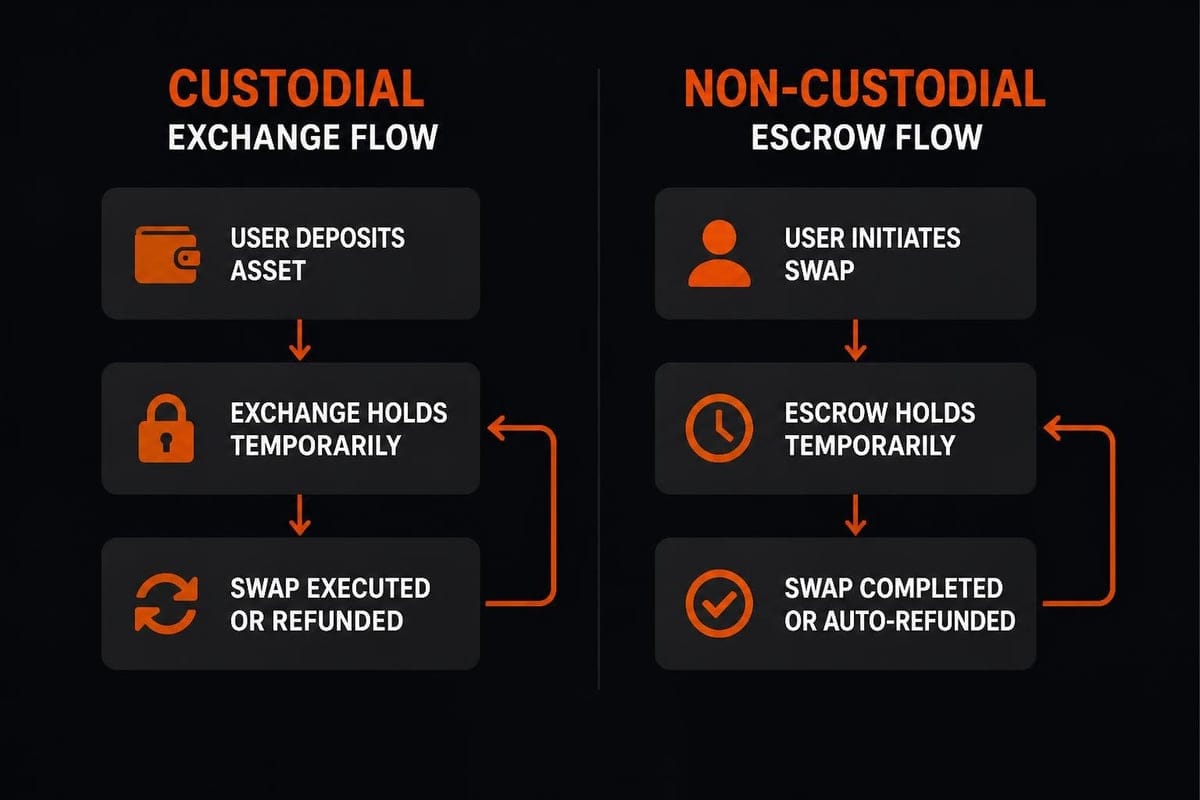
The best way to swap ZEC to XMR avoids custodial services entirely. A non-custodial swap means the service never takes possession of your coins. Instead, it coordinates an atomic swap or uses a brief escrow that automatically refunds if conditions aren't met. The service can't steal your funds, freeze your account, or comply with a seizure order targeting your specific swap.
| Service Type | Custody Model | KYC Requirement | Privacy Level | Technical Complexity |
|---|---|---|---|---|
| Non-custodial atomic | No custody | None | Highest | Medium-High |
| Non-custodial escrow | Temporary escrow | None | High | Low |
| Instant swaps | Full custody | Varies | Medium | Low |
| DEX aggregators | Mixed | None | Medium-High | Medium |
| Centralized exchange | Full custody | Required | Lowest | Low |
Non-custodial swap services range from single-operator platforms to decentralized protocols. The Monero ecosystem particularly values services that don't log IP addresses, don't require email registration, and support Tor access for complete network-level anonymity.
How MoneroSwap Handles ZEC to XMR
When you swap ZEC to XMR on MoneroSwap, the platform generates a unique deposit address for your ZEC and a receiving address where you'll get your XMR. You send shielded ZEC to the deposit address. The service detects your deposit, calculates the XMR amount based on real-time rates, and sends XMR to your specified address once your ZEC transaction confirms.
The entire process happens without account creation, email verification, or document uploads. MoneroSwap doesn't retain logs linking your ZEC deposit to your XMR withdrawal, and the open-source codebase lets you verify these claims. The service is also accessible via Tor, ensuring your IP address isn't recorded alongside transaction metadata.
Rate locks typically last 10-15 minutes, giving you time to broadcast your ZEC transaction without exposing yourself to significant price movement. If rates shift dramatically during this window, some services may adjust the output amount, while others guarantee the quoted rate. Always verify the specific terms before sending coins.
Trustless Atomic Swap Protocols
True atomic swaps between ZEC and XMR remain technically challenging in 2026. Atomic swaps require both chains to support compatible cryptographic primitives, typically hash time-locked contracts (HTLCs) or adaptor signatures. Monero's privacy features make standard HTLC implementations impossible because you can't verify a hash lock publicly on the chain.
Modern atomic swap research explores multi-party computation and adaptor signature schemes that work with Monero's architecture, but production-ready implementations are still limited. Most services advertising "atomic swaps" actually use a trusted escrow model where the service operator holds keys during the swap window, which introduces counterparty risk.
Actual atomic swap requirements:
- Both parties lock funds in conditional outputs
- Swap completes or both parties recover their original coins
- No trusted third party can steal funds
- Time locks ensure eventual refund if counterparty disappears
The cryptographic barriers mean the best way to swap ZEC to XMR in practice uses non-custodial escrow rather than pure atomic swaps. You trust the service operator won't steal during the brief window when funds are in flight, but you verify the operator can't access old swap records or link your identity to the transaction.
Privacy Considerations During the Swap
Even when using the best way to swap ZEC to XMR through a non-custodial service, several privacy leak vectors exist. Your network connection reveals your IP address unless you route through Tor or a trusted VPN. Your ZEC wallet may broadcast transactions through nodes that log IP addresses and transaction data. Your Monero wallet similarly connects to remote nodes unless you run your own.
Network-Level Privacy
Connect to both the swap service and your wallet backends through Tor. Most Zcash wallets in 2026 support Tor proxy configuration, though some mobile wallets still leak DNS queries or use clearnet connections for price data. Monero wallets generally have better Tor integration, with many defaulting to local node connections or trusted remote nodes over onion services.
Browser fingerprinting remains relevant even for services that don't require accounts. Your browser type, installed fonts, screen resolution, and dozens of other parameters create a unique identifier. Using Tor Browser in its default configuration mitigates most fingerprinting vectors, making your session indistinguishable from millions of other Tor Browser users.
Essential privacy steps:
- Use Tor or a no-log VPN for all swap-related connections
- Run your own ZEC and XMR nodes, or carefully vet remote nodes
- Clear browser state between sessions or use Tor Browser
- Avoid reusing addresses across different services or time periods
- Consider timing correlation attacks when performing large or unusual swaps
Risk Factors in Privacy Coin Swaps
Regulatory scrutiny of privacy coin swaps has intensified since 2024. The 2025 cross-chain crime report documents how law enforcement and compliance firms analyze instant swap services to trace illicit flows. Even non-custodial services face operational risk if they operate in jurisdictions with aggressive privacy coin regulations.
Users face different risks. If you send ZEC from a transparent address directly to a swap service, any observer of the ZEC chain can see the amount and destination. If the swap service later cooperates with law enforcement or suffers a data breach, that information could link your ZEC source to your XMR destination, negating the privacy benefits of both coins.
Mitigating Swap Risks
The best way to swap ZEC to XMR minimizes trust at every step. Verify the swap service's reputation through community feedback on privacy-focused forums, check that the codebase is open source and recently audited, and test with a small amount before committing larger sums. Services that have operated for years without incident have demonstrated both technical competence and resistance to compromise.
Diversify across services rather than using the same platform repeatedly. Even if a service doesn't log transactions, using it exclusively creates a behavioral pattern that might be detectable through timing analysis or amount correlation. Mixing services, delays, and intermediate steps makes holistic surveillance significantly harder.
Rate volatility poses practical risk, especially for larger swaps. Privacy coins often have thinner liquidity than major assets, and a 2-3% price move during the swap window can substantially change your output. Some users split large swaps into multiple smaller transactions executed over hours or days to average out price variance, though this introduces additional privacy considerations.
Alternative Methods and Their Tradeoffs
Direct peer-to-peer trading offers maximum privacy when executed carefully. You find a counterparty through forums or encrypted messaging apps, agree on a rate, and perform a manual swap where you each send coins to addresses the other provides. This eliminates the service operator as a potential surveillance point but introduces significant counterparty risk and requires finding someone who wants exactly the opposite trade.
| Method | Privacy | Convenience | Speed | Risk |
|---|---|---|---|---|
| Non-custodial swap service | High | High | Fast (10-30 min) | Low |
| P2P manual trade | Highest | Low | Slow (hours-days) | Medium-High |
| Centralized exchange | Lowest | High | Fast (minutes) | Medium |
| DEX with wrapped tokens | Medium | Medium | Medium (30-60 min) | Medium |
Some users route through intermediate coins to obscure the direct ZEC-to-XMR connection. You might swap ZEC for BTC on one service, wait several hours or days, then swap BTC to XMR on a different platform. This adds cost (two sets of fees), time, and counterparty exposure, while the privacy benefit depends heavily on execution details.
Zcash Shielded Transaction Best Practices
Using Zcash privacy features correctly requires understanding that shielded pools only protect you when enough other users also use them. If you're one of five users who shielded funds on a particular day, timing and amount correlation can still identify your specific transaction even though the cryptographic layer prevents direct address linking.
Wait at least several blocks after shielding before moving coins to a swap service. Let your shielded transaction mix with other shielded activity. This isn't mixing in the traditional sense (Zcash doesn't use decoy inputs like Monero), but it increases the anonymity set of potentially related transactions. The longer you wait and the more other shielded transactions occur, the harder timing correlation becomes.
Avoid round numbers when shielding or swapping. Sending exactly 10.0 ZEC makes your transaction easier to correlate than sending 10.1847 ZEC. The dust and fractional amounts from normal trading activity create cover for your specific transaction.
Unified Address Considerations
Unified addresses simplify Zcash UX by letting one address receive both transparent and shielded funds, but they don't automatically improve privacy. Coins received to the transparent component of a unified address remain fully visible on-chain. You still need to explicitly shield them before swapping.
Some wallets auto-shield transparent funds received to unified addresses after a certain number of confirmations. Verify your wallet's behavior rather than assuming automatic shielding. If the swap service requires a specific address type, generate the appropriate format from your wallet rather than relying on unified address auto-detection.
Monero Reception and Post-Swap Security
Once XMR arrives in your wallet, it benefits from Monero's mandatory privacy features. Each transaction uses ring signatures that hide your actual output among 15 decoy outputs, stealth addresses that prevent address reuse tracking, and RingCT that obscures amounts. Unlike ZEC where you had to actively choose shielded transactions, XMR makes privacy the only option.
Running your own Monero node provides the strongest privacy guarantees when checking your balance and broadcasting transactions. Remote nodes can theoretically correlate your IP address with the transactions you query, though they can't determine which outputs you actually control or spent. In 2026, Monero light wallet protocols have improved significantly, offering better privacy than earlier approaches while maintaining usability.
If your Monero transaction appears stuck or unconfirmed, the usual culprits are low fee rates, network congestion, or wallet synchronization issues. Unlike Bitcoin-based coins where you can fee-bump, Monero's dynamic block size usually absorbs congestion, making stuck transactions rare but wallet sync problems more common.
Fee Structure and Economic Considerations
Swap services charge fees ranging from 0.5% to 2% per transaction, plus network fees for both the ZEC deposit and XMR withdrawal. Network fees vary with blockchain congestion. Zcash fees remain relatively low even during high activity because blocks aren't consistently full. Monero fees fluctuate with the dynamic block size algorithm but generally stay under $0.50 in 2026.
Typical fee breakdown for a $1,000 swap:
- Service fee (1.0%): $10.00
- ZEC network fee: $0.05-0.20
- XMR network fee: $0.10-0.50
- Total cost: $10.15-10.70 (1.02-1.07% all-in)
Minimum swap amounts exist because network fees would make tiny swaps economically irrational. Most services set minimums around $50-100 equivalent, though this varies by coin and current fee environment. Maximum amounts depend on service liquidity and risk management policies, often ranging from $5,000 to $50,000 per single swap.
Services with higher fees sometimes offer better privacy practices, like storing less metadata or maintaining Tor-only operations that increase hosting costs. The cheapest option isn't always the best way to swap ZEC to XMR if it compromises privacy through excessive logging or poor operational security.
Verifying Swap Service Integrity
Open-source swap platforms let you audit the code that handles your transactions. Clone the repository, review the transaction handling logic, verify that sensitive data isn't logged, and check that the service doesn't phone home with transaction metadata. Building from source and comparing the binary hash against what the service runs gives cryptographic proof you're using the vetted code.
MoneroSwap's verification tools let you independently confirm swap status without logging into any account or revealing your identity. You enter the swap ID generated when you initiated the transaction and check progress without providing additional information. This separation of swap execution from status checking prevents accidental metadata correlation.
Reviews from privacy-focused communities carry more weight than generic crypto forums. Active users in Monero subreddits, Matrix channels, and privacy-focused Telegram groups often have direct experience with various services and can identify operators who've had security incidents, privacy breaches, or sudden operational changes that might indicate compromise.
When to Use Alternative Pairs
Sometimes the best way to swap ZEC to XMR isn't a direct swap. If ZEC liquidity is thin but ETH liquidity is deep, you might get better rates swapping ZEC to ETH, then ETH to XMR, even after paying two sets of fees. Real-time rate comparison across different paths reveals inefficiencies in thinly traded pairs.
Market conditions matter. During ZEC-specific volatility (major protocol upgrades, regulatory news, exchange delistings), spreads widen significantly. Waiting hours or days for volatility to settle can save several percentage points on larger swaps, though this introduces time risk if you're trying to exit ZEC entirely.
Privacy-conscious users might deliberately choose less efficient paths to obscure their conversion. If most people swap ZEC to XMR directly and you route through three intermediate assets over two services, you create a unique pattern that paradoxically might be more identifiable, or you blend into sophisticated users who all employ similar privacy-enhancing techniques.
Converting between privacy coins requires technical awareness of each coin's privacy model and careful attention to operational security throughout the swap process. The best way to swap ZEC to XMR combines shielded Zcash transactions before the swap, non-custodial services that don't log transaction metadata, and proper Monero wallet practices after receiving your coins. When you're ready to exchange ZEC for XMR with full privacy and no KYC requirements, MoneroSwap offers open-source, non-custodial swaps with Tor support and zero log retention.
Swap into or out of Monero, no KYC
MoneroSwap is a non-custodial way to swap Monero with no account, no KYC, and no logs. Open source and available over Tor. Verify every claim, then swap BTC to Monero, ETH to Monero, USDT to Monero, or see all pairs. New here? Start with the FAQ.
← All guides