
Non KYC Exchanges in 2026: What You Need to Know
Non kyc exchanges let you trade cryptocurrency without submitting identity documents or creating an account. These platforms skip the document scan and selfie requirement that centralized exchanges mandate, processing swaps through automated protocols or decentralized order books instead. The trade-off centers on regulatory risk, liquidity depth, and counterparty trust compared to KYC-compliant venues.
The landscape changed substantially in 2025 when several jurisdictions tightened rules around unhosted wallets and decentralized finance protocols. Law enforcement perspectives on anonymization services now frame much of the policy debate. Yet demand for privacy-preserving swaps continues growing as users weigh surveillance against convenience.
How Non KYC Exchanges Actually Work
Most non kyc exchanges operate through one of three architectures: atomic swaps, automated market makers, or hybrid order routing with ephemeral matching.
Atomic swaps use hash time-locked contracts to guarantee simultaneous settlement on two blockchains. You lock Bitcoin on one chain while your counterparty locks Monero on another. Both transactions execute or both fail. No custodian holds funds during the process. The protocol enforces the exchange through cryptographic commitments rather than a trusted intermediary.
Automated market makers deploy liquidity pools where traders swap against algorithmically priced reserves. You send one token into a smart contract and receive another based on the pool's ratio. No order book exists. Slippage depends on pool depth and trade size. The platform itself never sees your identity because the entire interaction happens on-chain through wallet signatures.
Hybrid models aggregate liquidity from multiple sources while maintaining privacy. These platforms temporarily match orders without storing user data, routing swaps through partners or integrated DEX protocols. You interact with an API endpoint or web interface but never create a persistent account. The service processes each swap as an isolated transaction with no link to previous activity.

Privacy Architecture Components
The strongest non kyc exchanges combine several technical elements to protect user anonymity:
- No registration: You paste two wallet addresses and initiate a swap. The platform generates a temporary session ID for tracking the transaction status but stores no personal identifiers.
- No log retention: Server logs either don't record IP addresses or purge them within minutes. Some platforms run entirely on stateless infrastructure.
- Tor compatibility: The service operates as a hidden service or allows clearnet access through Tor circuits without blocking or rate-limiting.
- Open source code: Anyone can audit the swap logic, verify no data collection happens, and run their own instance if desired.
MoneroSwap's open-source implementation demonstrates this architecture. You can verify the code, use the Tor hidden service, and complete swaps without ever exposing an identifier to the platform.
Regulatory Framework and Compliance Risk
Non kyc exchanges sit in a complex legal position. The FinCEN Customer Due Diligence requirements explicitly mandate identity verification for money service businesses operating in the United States. Exchanges registered in that jurisdiction must collect and verify names, addresses, dates of birth, and identification numbers.
Platforms dodge this by operating offshore, limiting services to non-US persons, or structuring as pure software providers rather than financial intermediaries. The third approach argues the code simply facilitates peer-to-peer transactions without the platform ever taking custody or control. Courts haven't settled which model survives regulatory scrutiny.
Europe's approach differs slightly. The Fifth Anti-Money Laundering Directive extends obligations to virtual asset service providers but leaves member states to implement specifics. Some countries require KYC for all fiat on-ramps but remain ambiguous about crypto-to-crypto swaps. Others apply transaction thresholds below which verification isn't required.
| Jurisdiction | KYC Threshold | Enforcement Focus | Non-KYC Viability |
|---|---|---|---|
| United States | All transactions | Criminal use cases | Low |
| European Union | Varies by state | Large-volume traders | Medium |
| Switzerland | Above CHF 1,000 | Mixer services | Medium |
| Singapore | All fiat on/off ramps | Unlicensed operators | Low |
| Malta | Varies by license type | Tax evasion | Medium |
The World Economic Forum's regulatory pathways report suggests global coordination will eventually tighten. For now, regulatory arbitrage remains possible for platforms willing to accept jurisdictional risk.
Trade-offs Compared to KYC Platforms
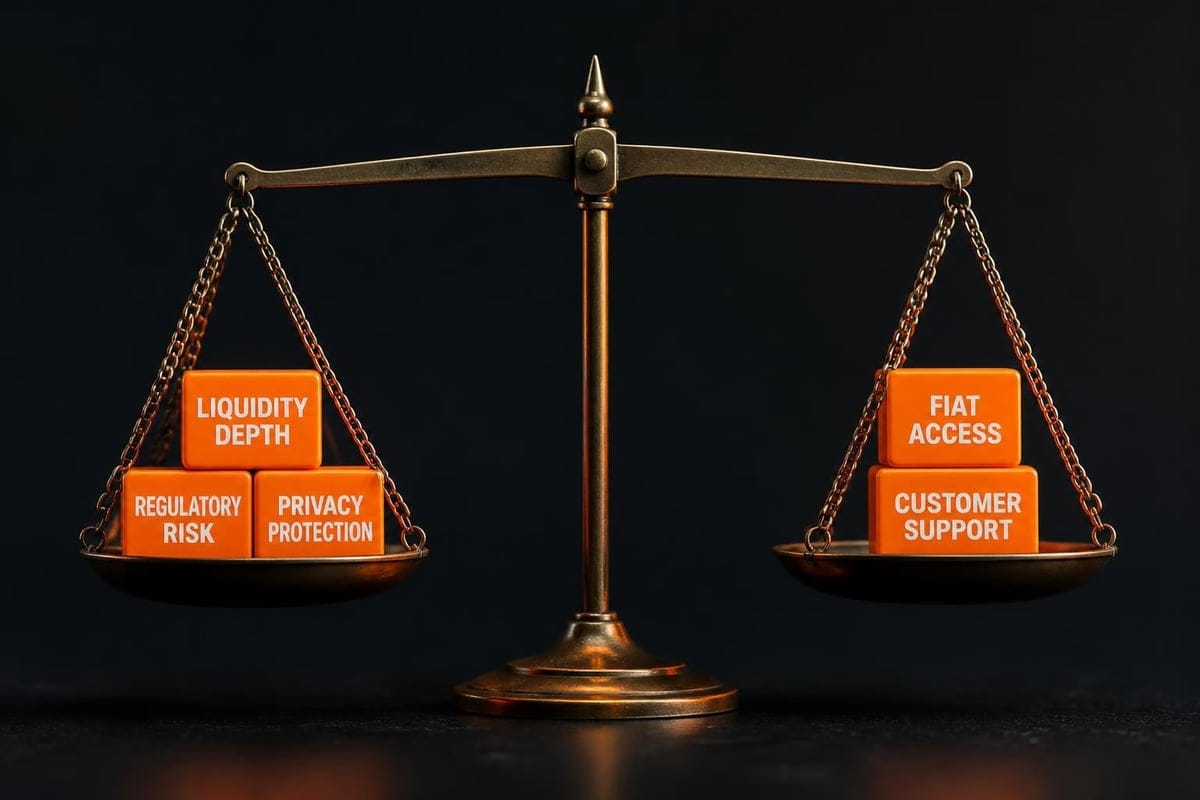
Non kyc exchanges sacrifice certain features that centralized venues provide. Understanding these trade-offs helps you decide when privacy justifies the cost.
Liquidity depth ranks as the primary limitation. Binance or Coinbase processes billions in daily volume across thousands of trading pairs. A typical non-KYC platform might handle millions across a few dozen pairs. Tighter spreads and deeper order books mean less slippage on large trades when you use KYC exchanges.
Fiat on-ramps rarely exist for non kyc exchanges. You can't wire dollars from a bank account and buy Bitcoin without identity verification. Most users bridge into crypto through a KYC exchange or peer-to-peer trade, then migrate to privacy-focused platforms for subsequent swaps.
Customer support operates differently. When Kraken or Gemini freezes your account, you can file a support ticket, escalate through their system, and potentially recover funds through legal action. Non kyc exchanges typically offer minimal support because helping you requires verifying identity, which defeats the purpose. You're responsible for correct addresses, sufficient network fees, and understanding the protocol's limitations.
Reversibility doesn't exist. Blockchain transactions finalize within minutes or hours depending on confirmation requirements. If you send funds to the wrong address or fall victim to a phishing site impersonating a non-KYC platform, recovery options evaporate. KYC exchanges can sometimes reverse or freeze transactions during investigation.
When Privacy Outweighs Convenience
You might choose non kyc exchanges when:
- Geographic restrictions block you from KYC platforms due to sanctions, local regulations, or platform policies
- Privacy concerns around data breaches, government surveillance, or commercial data sales justify the operational friction
- Small trade sizes keep slippage acceptable even with limited liquidity
- Crypto-to-crypto swaps eliminate the need for fiat rails that require banking integration
The typical user profile includes people in countries with capital controls, activists and journalists managing sensitive funds, and crypto-native traders who value pseudonymity over fiat integration.
Evaluating Platform Safety and Legitimacy
Scams proliferate in the non-KYC space precisely because users can't rely on regulatory oversight or identity verification. You need alternative methods to assess whether a platform will actually complete the swap or simply steal your deposit.
Code transparency matters most. Open source platforms let you inspect the swap logic, verify no backdoors exist, and confirm the implementation matches the description. You can also check whether anyone has identified vulnerabilities in the codebase. Closed-source platforms require trusting the operator's claims without verification.
On-chain settlement eliminates counterparty risk when implemented correctly. Atomic swaps and smart contract-based exchanges settle directly on blockchains without giving the platform custody. You can verify the contract addresses, confirm transactions on a block explorer, and see exactly where funds move. Contrast this with platforms that hold deposits in centralized wallets during processing.
Community reputation provides signal despite being easy to manipulate. Check how long the platform has operated, whether independent reviewers have tested it, and if users report successful swaps on forums. New platforms with no history and glowing testimonials deserve skepticism.
Domain and infrastructure details reveal operational security. Does the platform use HTTPS correctly? Is the domain registered anonymously or to a known entity? Can you access it through Tor without JavaScript requirements that could de-anonymize you? These technical choices signal whether the operators actually prioritize privacy.
Red Flags to Avoid
Skip platforms that exhibit these warning signs:
- Unrealistic rates: Spreads significantly better than market prices indicate either a scam or hidden fees
- Custody during swaps: Platforms that ask you to deposit first, then process the swap later, introduce exit scam risk
- Required registration: Any identity collection negates the privacy benefit and creates honeypot risk
- No blockchain proof: If you can't verify transactions on a public explorer, you're trusting the platform's interface
- Poor operational security: Platforms with frequent downtime, confusing interfaces, or slow support likely lack resources to maintain secure infrastructure
The CoinDesk Research Exchange Benchmark provides context on how established exchanges implement security, though it focuses primarily on KYC-compliant platforms.
Criminal Use and Risk Management
Non kyc exchanges attract criminal activity because identity verification creates forensic trails. The 2025 Crypto Crime Report documents how ransomware operators, darknet vendors, and sanctions evaders use privacy-preserving swaps to obscure fund flows. This reality shapes both regulatory pressure and technical countermeasures.
Platforms face a tension between protecting legitimate user privacy and avoiding facilitation of serious crimes. Some implement partial mitigations:
- Transaction limits: Capping swap sizes to a few thousand dollars reduces appeal for money laundering while preserving utility for normal users
- Velocity controls: Throttling how many swaps a single wallet can initiate prevents high-frequency mixing
- Sanctioned address screening: Blocking deposits from wallets flagged by Chainalysis or similar vendors without requiring user identity
- No privacy coin outputs: Refusing to facilitate swaps into Monero or Zcash eliminates the most effective obfuscation method
Each mitigation erodes privacy to some degree. Screening requires the platform to monitor on-chain activity. Transaction limits force users to split large swaps across multiple sessions, creating additional metadata. The question becomes where platforms draw the line between protecting users and protecting themselves from enforcement action.
Analysis of seizable crypto assets shows law enforcement now traces funds through multiple hops, including privacy coins and decentralized swaps. The assumption that non kyc exchanges provide perfect anonymity doesn't hold when chain analysis links your deposit address to previous activity.

Privacy Coins and Swap Dynamics
Non kyc exchanges see particularly high demand for privacy coin pairs. Monero swaps account for a disproportionate share of volume because XMR provides transaction-level privacy that Bitcoin and Ethereum lack. This creates specific dynamics for platforms and users.
Converting BTC to XMR serves as the primary on-ramp for users wanting to break the chain analysis trail. Bitcoin's transparent blockchain lets anyone trace funds from exchange withdrawal through subsequent transactions. Swapping to Monero severs that link because XMR transactions hide amounts, sender, and recipient by default.
The reverse swap creates different considerations. Moving XMR to BTC makes sense when you need to interact with services that don't accept privacy coins or want to cash out through a KYC exchange. The challenge lies in explaining the source of your Bitcoin if it appears with no transaction history. Some exchanges flag deposits from addresses with no prior activity as potentially suspicious.
Stablecoin pairs like USDT to XMR and USDC to XMR let users move between fiat-pegged value and privacy without touching Bitcoin's fees or volatility. These swaps particularly appeal to users in countries where stablecoin access exceeds local banking stability.
Liquidity Challenges for Privacy Pairs
Privacy coins face persistent liquidity issues on both KYC and non-KYC venues. Major exchanges delisted Monero in 2024 and 2025 due to regulatory pressure. This pushed volume toward decentralized platforms but fragmented liquidity across many small pools.
Non kyc exchanges partially solve this through cross-chain aggregation. Rather than maintaining a single Monero pool, platforms route swaps through multiple liquidity sources including automated market makers, cross-chain bridges, and over-the-counter desks. You see a unified interface while the platform optimizes for best execution across backends.
The fragmentation creates arbitrage opportunities. Monero often trades at different implied rates across non-KYC platforms depending on liquidity depth and regional demand. Users who monitor multiple platforms can capture spreads, though transaction fees and timing risk limit profitability to larger swaps.
Operational Patterns and User Behavior
Data from platforms that publish aggregate statistics reveals how people actually use non kyc exchanges. The median swap size hovers around $200 to $800, substantially smaller than typical centralized exchange trades. This suggests users prioritize privacy for specific transactions rather than migrating all trading activity.
Swap frequency shows clustering around regulatory announcements, exchange hacks, and crypto market stress. When Binance or Coinbase implements new verification requirements, non-KYC platform volume spikes. The same pattern appears after data breaches expose customer information or governments announce new surveillance programs.
Geographic distribution concentrates in regions with capital controls, authoritarian governance, or limited banking access. Platforms using Cloudflare or similar CDNs can observe connection patterns without logging IP addresses. Traffic originates heavily from Southeast Asia, Africa, and Latin America compared to North American or European concentration on KYC exchanges.
Preferred swap pairs vary by region:
- Asia-Pacific: ETH to XMR dominates due to high Ethereum adoption and capital controls
- Latin America: Stablecoin to BTC pairs driven by inflation hedging
- Africa: Smaller trades across diverse pairs reflecting mobile money integration
- Eastern Europe: Heavy privacy coin usage correlated with conflict zones and sanctions
The pattern suggests non kyc exchanges serve primarily as privacy gateways rather than full-service trading venues. Users acquire crypto through any available method, then swap to privacy coins for storage or specific transactions before potentially converting back.
Technical Implementation Details
Understanding how non kyc exchanges implement swaps helps you evaluate security and privacy claims. The implementation determines what data exists, who can access it, and what forensic traces remain.
Stateless session management means the platform generates a random identifier when you initiate a swap but stores no database record linking it to you. The ID appears in your browser's URL so you can check transaction status. Once the swap completes and both parties confirm, the platform deletes all data associated with that session. You can verify this pattern by checking whether refreshing the status page after completion returns an error.
Server-side validation happens through blockchain monitoring without storing transaction graphs. When you initiate a swap, the platform generates a deposit address and watches for an incoming transaction matching the amount. It confirms sufficient network confirmations, then triggers the outbound transfer to your specified address. The validation logic operates in memory during processing but doesn't persist.
Rate determination varies by architecture. Automated market makers calculate rates from on-chain pool ratios. Aggregator platforms query multiple liquidity sources and return the best available rate plus a service fee. Some platforms use oracles to fetch market rates from major exchanges, then apply a spread. The methodology affects whether you get competitive pricing and how much execution risk exists between rate quote and settlement.
Infrastructure and Hosting
Where platforms run their infrastructure impacts both uptime and seizure risk. Traditional cloud hosting through AWS or Google Cloud exposes platforms to takedown requests. Law enforcement can serve warrants to hosting providers and seize servers along with any data they contain.
Distributed hosting across multiple providers in different jurisdictions makes coordinated takedowns harder. Some non kyc exchanges operate through a network of servers that can route around failures or seizures. You might connect to different backend nodes on successive visits without realizing it.
Tor hidden services eliminate server location entirely from the threat model. The platform publishes an onion address that routes through the Tor network. Users access the service without knowing where servers physically run. Law enforcement must compromise the Tor network or exploit software vulnerabilities rather than serving warrants to hosting companies.
Future Development and Regulatory Pressure
The trajectory for non kyc exchanges depends largely on regulatory evolution. Current trends point toward tighter requirements but implementation remains inconsistent globally. This creates ongoing arbitrage opportunities for platforms willing to accept legal risk.
Privacy-preserving technology continues advancing faster than regulation can adapt. Zero-knowledge proofs now enable transaction validation without revealing amounts or parties. These protocols could let platforms prove compliance with transaction limits or sanctions screening without compromising user privacy. The regulatory question is whether authorities will accept cryptographic proofs in lieu of direct identity verification.
Cross-chain interoperability improves through new bridge protocols and atomic swap implementations. You can already swap between Bitcoin, Ethereum, and Monero without a centralized party. Expanding this to more chains and improving user experience could push more volume toward fully decentralized infrastructure that no single jurisdiction controls.
Emerging trends include:
- Built-in mixing: Some platforms combine swaps with coin mixing to obscure on-chain trails more thoroughly than simple exchange
- Layer-2 integration: Lightning Network and similar protocols enable faster, cheaper swaps with better privacy than base-layer transactions
- Decentralized identity: Systems like Web3 DIDs could let you prove attributes (age, accreditation status) without revealing identity, potentially satisfying some regulatory requirements
- Submarine swaps: Technology that lets you swap between on-chain and Lightning with no trusted intermediary
Each development changes the trade-offs between privacy, security, regulatory risk, and user experience. Platforms that successfully integrate new privacy tech while maintaining usability will likely capture growing market share as surveillance pressure increases.
Non kyc exchanges provide essential privacy protection for cryptocurrency users who refuse to submit identity documents or create trackable accounts. The technical architecture, regulatory landscape, and operational trade-offs all factor into whether these platforms suit your specific needs versus KYC-compliant alternatives. When you need to swap crypto while preserving anonymity, MoneroSwap offers a non-custodial, open-source platform that processes exchanges without registration, KYC, or log retention-just paste your addresses and complete the swap through Tor or clearnet.
Swap into or out of Monero, no KYC
MoneroSwap is a private Monero swap with no account, no KYC, and no logs. Open source and available over Tor. Verify every claim, then swap BTC to Monero, ETH to Monero, USDT to Monero, or see all pairs. New here? Start with the FAQ.
← All guides