
KYC Exchange: What It Means and How It Works in 2026
A kyc exchange is a cryptocurrency trading platform that requires you to submit identity documents and personal information before you can buy, sell, or withdraw digital assets. These platforms collect government-issued IDs, proof of address, and sometimes selfies to comply with anti-money laundering (AML) and counter-terrorist financing (CTF) regulations. Most centralized exchanges enforce KYC verification today, limiting or fully restricting access for unverified users.
The shift toward mandatory verification has accelerated since 2020. Regulators in the United States, European Union, and Asia now treat cryptocurrency exchanges as financial institutions subject to the same compliance frameworks as banks. This means platforms must verify customer identities, screen against sanctions lists, and report suspicious activity.
Why Cryptocurrency Exchanges Implement KYC
Exchanges adopt KYC protocols primarily to comply with national and international regulations. The U.S. Bank Secrecy Act (BSA) requires virtual currency businesses to establish customer identification programs (CIP) and maintain records of transactions over certain thresholds. European operators follow the Fifth Anti-Money Laundering Directive (5AMLD) and, as of 2026, the Markets in Crypto-Assets Regulation (MiCA), which brings uniform KYC standards across member states.
Beyond legal compliance, a kyc exchange uses verification to manage operational risk. Platforms face pressure from banking partners, payment processors, and liquidity providers who refuse to work with services that allow anonymous trading. Insurance underwriters and institutional investors also demand proof of robust compliance before deploying capital.
Key regulatory drivers include:
- Prevention of money laundering and terrorist financing
- Sanctions screening against OFAC, UN, and EU lists
- Tax reporting obligations (Form 1099 in the U.S., DAC8 in the EU)
- Fraud prevention and dispute resolution

The European Banking Authority has published detailed guidance on how crypto-asset service providers must assess and mitigate money laundering and terrorist financing risks. These frameworks extend traditional banking KYC to digital assets, requiring layered due diligence for higher-risk customers.
What Data a KYC Exchange Collects
When you register on a kyc exchange, the platform typically requests multiple categories of personal information. The exact requirements vary by jurisdiction and the exchange's risk appetite, but most follow a tiered structure.
| Verification Level | Data Required | Typical Limits |
|---|---|---|
| Basic (Tier 1) | Email, phone number, name | $500–$2,000/day withdrawals |
| Intermediate (Tier 2) | Government ID, address proof, selfie | $10,000–$50,000/day |
| Advanced (Tier 3) | Bank statements, source of funds, employment | Unlimited or very high caps |
Standard identity documents include:
- Passport (most widely accepted)
- National ID card
- Driver's license (accepted in some jurisdictions)
Proof of address documents:
- Utility bill (electricity, water, gas) dated within 90 days
- Bank or credit card statement
- Government-issued residence certificate
Some platforms require a liveness check: you hold your ID next to your face while the camera captures a photo or short video. This prevents submission of stolen or synthetic identities. Advanced systems use facial recognition to match the selfie against the ID photo and cross-reference against watchlists.
How the KYC Verification Process Works
The verification process on a kyc exchange follows a predictable sequence, though timelines vary. Automated systems handle most checks, escalating edge cases to human reviewers.
- Account creation: You provide an email address and create a password. Some exchanges allow limited browsing without verification.
- Personal information form: You enter full legal name, date of birth, nationality, and residential address exactly as they appear on your ID.
- Document upload: You photograph or scan your government-issued ID and proof of address, then upload the images through the exchange's web or mobile interface.
- Selfie or liveness check: The platform prompts you to take a photo of yourself, often with specific instructions (remove glasses, face the camera directly).
- Automated verification: Optical character recognition (OCR) extracts data from your ID. The system checks document security features (holograms, fonts, microprinting) and compares the selfie to the ID photo.
- Sanctions and PEP screening: Your name and address are checked against sanctions lists (OFAC, UN, EU) and politically exposed persons (PEP) databases.
- Manual review (if needed): Documents that fail automated checks or trigger risk flags go to a compliance officer for human review.
- Approval or rejection: You receive an email confirming successful verification or requesting additional documents. The process takes minutes to several days.
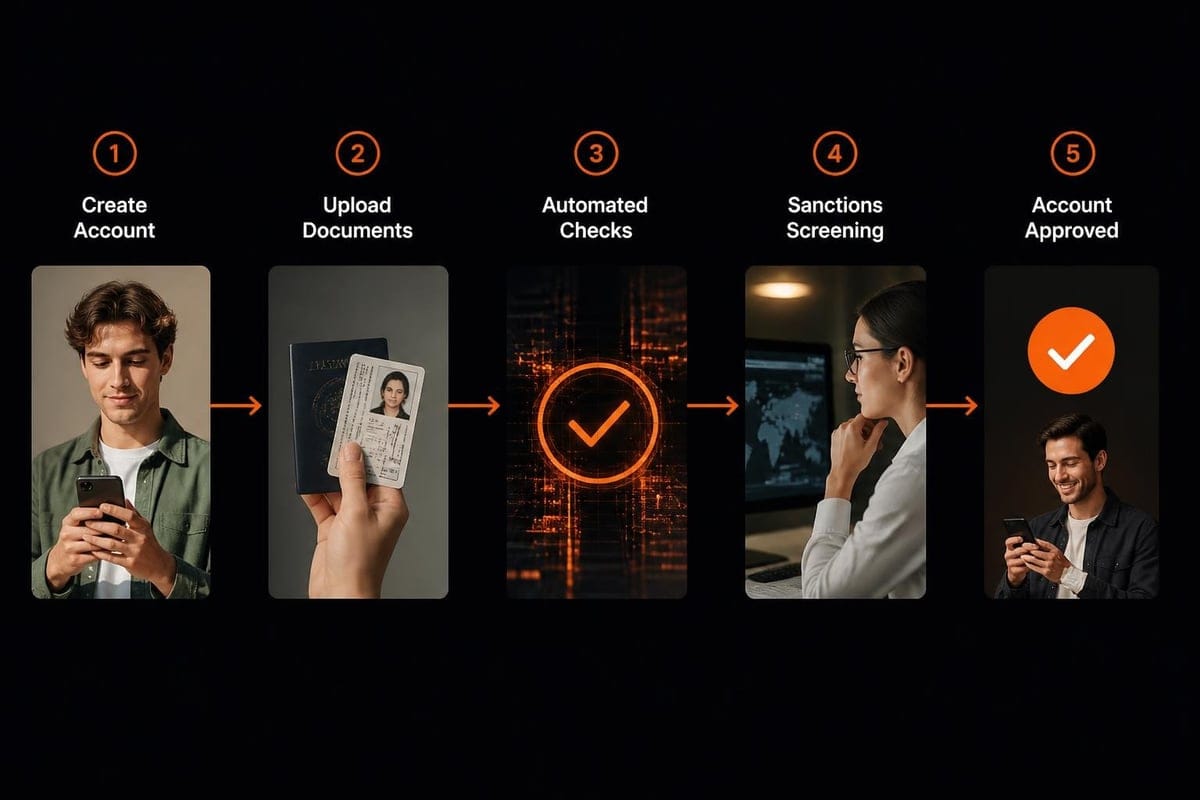
Failed verifications usually result from mismatched information (name on ID differs from registration form), poor image quality, expired documents, or unsupported ID types. OFAC sanctions compliance guidance emphasizes that exchanges must screen not just at onboarding but continuously, re-checking users against updated watchlists.
Enhanced Due Diligence for High-Risk Users
A kyc exchange applies stricter scrutiny to customers who trigger risk indicators. Enhanced due diligence (EDD) involves deeper investigation into the source of funds, transaction patterns, and beneficial ownership of corporate accounts.
EDD triggers include:
- Large transaction volumes (typically above $100,000)
- Customers from high-risk jurisdictions (FATF blacklist or graylist countries)
- Politically exposed persons (PEPs) or their family members
- Businesses in cash-intensive industries
- Frequent deposits from multiple sources
EDD procedures require you to provide additional documents: bank statements showing the origin of deposited funds, employment contracts, tax returns, or incorporation papers for business accounts. The European Commission's due diligence guidance outlines practical risk indicators and red flags that crypto platforms must monitor, including structuring (splitting transactions to avoid thresholds), rapid movement of funds, and use of mixing services.
Some exchanges conduct video interviews with high-value customers, asking you to explain your trading strategy and demonstrate familiarity with the account. This human touchpoint helps detect account takeovers and synthetic identities.
Privacy Trade-offs on a KYC Exchange
Submitting identity documents to a kyc exchange creates permanent records linking your real-world identity to your cryptocurrency holdings and transaction history. These databases become targets for hackers, government subpoenas, and internal misuse.
Major breaches have exposed customer data at multiple exchanges. In 2020, attackers stole KYC documents from a third-party vendor serving several Asian platforms, leaking passports and selfies onto the dark web. In 2022, law enforcement seized customer databases from a European exchange under investigation for facilitating money laundering, revealing trading patterns of tens of thousands of users.
Privacy risks include:
- Data breaches: Centralized storage of identity documents creates a single point of failure.
- Government surveillance: Regulators can subpoena customer records, linking identities to blockchain addresses.
- Cross-platform tracking: Blockchain analysis firms build profiles by correlating KYC data from multiple exchanges.
- Insider threats: Exchange employees with database access can steal or sell customer information.
Once a kyc exchange links your identity to deposit addresses, every subsequent on-chain transaction becomes traceable. Even if you withdraw to a non-custodial wallet, the origin point remains tied to your name. Academic research on privacy coin trading activity shows that centralized KYC exchanges create chokepoints where user anonymity is permanently compromised, influencing decisions by privacy-focused traders to avoid verification entirely.

Industry KYC Practices and Compliance Gaps
The 2024 TokenInsight Crypto Exchange Compliance Report benchmarks KYC practices across major platforms. It found significant variation in verification rigor, with some exchanges accepting easily forged documents and others using multi-layered biometric checks. Common gaps include weak proof-of-address validation, insufficient PEP screening, and failure to re-verify customers periodically.
A few large platforms have moved beyond basic KYC to implement Know Your Transaction (KYT) monitoring. These systems flag deposits from mixers, sanctioned addresses, or known darknet markets. Chainalysis reports that exchanges increasingly adopt Know-Your-VASP protocols to assess the compliance posture of counterparty platforms before enabling withdrawals, creating a tiered ecosystem where verified exchanges trust each other's due diligence.
Alternatives to Using a KYC Exchange
Users who prioritize privacy or cannot pass verification due to documentation issues have several options outside the traditional kyc exchange model.
Non-custodial swap services allow you to exchange cryptocurrencies without creating an account or submitting identity documents. These platforms facilitate peer-to-peer trades or use atomic swaps and cross-chain protocols to execute exchanges directly between user wallets. MoneroSwap operates as an open-source, non-custodial service where you can swap BTC to XMR or exchange ETH to XMR without registration, KYC, or log retention.
Peer-to-peer (P2P) marketplaces connect buyers and sellers directly, allowing payment via bank transfer, cash, or even gift cards. These platforms (LocalBitcoins, Bisq, HodlHodl) offer varying degrees of anonymity. Bisq runs as desktop software over Tor, never touching your identity data. Others require minimal account setup but still collect IP addresses and transaction records.
Decentralized exchanges (DEXs) enable trading between wallet addresses without an intermediary. Uniswap, SushiSwap, and PancakeSwap let you swap ERC-20 or BEP-20 tokens by connecting a Web3 wallet. No email, no ID, no central database. Limitations include limited asset pairs (mostly tokens on a single chain), slippage on large trades, and higher fees for complex routes.
| Platform Type | KYC Required | Privacy Level | Asset Coverage | Liquidity |
|---|---|---|---|---|
| Centralized KYC exchange | Yes | Low | Broad (100+ assets) | High |
| Non-custodial swap | No | High | Moderate (major chains) | Moderate |
| P2P marketplace | Sometimes | Moderate | Moderate | Low-Moderate |
| DEX (AMM) | No | High | Single-chain tokens | Variable |
Non-KYC services trade convenience for privacy. They often have higher spreads, lower liquidity, and limited fiat on-ramps. You take custody of your private keys, accepting full responsibility for security and recovery.
Why Some Users Avoid KYC Exchanges
Beyond privacy preferences, practical barriers prevent many people from completing verification. Users in countries with weak identity infrastructure lack the documents a kyc exchange accepts. Refugees, stateless persons, and victims of domestic violence may not possess valid government IDs. Others have name mismatches due to marriage, translation issues, or legal name changes not reflected on older documents.
Residents of sanctioned countries face blanket exclusions. A Russian user cannot register on most Western exchanges, regardless of individual risk. The same applies to Iranians, North Koreans, and citizens of other OFAC-restricted jurisdictions. Even travelers can encounter problems when their proof of address is temporarily outdated.
Common reasons for avoiding KYC:
- Philosophical commitment to financial privacy
- Lack of acceptable identity documents
- Residence in a sanctioned or restricted jurisdiction
- Distrust of centralized data storage
- Concern about government overreach or surveillance
- Previous negative experiences with data breaches
Some cryptocurrency users believe that mandatory KYC contradicts the founding ethos of Bitcoin and other decentralized systems. They argue that peer-to-peer electronic cash should not require permission from intermediaries or surveillance by nation-states.
How Regulations Are Tightening in 2026
Regulatory pressure on a kyc exchange has intensified through 2026. The European Union's MiCA framework, fully enforced as of January 2026, requires all crypto-asset service providers to implement KYC for transactions above €1,000 and to share data with tax authorities under DAC8. The United States expanded FinCEN reporting requirements, mandating that exchanges file Suspicious Activity Reports (SARs) for transactions above $10,000 and maintain records for five years.
Asia-Pacific jurisdictions have diverged. Singapore and Japan enforce strict licensing regimes with comprehensive KYC mandates. Hong Kong's new VASP framework requires enhanced due diligence for all customers. Meanwhile, some jurisdictions continue to allow lighter-touch approaches, creating regulatory arbitrage opportunities that attract exchanges willing to operate in gray areas.
Recent regulatory developments:
- Travel Rule enforcement: Exchanges must share sender and recipient information for transactions above $1,000 (FATF guideline).
- Unhosted wallet rules: Proposed EU and U.S. regulations would require KYC for withdrawals to private wallets above certain thresholds.
- DeFi regulation: Regulators increasingly view DEX front-ends and liquidity providers as service providers subject to KYC requirements.
- Privacy coin restrictions: Several exchanges have delisted Monero, Zcash, and other privacy-preserving assets due to regulatory pressure.
The net effect is that operating a compliant kyc exchange has become more expensive and operationally complex. Smaller platforms struggle to afford enterprise-grade compliance software, leading to market consolidation around a few large, well-capitalized exchanges.
The Future of KYC in Cryptocurrency
Industry observers expect KYC requirements to expand rather than contract. Central bank digital currencies (CBDCs) under development in China, the EU, and elsewhere build identity verification into the protocol layer. Stablecoin issuers face increasing pressure to implement KYC at the wallet level, not just at on-ramps.
At the same time, privacy-preserving technology is improving. Zero-knowledge proofs enable selective disclosure, where you prove you meet requirements (age, residency, non-sanctioned status) without revealing your full identity. Some projects are building decentralized identity systems where users control their data and share credentials only when necessary.
The tension between regulatory compliance and user privacy will likely persist. A kyc exchange will remain the dominant model for fiat on-ramps and institutional trading, while parallel infrastructure serves users who refuse to sacrifice anonymity. Cross-chain bridges, atomic swaps, and non-custodial protocols will continue to evolve, offering alternatives to centralized verification.
Emerging trends include:
- Increased use of biometric verification (facial recognition, fingerprint scans)
- Real-time transaction monitoring integrated with KYC data
- Cross-border information sharing between regulators and platforms
- Self-sovereign identity solutions using blockchain-based credentials
The gap between compliant and non-compliant services will widen as regulators target platforms that facilitate anonymous trading. Exchanges caught serving sanctioned users or failing to report suspicious activity face severe penalties: license revocations, multi-million dollar fines, and criminal prosecution of executives.
Balancing Compliance and User Control
The kyc exchange model represents a compromise between regulatory demands and the cryptocurrency industry's need to operate within legal frameworks. For users who accept this trade-off, centralized platforms offer convenience, liquidity, and fiat integration. For those who prioritize privacy, non-custodial alternatives provide viable paths to acquire and exchange digital assets without submitting identity documents.
Understanding what a kyc exchange collects, how that data is used, and the risks of centralized identity storage helps you make informed decisions. If you value anonymity and are willing to accept lower liquidity and narrower asset selection, you can route around verification requirements entirely. If regulatory compliance and ease of use matter more, you can select a kyc exchange with strong security practices and transparent data handling policies.
The choice ultimately depends on your threat model, jurisdiction, and use case. A trader seeking to cash out large positions into fiat will likely need to pass KYC somewhere in the process. Someone using cryptocurrency for censorship-resistant payments or store of value can operate entirely within the non-KYC ecosystem, swapping USDT to XMR or converting ETH to XMR through non-custodial services.
Privacy-focused users increasingly layer tools: buying on a kyc exchange, withdrawing to a non-custodial wallet, swapping through MoneroSwap or similar services, and using Monero for final transactions. Each step adds friction but also breaks the on-chain link between identity and activity.
The infrastructure for non-KYC trading has matured significantly. Open-source projects, Tor-compatible interfaces, and cross-chain protocols now provide feature parity with centralized platforms for many use cases. As long as regulatory pressure continues to mount, demand for these alternatives will grow.
KYC exchanges collect identity documents to satisfy anti-money laundering regulations and manage operational risk, creating trade-offs between compliance and privacy. For users who want to avoid submitting personal information, non-custodial swap services offer a practical alternative. MoneroSwap lets you exchange major cryptocurrencies for Monero without registration, KYC, or log retention, using open-source protocols over Tor to preserve anonymity. If privacy matters more than convenience, non-custodial swaps provide a clear path forward.
Swap into or out of Monero, no KYC
MoneroSwap is a Monero swap with no account with no account, no KYC, and no logs. Open source and available over Tor. Verify every claim, then swap BTC to Monero, ETH to Monero, USDT to Monero, or see all pairs. New here? Start with the FAQ.
← All guides