
What Are Custodial Wallets? (Explained for 2026)
Custodial wallets are cryptocurrency storage solutions where a third party (an exchange, service provider, or platform) holds and controls the private keys to your funds. You access your balance through their interface, but they execute transactions on your behalf. This model mirrors traditional banking, where the institution maintains custody of your assets and you interact through an account system rather than direct ownership.
The distinction matters because control of private keys determines who actually owns the cryptocurrency. When Coinbase or Kraken holds your Bitcoin, you're trusting their database entry that says you own 0.5 BTC. You can't independently verify that those coins exist in an address you control. You can't move them without requesting permission through their withdrawal system. The platform can freeze your account, demand additional verification, or (in worst cases) lose your funds to hacks or insolvency.
How Custodial Wallets Actually Work
The technical architecture is simpler than you'd expect. When you deposit cryptocurrency to a custodial wallet, you send it to an address controlled by the service provider. They credit your account in their database. Your "wallet" is really just a user interface showing your balance from their records.
Most platforms pool customer funds in a limited number of hot wallets (connected to the internet for operational needs) and cold wallets (offline storage for security). When you click "withdraw," the platform doesn't give you control of private keys. They sign a transaction from their wallet infrastructure and send funds to your specified address.
Database Records vs Blockchain Ownership
Your custodial wallet balance exists in two places with different properties:
| Location | What It Represents | Who Controls It | Verification Method |
|---|---|---|---|
| Platform Database | Account balance, transaction history | Service provider | Login to interface |
| Blockchain | Actual cryptocurrency in addresses | Service provider's private keys | Block explorer (but can't prove it's yours) |
| Your Control | Permission to request withdrawals | Subject to platform rules | Terms of service |
This creates a trust dependency. The platform's internal accounting must match the actual cryptocurrency they hold. Regulatory frameworks like Dubai's VARA custody rules require asset segregation and proof of reserves specifically because this mismatch has caused customer losses when platforms commingled funds or operated fractional reserves.
Why Custodial Wallets Exist
Platforms offer custodial wallets because they solve real usability problems. Most users don't want to manage seed phrases, worry about hardware wallet firmware, or understand transaction fee markets. A username and password feels familiar. Forgot your password? Customer support can reset it. Lost your phone? No problem, your coins are still "there."
Exchanges need custody to operate their core business model. When you trade BTC for ETH on Binance, no blockchain transaction occurs. The exchange updates two database entries. This enables instant trading, order books, margin trading, and all the features that make centralized exchanges fast and liquid.
Common custodial wallet use cases:
- Trading platforms: Binance, Kraken, Coinbase, FTX (pre-collapse)
- Payment processors: BitPay merchant accounts, Strike custodial balances
- Interest accounts: BlockFi, Celsius (both collapsed), Nexo
- Institutional services: Coinbase Custody, Fidelity Digital Assets
- Mobile apps: Cash App, PayPal crypto (you can't withdraw to external addresses)
The convenience trades off against the core value proposition of cryptocurrency: permissionless, trustless value transfer. You're back to asking permission.
Security Risks in Custodial Systems
The empirical record of exchange and wallet cybersecurity incidents from 2009-2024 shows custodial platforms remain high-value targets. Mt. Gox (2014), Bitfinex (2016), Coincheck (2018), QuadrigaCX (2019), and FTX (2022) represent different failure modes with the same outcome: customers lost funds they thought were safely stored.
Attack Vectors and Failure Modes
Custodial wallets concentrate risk in ways non-custodial solutions don't:
- Hot wallet compromises: Platforms keep operational funds online, making them vulnerable to remote attacks
- Insider theft: Employees with key access can steal funds (see Thodex, Africrypt)
- Insolvency fraud: Platforms lend out customer deposits, suffer losses, become insolvent (Celsius, BlockFi, FTX)
- Regulatory seizure: Governments can force platforms to freeze or confiscate funds
- Operational failure: Lost keys, failed backups, or simple incompetence (QuadrigaCX claimed only the deceased CEO knew cold wallet keys)
The "not your keys, not your coins" principle exists because these aren't theoretical risks. They're documented, repeated patterns. When you use privacy-focused non-custodial swap services, you eliminate this entire category of risk. The service can't lose your funds because they never control them.

Regulatory Treatment of Custodial Services
Jurisdictions treat custody as a distinct regulated activity because it creates fiduciary obligations. Abu Dhabi's ADGM guidance on virtual asset activities explicitly categorizes wallet services into custodial and non-custodial types, applying different licensing requirements to each.
Compliance Burdens
Platforms offering custodial wallets face extensive requirements:
- Capital reserves: Minimum liquid capital to cover operational risks
- Asset segregation: Customer funds separated from company operational funds
- Insurance or bonding: Protection against theft or loss
- Regular audits: Third-party verification of reserves matching customer balances
- Cybersecurity standards: Specific technical controls, penetration testing, incident response
- KYC/AML screening: Identity verification, transaction monitoring, suspicious activity reporting
The Bank of England's analysis of stablecoin custody risks highlights how systemic custodial services might require bank-like regulation. When a platform holds billions in customer funds, its failure creates contagion risk across the entire market.
These requirements increase costs and reduce privacy. Every custodial wallet provider collects identity documents, links your real-world identity to your transaction history, and shares data with regulators and law enforcement. That's antithetical to the privacy properties many cryptocurrency users value.
Custodial vs Non-Custodial Architecture
The technical difference is straightforward. Non-custodial systems never take possession of private keys. Smart contracts, atomic swaps, or client-side key management keep users in control throughout transactions.
Architectural Comparison
| Feature | Custodial Wallets | Non-Custodial Wallets |
|---|---|---|
| Private Key Control | Platform holds keys | User holds keys |
| Account System | Username/password login | Seed phrase or hardware device |
| Transaction Signing | Platform signs on your behalf | You sign locally |
| Recovery Method | Customer support, email reset | Seed phrase backup (if lost, funds gone) |
| KYC Requirements | Always required | Platform-dependent |
| Censorship Resistance | Platform can freeze funds | Transactions can't be blocked |
| Convenience | High (familiar UX) | Lower (more responsibility) |
| Risk Profile | Counterparty risk | User error risk |
When you swap BTC to XMR through a non-custodial service, the platform facilitates the exchange without ever controlling your keys. You send from your wallet, the counterparty sends from theirs, and the service coordinates timing. If the service disappears mid-transaction, atomic swap protocols ensure either both sides complete or both sides refund.
Why Privacy-Focused Users Avoid Custodial Wallets
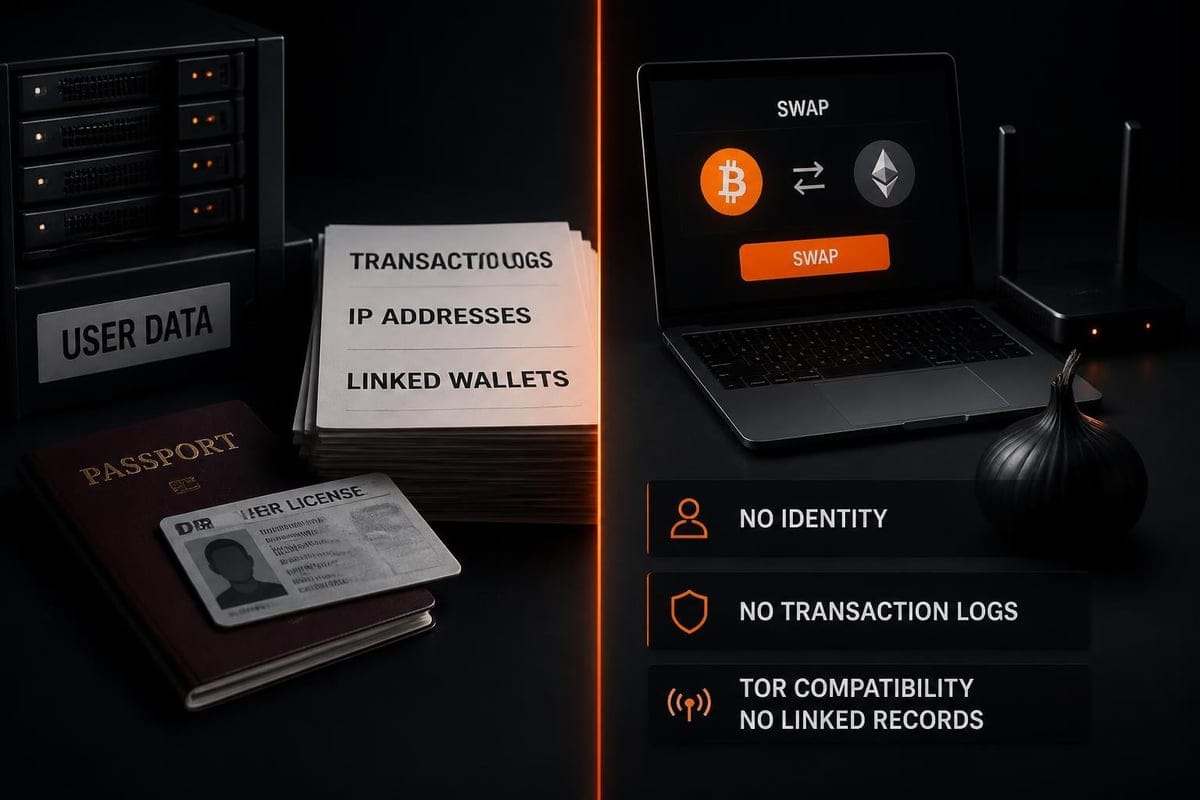
Custodial platforms create comprehensive surveillance records. Every deposit, trade, and withdrawal links to your verified identity. The platform knows your balance, your trading patterns, your counterparties (if you withdraw to external services), and can correlate this with IP addresses, device fingerprints, and timing data.
Information custodial platforms collect:
- Full legal name, date of birth, nationality
- Government-issued ID documents (passport, driver's license)
- Proof of address (utility bills, bank statements)
- Selfie photos ("liveness checks")
- Source of funds declarations
- Tax identification numbers
- Complete transaction history
- Withdrawal addresses (revealing connections to other services)
This data persists indefinitely. Platforms share it with regulators, law enforcement, tax authorities, and (in data breaches) potentially everyone. When Ledger's customer database leaked in 2020, it included names, phone numbers, and physical addresses of hardware wallet purchasers, leading to physical threats and targeted phishing.
The Monero Use Case
Monero users specifically choose XMR for its privacy properties. Using a custodial wallet defeats the purpose. The exchange sees your XMR balance, knows when you acquired it, tracks your trading patterns, and can link your identity to specific transactions when you withdraw.
A privacy-focused swap service compatible with Tor preserves the privacy properties Monero offers. No account means no identity record. No KYC means no document trail linking you to your XMR holdings. No logs means no stored transaction history connecting your IP address to specific swap amounts or timing.
When Custodial Wallets Make Sense (And When They Don't)
Custodial solutions aren't universally wrong. They fit specific use cases where the tradeoffs align with user needs.
Reasonable custodial wallet uses:
- Day trading where you need instant execution and don't want to pay network fees for every trade
- Receiving small, regular payments where withdrawal fees would eat into value
- Testing cryptocurrency with amounts you can afford to lose completely
- Institutional custody where regulatory compliance requires third-party attestation
Poor custodial wallet uses:
- Long-term holding of significant value (withdraw to self-custody)
- Privacy-sensitive transactions (use non-custodial tools)
- Situations where you can't afford total loss (exchanges aren't insured like banks)
- Accessing cryptocurrency in jurisdictions with capital controls or unstable platforms
The rule is simple: minimize time and value in custodial wallets. If you trade on an exchange, withdraw to your own wallet when done. Don't treat exchange accounts as savings accounts. The yield isn't worth the risk, as BlockFi and Celsius customers learned when those platforms froze withdrawals before bankruptcy.
Exit Strategies and Withdrawal Patterns
Moving funds from custodial to non-custodial storage requires planning, especially for privacy-conscious users or those dealing with chain analysis concerns.
Withdrawal Best Practices
- Verify addresses carefully: Malware can clipboard-hijack addresses. Check the full address, not just first/last characters.
- Start with test transactions: Send a small amount first to confirm the address is correct and accessible.
- Understand network fees: Platforms often charge fixed withdrawal fees higher than actual network costs.
- Consider timing: Withdraw during low network congestion for Bitcoin/Ethereum to minimize fees.
- Batch if possible: One larger withdrawal costs less in fees than multiple small ones.
For Monero specifically, withdrawals from custodial wallets reveal less than transparent chains because the platform can't see what you do with XMR after withdrawal. But the platform still knows you withdrew X amount at Y time, creating a starting point for analysis if they later correlate with other data.
Better approach: avoid custodial Monero storage entirely. Swap directly from other cryptocurrencies to XMR without creating custodial records. Your USDT or Bitcoin moves from your control to XMR in your control, with no intermediate database entry linking your identity to the transaction.
The Ongoing Custodial Risk Landscape in 2026
Three years after the FTX collapse, custodial platforms still face the same structural risks. Regulatory clarity in some jurisdictions (MiCA in Europe, clearer SEC guidance in the US) has improved some operational standards, but hasn't eliminated counterparty risk.
Emerging concerns:
- Quantum computing threats: Future quantum computers could potentially break the cryptography securing private keys. Custodial platforms represent concentrated targets with high-value key stores.
- Regulatory fragmentation: Different jurisdictions impose incompatible requirements, forcing platforms to choose between market access and user privacy.
- Stablecoin custody: As stablecoins become payment infrastructure, custody of USD-pegged tokens creates systemic risk if large platforms fail.
- Cross-chain complexity: Supporting dozens of networks increases operational complexity and introduces new vulnerability surfaces.
The pattern hasn't changed. Custodial platforms fail when they take on risks (lending, proprietary trading, fractional reserves) beyond their stated business model. Customers discover the risk only when withdrawals halt.
Alternatives to Custodial Storage
The custody decision isn't binary between centralized platforms and complete self-custody. Multiple models exist with different tradeoff profiles.
Non-Custodial Options
- Hardware wallets: Ledger, Trezor, Coldcard store keys offline, sign transactions on device
- Software wallets: Electrum, Sparrow, Cake Wallet (for Monero) keep keys on your device
- Multisig setups: Require multiple keys to sign, distributing risk across devices or people
- Smart contract wallets: On-chain logic enables recovery, spending limits, or social recovery
- Atomic swap services: Exchange cryptocurrencies without custodial intermediaries
Each introduces different complexity and responsibility. Hardware wallets require managing a physical device and backup seed. Multisig requires coordinating multiple signers. But all keep you in control of the underlying private keys.
For users who want simple exchanges without custody risks, non-custodial swap services eliminate the need for exchange accounts entirely. Send one cryptocurrency, receive another, no account creation or identity verification required.
Custodial wallets trade genuine ownership for convenience and familiar user interfaces. The cost is counterparty risk, privacy loss, and dependence on third-party permission for your own funds. For privacy-focused cryptocurrency users, especially those working with Monero, avoiding custodial platforms preserves the core properties that make cryptocurrency valuable. MoneroSwap enables direct swaps between cryptocurrencies and XMR without custody, KYC, or account creation, maintaining privacy throughout the exchange process while eliminating platform risk entirely.
Swap into or out of Monero, no KYC
MoneroSwap is a Monero swap with no account with no account, no KYC, and no logs. Open source and available over Tor. Verify every claim, then swap BTC to Monero, ETH to Monero, USDT to Monero, or see all pairs. New here? Start with the FAQ.
← All guides